Shoppers typing airline approved soft sided pet carrier are not hunting another Amazon grid of “18-inch” totes. They already know Wirecutter named a Sleepypod and a SturdiBag. They are trying not to get bounced at the gate because the bag that fit a 737 last spring will not go under a regional jet with a 14-pound cat who grew two inches of winter coat.
Airline “under 18 inches” is a marketing sentence; the bag that boarded last month can fail a regional jet with a taller pet. This guide scores cabin bags the way frequent flyers actually fail: compressed height with the pet inside, zipper tape after a year, and whether a cat can hide without cooking on the tarmac.
It is a buying guide, not a veterinary flight-fitness exam and not a reprint of any one airline PDF. Policies move. Confirm the live pet page for your ticketed carrier and aircraft before you buy, then measure the bag you already own the same way a gate agent will: loaded.
How we score under-seat fit versus published airline boxes
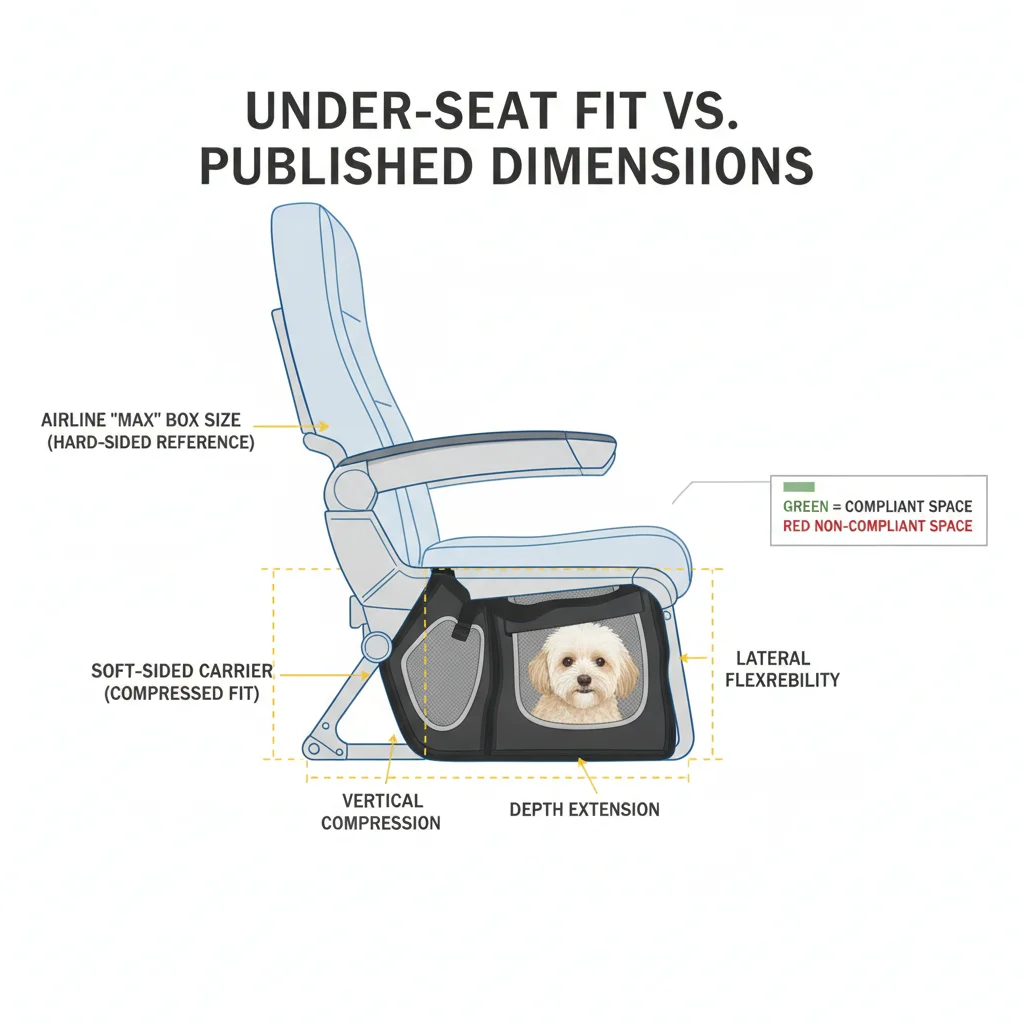
We treat cabin approval as a box plus a behavior, not a hologram sticker. The airline publishes a maximum length × width × height for the bag that lives under the seat in front of you. Soft-sided is required on most U.S. majors because a hard crate will not squash. Soft-sided still has a real exterior once a frame, wheels, or a panicked pet is inside.
The protocol is kitchen-table, not a secret lab. Tape the airline’s current numbers on the floor. Place the empty bag in that tape. Then put the pet in, zip, and measure again—including wheels, rubber feet, and the handle tunnel. If any dimension grows past the tape, that SKU is not “approved” for that aircraft even if the listing says it is.
- Empty listing vs loaded bag: EVA foam, wire frames, and pets who brace add height the photo never shows.
- Mainline versus regional: a bag that slid under a 737 can fail an Embraer or CRJ where the seat box is shorter.
- Southwest-class height: one dimension is often the killer; a tall Sleepypod-style box can lose to a squashable tote here.
Wheels are a frequent ghost inch. Spinner luggage logic does not belong on a cabin pet bag. If the listing leans on a trolley, assume you will remove the wheels or miss the box. Padded top handles that stand proud after you zip are the same problem.
Gate agents measure the bag with the pet inside; lab dimensions on an empty listing are a different product.
We also score whether the pet can stand, turn, and lie down in the interior once the bag is at the allowed exterior. That is the welfare line airlines write and then ignore in marketing photos of curled kittens. Tape the interior floor. If your cat’s ears hit mesh when they sit, they will hit it harder when the bag is shoved under a seat.
This is not a crash-test claim. Sleepypod markets structure; that is comfort and shape retention, not a reason to skip a hard crate in a car. For apartment containment that is not flying, a crate versus playpen training setup is the right tool. The cabin bag is a two-hour box, not a lifestyle kennel.
Best airline-approved soft sided carriers for 2026
There is no single winner across every airline and species. There is a default stack: one rigid-soft bag that keeps its box (Sleepypod Air class), one compressible workhorse (SturdiBag Large / Pro class), and a budget Sherpa-class tote you only trust for a handful of flights.
Street prices move. Treat the bands below as 2026 shopping ranges, not coupons. If a clone is $29 with the same silhouette as a $70 Sherpa, you are buying zipper tape, not cabin magic.
Sleepypod Air — default when you need the bag to stay a box
The Air is the bag most editorial roundups still land on: roughly an 18 × 11 × 11-inch class exterior, a few pounds empty, padded EVA-style walls, and a shape that does not pancake when a seatback tray slams. That rigidity is the feature. It is also why the Air loses on aircraft with a stingy height.
Typical street price sits in the low-to-mid hundreds. You are paying for a floor that does not sag into the pet, interior tether hardware, and walls that feel like a den. Cats who hide often settle faster than in a mesh cube. Dogs who pant on the jet bridge can overheat because those walls do not breathe like a SturdiBag.
Wash: wipeable interiors beat fabric sponges. The failure mode we care about is not the first Uber ride. It is mesh window abrasion and zipper sliders after a year of bin-to-seat cycles. If you fly monthly, budget for zipper service, not a new brand religion.
SturdiBag Large / Pro — default when the seat is shorter than the listing
Sturdi Products built the frequent-flyer reputation: fabric that compresses in height, generous mesh, and sizes (especially Large) that cabin groups still argue about because “Large” is not a legal airline size. You still have to match the loaded bag to this week’s published box.
Price usually undercuts Sleepypod, often in the high tens to low hundreds depending on Pro hardware. The Pro pitch is better zippers and structure than the older bags. The workhorse pitch is the same: you can mash the top under a seat that was never 11 inches tall, and the pet still gets airflow.
Tradeoff: a squashable bag can leave a tall dog in a flattened cave. If your terrier stands with ears up, do not celebrate compression. Celebrate a different flight or a smaller pet. Mesh also means a brighter, more stimulating ride—fine for many dogs, rough for a cat who wants darkness. A breathable cover on one panel is an ops choice, not a fashion accessory.
Mr. Peanut’s and Sherpa-class totes — budget cabin, honest lifespan
Mr. Peanut’s airline totes copy the classic Sherpa Original Deluxe silhouette: soft sides, mesh windows, a shoulder strap, and an Amazon price that looks like a steal next to Sleepypod. Sherpa itself still exists as the name-brand version of that same idea.
These bags get accepted when they fit. They fail when zipper tape separates, when a claw opens a mesh hole at TSA, or when the base sags so the pet sits in a hammock. For one round trip to a holiday, a well-reviewed Sherpa-class tote can be rational. For ten flights, you will likely buy a second bag—the SturdiBag or Air you skipped.
If the listing shows an expandable side “for more room on the plane,” treat that as a hotel feature. We cover expandables below. They are the fastest way a cheap bag becomes a gate-check.
What we skip
- Hiking backpacks and bubble-window cat packs: they sit on your back. They do not live under a mainline seat.
- Hard-sided crates sold as “airline approved”: that language often means cargo, not cabin. Soft sided vs hard pet carrier for flying is a legal path split, not a comfort debate.
- Wheeled pet strollers: jet bridges are not sidewalks. Remove the chassis or do not bring it.
- Generic “TSA approved” stickers: TSA screens you and the pet. They do not certify your 17-inch tote.
If you need the deep three-way on the two bags editorial always names, that comparison lives as its own page once it is published. This listicle is the buying stack and the ops around it.
Cats versus small dogs: ventilation, orientation, and hiding
Cats hide and overheat; dogs pant and push mesh—one SKU rarely serves both without a ventilation tradeoff. Roundups that mix a 12-pound Persian with a 15-pound terrier in the same “best cabin bag” slot are merchandising.
Cats want a cave. They do better with a solid wall they can turn their back to, a tether they cannot slip, and enough interior length to sprawl without being a loaf against the zipper. Sleepypod-style padding helps. Full-mesh cubes make some cats vocal from the first moving walkway. Darkness is not optional enrichment; it is how many cats inhibit in a terminal.
Small dogs want airflow and a floor that does not fold. They pant. They push. They will work a zipper pull with a nose if you leave it dangling. Mesh on two sides is a feature on the tarmac in July. It is a stressor if every passing shoe is visible. Orientation matters: a bag that is long and low fits under seats; a bag that is tall and short may match a published height and still leave a dachshund without a turn.
- Turn test: if they cannot turn at home in the zipped bag, they cannot turn under a seat.
- Tarmac test: if you would not sit in that bag in a sunny window for 20 minutes, do not ask a brachycephalic dog to.
- Hide test: if the cat only settles when a blanket covers three sides, buy walls, not a lantern of mesh.
Brachycephalic breeds and snub-nosed cats are a medical conversation with a veterinarian, not a bag upgrade. Some airlines restrict them. A breathable SturdiBag does not make a heat-sensitive pet legal. Fly early, use air-conditioned lounges, and skip midday tarmac holds when you can.
Practice at home the same way you would introduce a crate. A pet’s first closed-bag minute should not be on the jet bridge. If you already use indoor playpens for apartments, park the carrier in the pen with meals so the bag is furniture, not a trap.
Expandable carriers and the gate-check surprise
Expandable carriers rank because the extra mesh looks like kindness in a product photo. On a plane, unzipped expansion is how you void the cabin box. The agent is not required to love your “it still fits if I push.” They have a template.
Petsfit-style expandables and many Amazon clones sell a walking-around room and a flying-collapsed room as one SKU. That is honest if you keep the expansion zipped until the hotel. It is a trap if you board with the extra panel out so the cat can “see.” Seeing is not a cabin right. Under-seat volume is.
When extra space is for the hotel, not the jet: long layovers in a quiet corner, the rental-car ride, a friend’s kitchen. None of that requires the panel open at row 14. If you need more in-cabin volume, you need a different ticket (in-cabin pet plus a seat that actually has a taller box) or you need to admit cargo/hard-sided is the legal path for that animal’s size.
- Fly collapsed. Practice zipping the expansion shut with the pet inside so you are not fighting mesh at the desk.
- Do not argue photos. The listing’s “airline approved when compressed” sentence is the whole product.
- Watch zipper load. Expansion zippers are the first to skip teeth because they run around a corner under tension.
If a gate agent says cargo or offload, that is not a SturdiBag debate. It is a size or behavior fail. Have a backup plan that is not “hope the next agent is nicer.”
Zippers, mesh, and straps after a year of flights
Zipper tape and mesh panels usually fail between flight 8 and 15, not on the first Uber to the airport. First-trip reviews are comfort reviews. Durability is a different article, and Amazon star clusters hide it.
Watch the zipper tape, not the pull. The pull can be replaced. Tape that separates from the fabric is a dump risk in a TSA bin. YKK-class sliders on a Sleepypod or a Pro-level SturdiBag are why frequent flyers pay up. Budget totes use tape that looks identical in a photo and then waves after a summer of humidity and cat claws.
Mesh fails as a hole you can widen with a finger, usually at a corner where a claw caught during a startle. Repair patches exist. A hole at the zipper junction is a retire-the-bag event, not a duct-tape craft. Escape-artist dogs and cats will find that hole at the worst moment: the bin, the jet bridge, the rental-car lot.
- Backup clips: carabiner the zipper pulls together. It is ugly and it is how you keep a nose from walking the zipper open.
- Strap stitches: shoulder straps dump when the bartack at the bag body pulls. If the stitch is walking, stop hanging 20 pounds of pet plus bag on one shoulder.
- Base sag: a hammock floor means the pet’s weight is on zipper tape. That is a replacement, not a stuffing job.
We would rather you buy one $200 bag and service the zipper than three $45 totes that each fail before the frequent-flyer year is over. Replacement cost is the real budget line, same as it is for washable household gear like washable pee pads for apartments—the cheap unit that leaks twice is not cheap.
Pet-plus-bag weight, TSA, and the jet-bridge protocol
Facebook groups obsess over scale math because editorial skips it. Airlines publish a combined pet + carrier limit that is easy to miss if you only read the under-seat inches. A 16-pound dog in a 6-pound structured bag is a different ticket than a 9-pound cat in a 3-pound tote. Weigh them together the morning you leave, not after you add a travel bowl, pads, and a full water bottle to the “personal item.”
If you are over, you do not negotiate with the bag brand. You change the bag, the contents, or the itinerary. Gate-check as cargo is a temperature and handling risk, not a clever overflow. Soft cabin bags are not cargo kennels.
TSA is where escape artists win. The protocol is boring and it works:
- Leash or harness on before the bag is unzipped. The leash is in your hand, not in a pocket.
- Pet out, bag on the belt, you walk the pet through the scanner or follow the officer’s live instruction. Rules vary; argue later, contain now.
- Bag zipped, clips on, pet in, then you gather shoes. Do not set an open bag on the floor “for a second.”
- Jet bridge: both hands on the bag. Shoulder straps swing into knees and unzip on a catch. Carry like a box.
If your dog already unravels in storms, a cabin bag will not be their first closed-space drill. Work the calming a stressed dog plan at home, and treat calming treats for storm-level stress as a veterinarian conversation, not a boarding pass. This page does not dose anything.
Soft sided vs hard pet carrier for flying is simple at the policy layer: cabin wants soft and under the seat; cargo wants a rigid, ventilated kennel that meets live-animal rules. If your pet cannot stand and turn in any bag that fits the seat box, they are not a cabin pet on that aircraft. Do not trim the bag until it is cruel. Change the trip.
Your next step is not another tab of Amazon stars. Tape this week’s airline box on the floor, run the loaded measurement, and pick the bag whose failure mode you can live with: a rigid Air that might be too tall, a SturdiBag that might squash a tall dog, or a budget tote you will replace before flight ten.
Frequently Asked Questions
What makes a carrier airline approved for cabin?
Airlines approve a size and a behavior: soft-sided, under the seat in front of you, pet able to stand, turn, and lie down, and usually one pet per bag. There is no single TSA sticker that replaces the carrier dimensions on your ticketed airline and aircraft.
Do expandable sides void cabin approval?
If the extra mesh is unzipped, most gate agents treat the bag as oversize even when the listing said airline approved. Fly collapsed. Use expansion in the car, hotel, or lounge—not in the under-seat box.
Is a backpack better than a tote for under-seat travel?
Only if the backpack actually compresses to your airline's published box with the pet inside. Hiking and city backpacks that sit on your back rarely fit under a mainline seat, and they fail faster at TSA because the pet is vertical.
How do I know the bag will fit my cat or small dog?
Tape the interior floor and height, then have the pet stand and turn in that rectangle at home. If they brace against the ceiling mesh, they will fail a regional jet even if the empty bag matches an 18-inch marketing line.
When should I replace a cabin carrier?
Retire it when zipper tape separates, mesh has a claw hole you can widen with a finger, or a strap stitch is pulling. Those failures cluster after a year of real flying, not after the first trip.
Related reading on our sister sites: Best Pet Camera for Multi-Dog