Shopping a Center for Pet Safety certified dog harness is not the same job as buying anything with “crash-tested” in the Amazon title. Those words now cover three different products: an independent CPS protocol, a brand-paid sled test, and an untested tether wearing a serious photo. Mix the three and you will spend $90 on confidence you cannot cash at 30 mph.
We do not run a crash sled. We sort labels, read what the tests actually claimed, and apply that taxonomy to weekly vet parking lots versus highway miles. For the stay-on ranking that uses this taxonomy, see which harnesses stay on in a panic stop.
This page stays on car restraints. A walking harness with a seatbelt adapter can be a fine sidewalk tool. It is still the third column when the car moves.
Three labels that get conflated on Amazon
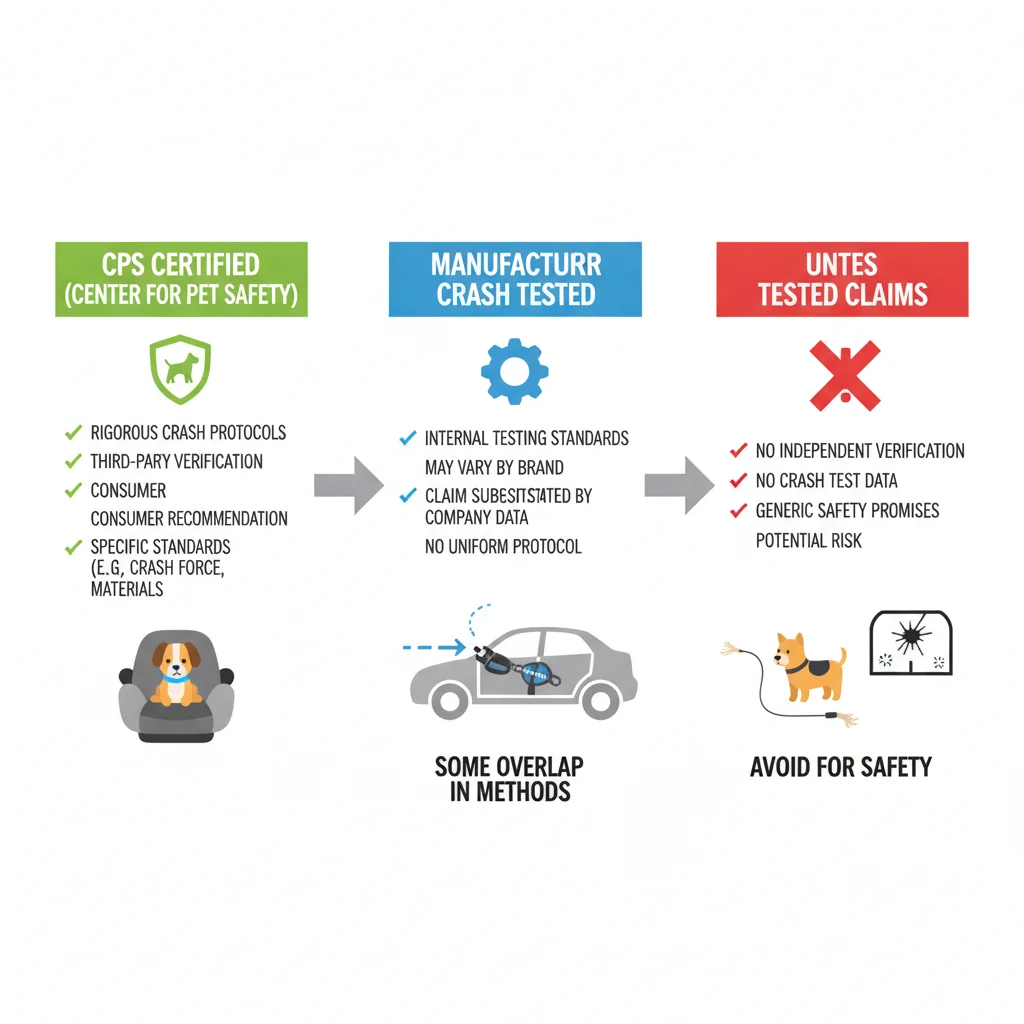
CPS-certified vs manufacturer crash-tested vs untested tether is the ranking axis. Everything else—padding, color, “travel” in the title—is secondary. If you cannot say which column a SKU sits in, you are not done shopping.
Listicles blur the columns because “crash-tested” is one keyword and three stories. Your dog does not care about the keyword. Your dog cares whether the belt stays in a designed path when the car pitches.
| Label | Who ran the test | What it usually means | What it does not mean |
|---|---|---|---|
| CPS certified | Center for Pet Safety, published protocol | Independent pass/fail on a named SKU and size band | Lifetime nylon, one-hand clinic speed, or a walking harness |
| Manufacturer crash-tested | Brand-paid lab, often FMVSS 213–adapted | A real sled on that company’s car harness | The same stamp, excursion limit, or belt path as CPS |
| Untested car tether | Nobody sled-tested this clip | A leash-class ring or $19 belt clip with safety language | A car restraint, even if the photo looks like a dummy |
CPS certified
Center for Pet Safety publishes a certified-products list. You want the exact SKU, not a cousin in a new colorway. Sleepypod Clickit Sport is the harness owners actually find with a current 5-star listing and published size ratings.
CPS is independent. That is the point. The brand does not write the pass line. You still have to buckle the wrap. A star on a website is not a vest on a dog.
- Check the CPS list for the current SKU.
- Read the size and weight band, not a breed nickname.
- Treat the star as entry to column one, not as 12-month webbing insurance.
Manufacturer crash-tested
This column is real work and a different stamp. The brand paid a lab. The procedure is often an FMVSS 213–adapted sled. That is not a hangtag generator. It is also not CPS.
Kurgo and Ruffwear live here for their car-specific harnesses. Read the lab name, the dummy weights, and any caveat the brand itself prints. If the brand says the path would not meet CPS excursion limits, believe them. That sentence is more useful than a five-star Amazon badge.
- Lab name on a page you can archive, not only in an ad.
- Named SKU, named dummy weights.
- Caveats in the same paragraph as the boast.
Do not promote a manufacturer test into a CPS star because you like the padding. Do not demote it to “fake” because it is not CPS. It is column two.
Untested car tether
This is the Amazon swamp. “Safety harness,” “crash tested look,” “seat belt clip for dogs,” photos of dummies that never met this SKU. The hardware is a dorsal ring sized for a leash and a tether sized for a grocery-bag latch.
Latch/clip and seatbelt-loop failure in a hard stop is how these fail in the real car: the clip opens, the loop walks, or the dog peels a Y-harness that was never a car path.
- No sled letter, no designed belt path: column three.
- Walking-harness D-ring plus a carabiner: still column three.
- A crash dummy in the gallery without a protocol: still column three.
Latch/clip and seatbelt-loop failure in a hard stop
If the product cannot tell you which column it is in, it is column three and hoping you will not ask.
What Center for Pet Safety actually tests
CPS is not a vibe. It is a protocol with published language, size ratings, and a list you can check without a brand PDF. That is why column one exists. It is also why people over-read the star.
CPS does not promise clinic speed. It does not freeze nylon. It does not certify your parking-lot order. It certifies a sample of a named harness under a named procedure.
Protocol basics
Think of it as an independent pass/fail on a car harness, not a consumer-magazine shootout. The details live on CPS’s materials. Your job as a buyer is simpler: confirm the SKU, confirm the star, confirm you will use the belt path they tested—not a headrest hack.
If you change the path, you left the protocol. A certified vest used as a dorsal tether is no longer the test article. It is a vest you are improvising.
- SKU match, not “Sleepypod-ish.”
- Belt path match, not a faster clip you invented.
- Size band match, not “he looks like the dog in the photo.”
We are not CPS. We are telling you how to read their stamp without turning it into a personality.
Which SKUs pass
Clickit Sport is the practical answer in this niche. Other products cycle on and off lists, get redesigned, or get invited to certify after an older fail. Invitation is not a star. Redesign is not a grandfather clause.
Kurgo’s older Tru-Fit Enhanced Strength history is the cautionary tale people still mash into today’s Impact marketing. An old fail plus a later invitation does not move a current SKU into column one. Read today’s belt path and today’s list.
- Pass: named SKU on the current CPS list.
- Not pass: “based on the same family” or “inspired by CPS.”
- Not pass: a crate protocol cited on a harness listing.
Print or screenshot the list on the day you buy. Listings drift. Arguments on Reddit drift faster.
Limits of the star
The star does not inspect your 12-month webbing. It does not time the dermatology lot. It does not make a spinning dog stand still for a wrap.
12-month webbing, stitching, and buckle wear
Treat CPS as the entry ticket to the class, then run a wear diary. Photograph the loop. Retire on fuzz, thumb-open clips, or any collision. Certification describes a new sample. Your vest is a used sample with a clinic calendar.
- Star: independent protocol on a new sample.
- Ownership: nylon, stitching, latch detent, sit geometry.
- Workflow: leash on before the car path comes off.
If you buy Clickit for the star and leave it in the trunk, you bought a poster. Buy the restraint you will latch.
Manufacturer crash tests vs marketing language
Column two is where honest brands and slippery listings both live. The work can be real. The headline can still over-claim. Your job is to keep the lab paragraph attached to the SKU, not to the word “safety.”
FMVSS 213 is a child-restraint standard people cite because it sounds official. “Adapted” is doing a lot of work. Adapted means the lab used a related procedure, not that your dog harness is a federally certified car seat.
Kurgo/Ruffwear claims
Kurgo documents crash testing on the Impact Dog Seatbelt Harness (and related Enhanced Strength Tru-Fit Smart Harness) at Calspan, using an FMVSS 213–adapted sled procedure. That is manufacturer crash-tested hardware. It is not Center for Pet Safety certification.
Ruffwear ran FMVSS 213–style dynamic tests at MGA Research on 25, 45, and 75 lb mannequins for Load Up. The brand itself says those results would not meet CPS excursion limits because the seatbelt path sits lower on the back. That caveat is the most adult sentence in this category. Keep it.
- Impact: column two, faster clinic on/off, inspect the tether latch.
- Load Up: column two, car chassis with an outdoor-shaped fit, CPS excursion caveat.
- Clickit Sport: column one, slower wrap, independent star.
EzyDog and others will show up in the same SERP with their own letters. Same rule: lab, SKU, caveat, belt path. No letter, column three.
Third-party gaps
A lab report you cannot find is a story. A PDF that names a different SKU is a story. A “tested to 2,000 lb static pull” number is a hang-test, not a sled, and it is how walking-harness brands sneak into car queries.
Static pull is not a panic stop. Dogs are not sandbags on a hook. If the listing leads with a hang number and has no dynamic protocol, you are still in marketing.
- Dynamic sled with dummy weights: column two candidate.
- Static hang number only: not a car test.
- Influencer “we slammed the brakes once”: not a lab.
Third-party should mean a lab, not a third cousin with a GoPro.
Red flags
Watch for crash dummy stock photos, “as seen in” banners with no protocol, and titles that say crash-tested next to a walking-harness silhouette. Watch for “CPS style” and “meets CPS” from brands that are not on the list.
Watch for mixing crate crash tests into a harness bullet list. Different product, different attachment, different failure mode.
- “Crash-tested” with no lab and no date.
- Seatbelt clip sold without a designed harness path.
- Claims that a leash-class ring is “rated for cars.”
If customer photos show the belt through a handle that was not the test path, the owner already left the protocol. Do not copy that photo because it looked tidy.
Apply the taxonomy to vet vs highway shopping
The taxonomy is not academic. Short clinic hops and interstate duty punish different lies. Clinic hops punish gear you will not put on. Highways punish gear with no designed path and tired webbing.
Both trips still have hard brakes and open doors. “It is only ten minutes to the vet” is how untested tethers get a second life they did not earn.
Short-trip minimum bar
Minimum bar: a car-specific harness you will latch, in column one or two, with a leash-before-door ritual. Column three is not “good enough because we are going slowly.” Parking lots have other cars. Lunges happen at 4 mph.
If two minutes of Clickit wrap means the vest stays in the trunk, column two is the adult choice. A manufacturer-tested harness on the dog beats a CPS vest on the floor.
- Will you thread a wrap every Thursday? Column one is in play.
- Need speed with a spinning dog? Column two, then inspect hardware harder.
- Walk harness plus clip: still column three, even for “just the clinic.”
Practice the order on a driveway loop this week, not on the morning of surgery.
Interstate duty
Highway duty wants the strictest column you will actually use, plus a wear plan. Column one if you will buckle Clickit. Column two if you accept the brand’s own CPS caveat and will inspect the path. Column three does not get a highway exception because the listing had the word travel.
Inspect webbing before a long run, not after. Shine without fuzz is watch. Fuzz you can pull is retire for interstate even if clinic hops still “feel fine.”
- Photograph the loop the night before a long drive.
- No mixing a loose walk vest in the same row.
- After any collision, retire the harness that was on the dog.
If the dog panics in storms on the same drive, the harness still only holds the body. Pair it with a real calming plan; our notes on calming a panicking dog cover the thrash, not a column upgrade.
When a crate beats a harness
A crash-tested crate is a different product class. It wins when you need a door you can latch without threading webbing, when the dog peels vests, or when solo on/off in the rain is a non-starter. Do not pretend a Y-harness is the crate’s little sibling.
When the trip continues to an airport, neither crate nor car harness is automatically the cabin bag. Use a carrier that fits under the seat for the flight leg—our cabin-travel carrier shortlist is that job.
- Peel artist: crate class.
- Two-person Clickit household: harness class can still work.
- Flight next: carrier class, not a stretched Clickit.
Mixing classes in one sentence—“crash-tested”—is how shoppers buy the wrong door.
Checklist before you click buy
Do this in order. Skipping to colorways is how column three wins.
- Name the column: CPS, manufacturer sled, or untested.
- Match the SKU and the belt path, not a cousin product.
- Measure girth on pavement and check the size band.
- Confirm you will actually buckle it in the clinic lot.
- Plan the inspect-and-retire clock on nylon, not on the hangtag.
If you cannot finish line one, close the tab. The listing is using your urgency.
Loop and clip hardware
You want a designed seatbelt path or a car-specific tether plate, not a leash ring. You want a latch that does not open with a casual thumb. You want bartacks you can see, not piping that hides the load.
Thumb-open is a fail even on a new product. Proud latch is a watch. A carabiner from a hiking aisle is not a car latch.
- Loop-through or designed car plate: good signs.
- Dorsal walk-harness ring: column three until proven otherwise.
- Two load paths at once: pick one; extra clips add swing.
Return window for fit
Stay-on dies on sit geometry. A vest that looked right in the kitchen can climb toward the ears once the dog sits. You need a return window long enough to sit, buckle, and watch ride-up on a real short drive.
If the seller will not take a used-looking harness back, size with more humility or buy from someone who will. Wrong and certified is still wrong.
- Girth first, sit second, highway third.
- Refit after the first long sit.
- Do not keep a climbing vest because the star is pretty.
Replacement part availability
Replacement buckles only help if the webbing and stitch boxes are healthy. A spare of the whole harness is more honest than a $6 clip on a 14-month loop. Keep the spare in a closet, not a hot trunk.
Ask whether the brand still sells the current path. SKUs change quietly. Buying a discontinued loop because it was on sale is how people attach old letters to new hardware.
- Spare of the class you actually use.
- No cheap clip on a thin loop.
- Retire after collision; parts do not reset a pulse.
Then inspect like nylon that has a job. 12-month webbing, stitching, and buckle wear is the clock. The taxonomy only gets you to the right aisle.
Frequently Asked Questions
Is a Center for Pet Safety certified dog harness the same as crash-tested?
No. CPS certification is an independent protocol with published pass/fail language. Manufacturer crash-tested usually means the brand paid a lab for an FMVSS 213–adapted sled on its own SKU. Untested tethers say crash-tested because a photo looks serious. Read which column the product is in before you trust the hangtag.
Which dog car harnesses are CPS certified right now?
Sleepypod Clickit Sport is the harness owners actually find with a current CPS 5-star listing and published size ratings. Other brands sometimes cite older studies, redesigns, or invitations to certify. Invitation is not a star. Check the CPS certified-products list for the exact SKU, not a lookalike colorway.
Are Kurgo Impact and Ruffwear Load Up fake if they are not CPS certified?
No. Both have published manufacturer sled work. That is a real test and a different stamp. Kurgo cites Calspan with an FMVSS 213–adapted procedure. Ruffwear cites MGA Research and says its path would not meet CPS excursion limits. Treat them as manufacturer-tested car hardware, not as CPS vests.
Can I use a walking harness with a seatbelt tether on the highway?
You can physically clip one. That does not make it a car restraint. Dorsal rings and $19 tethers are sized for leash loads. Latch/clip and seatbelt-loop failure in a hard stop is how those setups fail. If the product has no sled letter and no designed belt path, it is an untested tether wearing a safety photo.
When should a crate beat any crash-tested harness?
When you will not buckle a wrap, the dog peels vests, or you need a door you can latch without threading webbing in the rain. A crash-tested crate is a different product class. Do not mix a loose walk vest in the same row as a CPS harness and call it equivalent.
Your next step
Name the column first. Then match the SKU and the belt path. Then measure girth on pavement and decide whether you will actually buckle the thing at the clinic. Photograph the loop on day one so month twelve has a comparison.
If the listing cannot tell you whether it is CPS, manufacturer-tested, or untested, it already answered. Stay-on is a path plus a habit, not a keyword stuffed into a title.
Related reading on our sister sites: Crash Tested Dog Crate vs Heavy Duty Specs