Shoppers comparing a crash tested dog car harness after a clinic parking-lot scare already know the walking vest held the leash and still slid toward the dash when the seatbelt yanked. The listing sold “safety.” The stop sold hardware: chest clip, seatbelt loop, and whether the dog is still inside the vest at a panic brake.
We do not run a crash sled. We score stay-on fit, latch class, and strap wear after a year of weekly vet miles plus highway trips. That is the job Amazon roundups skip when they paste five-star icons onto a $19 tether.
This page ranks car-restraint classes, not hiking harnesses with a seatbelt adapter. If the product cannot keep the dog in the vest through a hard stop and a sweaty clinic parking lot, it is not in the shortlist.
How we test stay-on fit, latch hardware, and strap wear
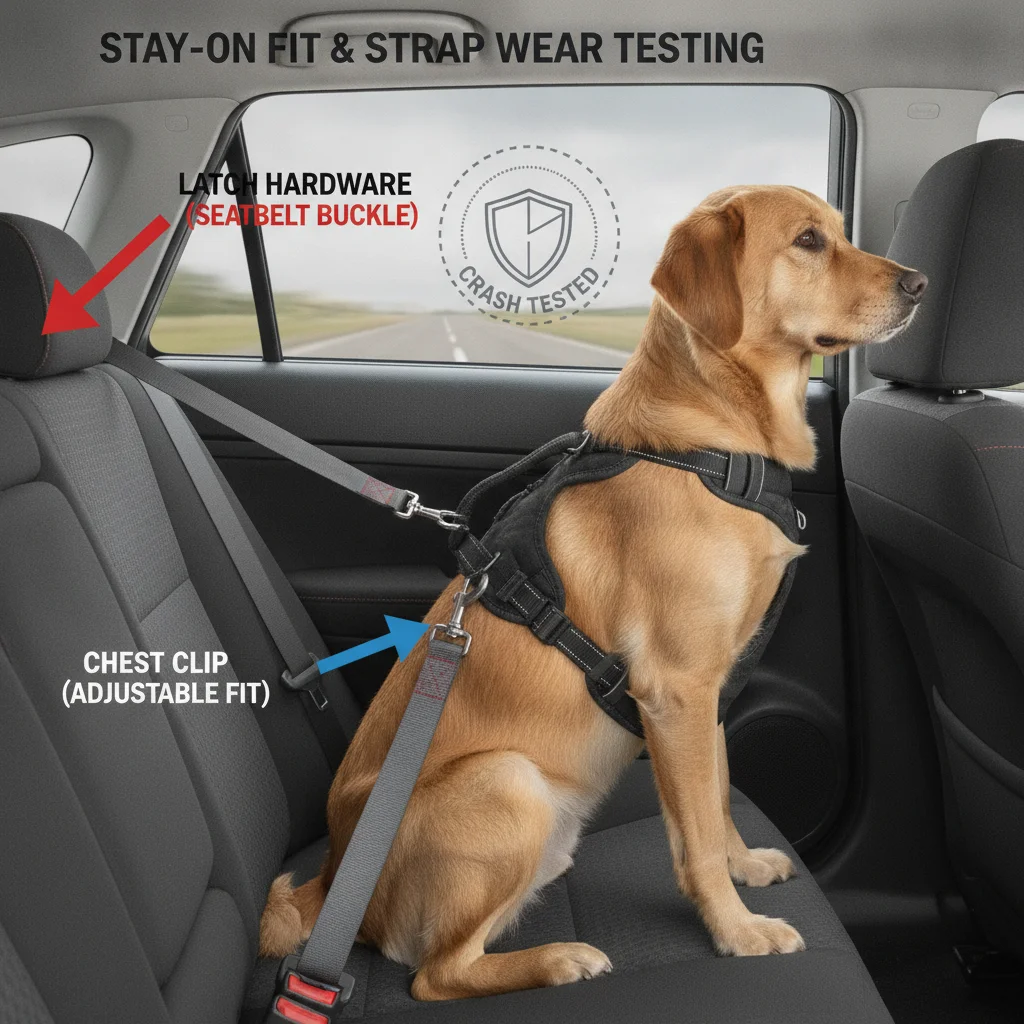
Stay-on is not a marketing adjective. It is whether the dog is still wearing the vest after a sudden stop, a twist, and a thrash. We treat three measurements as the scorecard: clip retention, belt routing, and 12-month webbing, stitching, and buckle wear.
A harness that “crash tested” on a hangtag and then pops in the clinic lot has already failed the job. Highway miles without a vet stop are the easy half. The hard half is on-off ten times a month in a windy parking lot with a dog who wants the grass.
Panic-stop simulation and clip retention
We cannot certify G-loads. We can watch hardware under a hard brake from neighborhood speeds and under a yank that mimics a dog hitting the end of a short tether. Latch/clip and seatbelt-loop failure in a hard stop is the first failure mode owners actually see.
A clip that opens with a thumb in a grocery bag is not “easy access.” It is a latch with no remaining detent. If you can bump it open while buckling a child seat next to it, assume the dog can too when the car pitches.
- Pass: the chest or belly path stays closed after a two-hand yank and a twist.
- Watch: the latch clicks, then sits visibly proud of the housing.
- Fail: pop-off in the parking lot, or a seatbelt loop that walks off the belt.
We also watch the dog, not just the plastic. If the vest rides up to the ears in a stop, the clip can be perfect and the dog is still loose in the cabin. Stay-on is vest geometry plus latch class.
Seatbelt loop vs tether routing
Two load paths exist. A seatbelt threaded through a reinforced loop loads the vest the way the test lab pictured. A short tether from a back-seat latch to a dorsal D-ring loads one point and loves to rotate the dog.
Loop-through designs (Sleepypod Clickit class) keep the belt in the vest. Tether-to-D-ring designs need a car-specific dorsal plate, not a walking-harness ring that was sized for a leash. If the D-ring sits on a walk vest, you bought a leash attachment that happens to click into a seatbelt.
- Loop-through: slower to buckle, harder for the dog to spin out of, easier to inspect for webbing shine.
- Short tether: faster clinic on/off, higher chance the clip is the only thing between the dog and the dash.
- Long tether: a swing. Not a restraint. Skip it for highway and for a front-passenger airbag zone.
Never attach a car harness to a headrest strap and call it tested. Headrests are not crash structures. If the brand’s own test photo shows a seatbelt path, copy that path, not a YouTube shortcut.
12-month webbing and buckle inspection
Unboxing photos lie. Clinic rides grind the same loop against the same belt edge. Salt, fur, and cup-holder soda finish the job. 12-month webbing, stitching, and buckle wear is the inspection we want in a buying guide, not a first-week “seems sturdy.”
Look at the belt path first. Shine, flattened weave, and popped bartacks at the loop are retire signs even if the chest clip still laughs at your thumb. Buckle play—housing that rattles, a pawl that sits crooked—comes next.
Latch/clip and seatbelt-loop failure in a hard stop
Photograph the loop on day one. Compare at month three and month twelve. If you cannot tell the day-one photo from month twelve, you either drive less than this page assumes or you bought webbing that is actually doing the job.
CPS-certified harnesses ranked for vet and highway trips
CPS-certified vs manufacturer crash-tested vs untested tether is the only ranking axis that matches how these products fail. Stars on Amazon are a walking-harness popularity contest. We rank classes for a dual workflow: weekly clinic, plus highway.
Brand names below are class examples. SKUs change hardware. Read the current belt path and the current certification letter, not a 2019 blog photo.
| Class | Stay-on in a stop | Clinic on/off | 12-month hardware | Best job |
|---|---|---|---|---|
| CPS-certified vest (Sleepypod Clickit Sport / Terrain class) | Highest of the consumer set when fit is honest | Slow; two hands, often two people | Watch the belt-path webbing, not the logo | Highway plus vet when you will actually buckle it every time |
| Manufacturer crash-tested car harness (Ruffwear Load Up, EzyDog Drive, Kurgo car lines) | Better than a walk vest; not the same stamp as CPS | Faster than a full Clickit wrap on some dogs | Mixed; dorsal tethers take clip abuse | Owners who will not fight a full vest but will still use a car-specific path |
| Untested “safety” tether on a walking harness | Unknown; often a clip and a prayer | Easy, which is why people buy it | The clip is usually the first thing to die | None we will recommend for highway |
Sleepypod Clickit Sport class
Sleepypod Clickit’s whole product is the car. The vest wraps, the seatbelt threads, and Center for Pet Safety testing is the reason the brand sits at the top of this list instead of another pretty hike harness. Stay-on is the design brief, not a bonus icon.
The cost is time. You do not one-hand a Clickit in a rainstorm while holding a prescription bag. That is not a product defect. It is the trade for a wrap that does not peel off a panicking dog as easily as a Y-harness.
- Choose Sport-class when the dog rides in a back seat and you will budget two minutes to buckle.
- Terrain-class (when offered) is the same job with a different shell, not a walking harness with a belt loop glued on.
- If you will not buckle it for a five-minute clinic hop, you will not buckle it at 70 mph. Buy something you will use, then be honest if that something is a crate.
Fit still wins. A Clickit sized like a sweater will ride up. Deep-chest dogs need the girth you measure standing in the parking lot, not the size chart you guessed from a walking harness.
Manufacturer-tested alternates
Ruffwear Load Up is a car harness with a manufacturer crash protocol and a hiking-adjacent cut. It is the pick when you already live in Ruffwear sizing and will actually route the belt the way the diagram shows. It is not “CPS but orange.”
EzyDog Drive and Kurgo’s car-specific lines (Impact / Enhanced Strength Tru-Fit when sold as car restraints) occupy the same manufacturer-tested band. They are faster to click than a full wrap. They also concentrate load on dorsal hardware, which is where we see clip fatigue after a season of clinic on/off.
- Load Up: better stay-on than a walk vest; inspect the car attachment, not the hike webbing.
- Kurgo car lines: widely available; confirm you bought the car SKU, not the lookalike walk harness.
- EzyDog Drive: car-shaped; still manufacturer-tested, still a belt-path product, still not a CPS letter.
Use this band when a CPS vest is a fight you will lose every Tuesday at 7:40 a.m. A manufacturer-tested harness you buckle beats a certified vest that lives in the trunk. That sentence is not permission to buy an untested tether.
When to skip untested tethers
The $19 “dog seatbelt” with a carabiner and a length of nylon is not a third class of crash testing. It is an untested tether. It clips to whatever D-ring your walking harness happens to have. That D-ring was sized for a leash jerk, not a cabin stop.
Listicles blur this on purpose because untested tethers convert. CPS-certified vs manufacturer crash-tested vs untested tether is the taxonomy we keep even when the SERP does not. If the brand cannot point to a test method, we do not invent one for them.
CPS-certified vs manufacturer crash-tested vs untested tether
Skip anything that attaches only to a headrest, anything that lengthens enough for the dog to reach the driver, and anything whose “crash tested” claim is a lifestyle photo. If you need speed in the clinic lot, buy a manufacturer-tested car harness with a short, documented belt path—not a coil of webbing from a bulk listing.
Latch and clip failure after months of clinic drives
Weekly vet runs are a hardware torture test. You open the same buckle in gloves, in rain, with a dog spinning toward the grass. Plastic sees grit. Springs see fur. The failure is rarely a cinematic highway crash. It is a clip that already had play at month four.
Owners replace the harness when the webbing looks fuzzy. They should replace it when the latch sounds different. Sound is data. A mushy click is a pawl that no longer centers.
Pop-off patterns we see
Three patterns repeat. Side-load: the clip opens because the dog hits it against the door card. Belt-walk: the seatbelt tongue creeps and the loop is no longer capturing the belt. Thumb-open: you can unlatch it without meaning to while wrestling a second dog.
Side-load is why a walking-harness chest clip is the wrong part in a car. Those clips are happy in a Y-shape on a trail. In a cabin they sit where a door slam and a seatbelt edge can pinch them. Car-specific housings bury the release or require two motions.
- If it popped once in a parking lot, treat that as a fail, not an anecdote.
- If it only pops when the belt is twisted, the routing is wrong even if the SKU is famous.
- If it pops when the dog is calm, the detent is gone. Retire the clip. Retire the harness if the clip is sewn in.
Chest clip vs carabiner weak points
Carabiners look bombproof and then gate-open against a seat frame. Unlocking gates are a non-starter. Locking gates still eat finish and then sit half-screwed because you were holding a leash in your teeth. If the brand’s car path uses a carabiner, it should be captive and lockable, and you should check the lock every trip.
Chest clips fail by grit and by side-load. Dorsal carabiners fail by gate and by the D-ring tearing the surrounding webbing. Inspect the stitch box around the ring, not only the shiny gate.
Metal is not automatically better. A bent gate is a retire. Cracked plastic is a retire. “It still closed” is how people narrate the week before the dog meets the back of a seat.
Replacement intervals
There is no calendar that fits every clinic schedule. A once-a-year highway trip to the in-laws is not the same as dermatology every other Thursday. Use inspections, not a vibe.
- After any collision, even a parking-lot bump that dumped groceries: retire. Hidden webbing damage is the point of that rule.
- When buckle play shows, or the release sits proud: replace the hardware or the harness.
- When the belt-path weave is shiny and thin: replace even if the chest clip feels new.
Do not “just buy a new tether” for a worn vest. The vest is the stay-on system. A fresh clip on dead webbing is a new weak story.
Fit for deep-chest and anxious dogs
Stay-on dies on greyhounds, whippets, some pit-mixes, and anyone who can shrug a Y-harness at the park. Cabin panic makes that shrug violent. Anxious dogs are not a temperament footnote. They are a fit-and-workflow problem.
If the dog already slips walking harnesses, a car tether on that same harness is how you buy a projectile with a receipt. Fix the vest geometry first. Then talk about certification class.
Girth sizing mistakes
People size from a walking harness they already own. Walking girth is often loose on purpose. Car girth should be snug enough that two fingers fit, not a fist, with the dog standing on the pavement—not sitting in the footwell.
Deep chests need the strap to sit behind the elbows without climbing into the armpit. If the strap rides up to the neck in a stop, you will think the clip failed when the dog simply left the vest. Measure the chest at the widest point and the neck where a collar sits. Use both numbers.
- Coat compression: fluffy dogs measure big and then shrink in a cinched vest. Recheck after two minutes of wear.
- Seasonal weight: clinic dogs on rest gain. Recheck after steroids or a food change.
- Between sizes: size to the chest, not the cute photo of a smaller shell.
Escape artists in back seat
Back-seat escape artists use the seat bolster as a fulcrum. They back out, then stand on the parcel shelf, then you discover it at 65 mph. A wrap vest plus a loop-through belt is the stay-on answer. A dorsal tether on a walk harness is the invitation.
Window ledges and unlatched center consoles are launch pads. Close them. A harness is not a substitute for a cabin that gives the dog a step. If the dog’s job is to watch out the windshield, you do not have a harness problem. You have a front-seat problem.
For dogs who panic in storms on the same drive, pair the restraint with a real calming plan. Our notes on calming a panicking dog are about the thrash, not about swapping clips. The harness keeps the body in the seat. It does not teach the nervous system to sit still.
Two-person on/off workflow
The clinic parking lot is where good harnesses get abandoned. One person holds the leash and the door. The other threads the belt or closes the wrap. If you are solo, stage the vest on the dog before you leave the house and only do the belt in the lot.
Do not unclip the car path until the leash is on. Do not open the door before the leash is on. That order is the whole workflow. Reverse it once and you will write a different article about a dog in traffic.
- House: vest on, clip check, leash in pocket.
- Lot: belt or tether on before the engine dies if the dog doorsurfs.
- Clinic door: leash on, car path off, then feet on pavement.
If two minutes of that dance is too much, you will hate a Clickit and you should not pretend a carabiner tether is the clever hack. You wanted a crate with a door you can latch without threading webbing. That is a different product, and it is allowed to be the honest answer.
12–18 month ownership: stitching, fuzz, and retire signs
A year of Thursday dermatology plus two highway holidays is a real duty cycle. Unboxing reviews never meet that dog. 12-month webbing, stitching, and buckle wear is the ownership chapter we keep even when it kills a ranking.
Wash the vest. Salt and slobber hide shine. Dry it and look at the belt path in daylight, not in a garage. Fuzz is not cute. Fuzz is fibers leaving the load path.
Webbing fray
Fray starts at the seatbelt slot and at any metal edge. A plastic sleeve on the loop exists to stop that. If the sleeve has migrated, the edge is already cutting. Restitch jobs at home are not a crash-structure repair. Retire.
Bar tacks that have “grinned” (threads spreading so you see daylight) are done. Do not melt the ends with a lighter and call it maintenance. You changed the failure point, not the strength.
- Shine without fuzz: watch list, photograph, recheck in 30 days.
- Fuzz you can pull off: retire for highway; clinic-only use is still a gamble.
- Cut or melted edge: retire now.
Buckle play
Play is motion that was not there at month one. Wiggle the housing. If the two halves rock, grit has worn the channel. A buckle that needs a knee to close is swollen with fur, not “breaking in.” Clean it. If play remains, replace it.
Replacement buckles only help if the webbing and stitch boxes are healthy. Swapping a $4 clip onto a 14-month vest with a thin loop is how people keep a familiar colorway past its job.
12-month webbing, stitching, and buckle wear
Keep a cheap spare of the same class in the hall closet if this harness is the only plan for a seizing dog at 2 a.m. A spare is not hoarding. It is how you retire on a Tuesday instead of driving unrestrained to emergency because the clip died in the lot.
When CPS rating is not enough
A CPS letter describes a test on a sample in a size. It does not describe your 18-month-old webbing or your dog who learned to back out. Certification is the entry ticket to this page. Ownership is the ranking.
If the certified vest does not stay on your sighthound, you do not have a “CPS is fake” story. You have a fit miss. If the certified vest stays on and the clip is mush, you have an ownership miss. Both can be true while the class is still the right class.
Do not mix classes on one dog in one trip—CPS vest plus an untested tether “for backup” is how you add a swing. One path, correctly routed, inspected this season.
What we skipped (and why)
We skipped formats that rank for a different query. That is how this page stays a car-restraint guide instead of another vest colorway list.
Walking-harness roundups
Walking-harness roundups optimize for leash manners, escape-proof walks, and reflective trim. Those are real jobs. They are not a 30 mph stop. A great walk harness with a seatbelt adapter is still a walk harness with an adapter.
If your dog needs an escape-proof walk vest, keep it for the sidewalk. Put a car-specific harness on for the drive. Two products beat one compromised clip.
Untested Amazon tether lists
Those lists exist because they are easy to photograph: a clip, a belt, a smiling golden. They do not survive the taxonomy. We will not rank five tethers with no protocol just to look like a listicle of ten.
If a tether is sold with a manufacturer crash method and a car-specific dorsal plate, it can enter the manufacturer-tested band. Until then it is a skip, not a “budget pick.”
Crate-only highway guides
Crates are a valid cabin plan. They are not this page’s product. A crash-tested crate plus a loose dog in a walk harness in the same row is two half-plans. Pick the restraint you will actually latch.
When the trip continues to an airport, the car harness is not the cabin bag. Use a carrier that fits under the seat for the flight leg—our cabin-travel carrier shortlist is that job. Do not stretch a Clickit into an airline-approved bag. Different hardware, different failure modes.
Car-and-driver-style crate advice is fine for people who will bolt a crate. This site’s reader is often in a compact SUV with a dog who also needs a weekly clinic hop. That reader needs a harness class, a stay-on inspection, and a parking-lot workflow—not a lecture to buy a different vehicle.
Frequently Asked Questions
Is a crash-tested walking harness the same as a car harness?
No. A walking harness is built for leash load, not a seatbelt yank. Car models add a seatbelt path, a stay-on vest or wrap, and hardware meant to keep the dog in the vest during a stop. Using a walk vest plus a cheap clip is the usual failure.
Does Center for Pet Safety certification beat a manufacturer crash test?
CPS is an independent protocol with published pass/fail. Manufacturer tests are useful when the brand shows the method, but they are not the same stamp. CPS-certified vs manufacturer crash-tested vs untested tether is the buying taxonomy. Untested tethers sit in a third, weaker class.
Why do car harness clips pop on the way to the vet?
Weekly clinic rides load the same plastic chest clip and seatbelt loop until the latch gets sloppy. Latch/clip and seatbelt-loop failure in a hard stop often starts as a soft click you ignored at week eight. Replace hardware that already pops in the parking lot.
How often should I replace a crash-tested dog car harness?
Inspect after every season of weekly drives. 12-month webbing, stitching, and buckle wear is the real clock, not the hangtag. Retire for fuzz at the seatbelt path, buckle play, or a clip that opens with a thumb. After any collision, retire it even if the webbing looks fine.
Can an anxious dog back out of a Clickit-style vest?
Deep-chest and slick-coated dogs still escape if girth is loose or the vest rides up. Stay-on is a fit job plus a two-person on/off in the clinic lot. Tighten for the car, then add a calming plan if the dog thrashes—the harness is not a behavior program.
Your next step
Pick a class first: CPS vest if you will buckle a wrap; manufacturer-tested car harness if that is the one you will actually use; never an untested tether for highway. Then measure girth on pavement. Then photograph the belt path so month twelve has a comparison.
Practice the parking-lot order this week on a short drive: leash on before the car path comes off. If the clip already sounds mushy, retire it before the next clinic Thursday. Stay-on is a habit plus hardware, not a hangtag.
Related reading on our sister sites: Crash Tested Dog Crate vs Heavy Duty Specs