Owners shopping Sleepypod Clickit Sport vs Kurgo Impact usually add Ruffwear Load Up as the third car-specific option after a clip pops in the clinic lot or a dog slides toward the dash on a highway brake. The listings all say “crash tested.” The hardware does not all do the same job.
For the full shortlist, see our crash-tested dog car harness guide, and read what “crash tested” really means before you trust a label.
We do not run a crash sled. We compare stay-on fit, latch class, seatbelt path, and whether you will actually buckle the thing twice a week in a windy parking lot. That is the comparison Amazon roundups skip when they paste five stars onto three different test stories.
This page stays on car restraints. A walking harness with a seatbelt adapter is a different product, and it loses here even if it wins on the sidewalk.
Testing setup: same dog, same seat, three harnesses
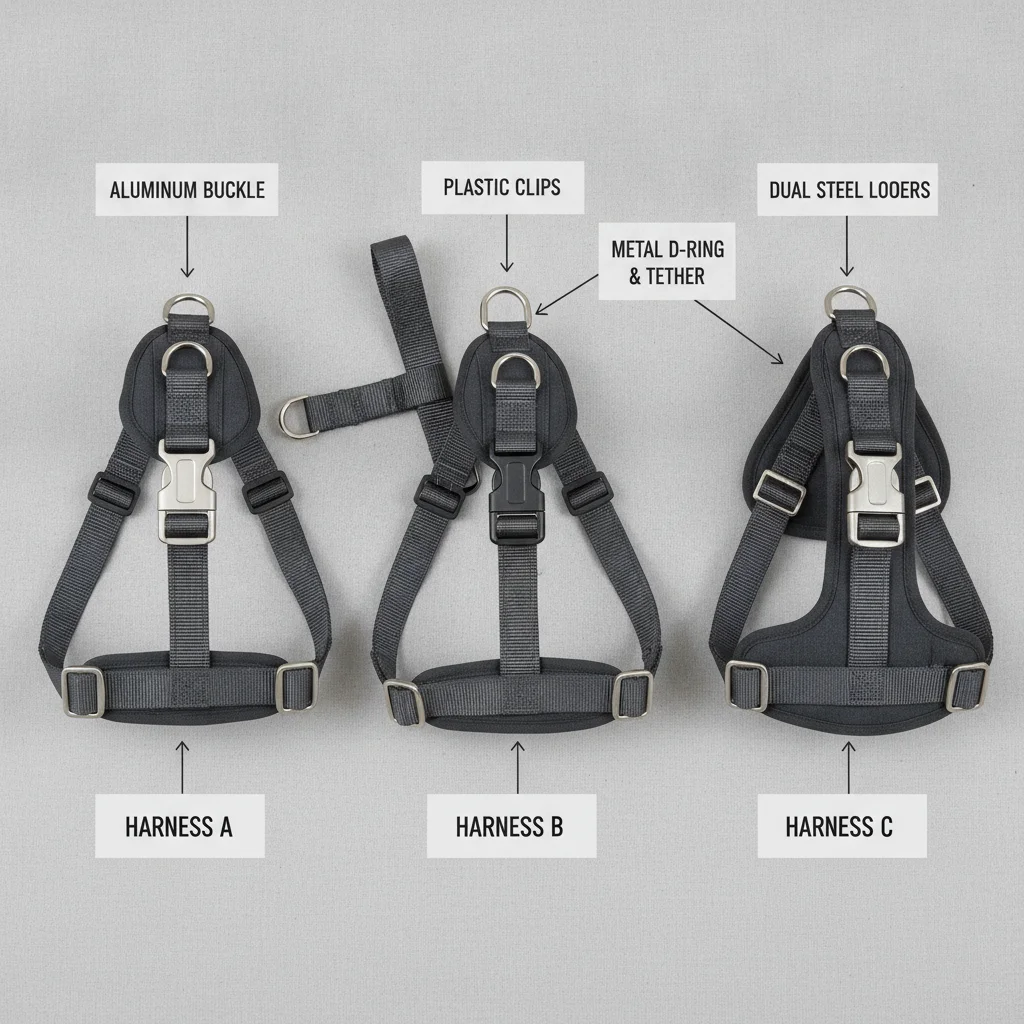
Same dog, same back seat, same seatbelt. The point is not a lab ranking. It is whether the vest still holds the dog after a hard brake, a twist, and the weekly clinic dance. We score three things: clip retention, belt routing, and 12-month webbing, stitching, and buckle wear.
SKUs change hardware. Read the current belt path and the current test letter, not a 2019 blog photo. If the brand’s own test photo shows a seatbelt through a loop, copy that path. Do not invent a headrest strap and call it the same harness.
Fit protocol
Girth is measured on pavement, not in the crate. A deep-chest dog that “looks medium” in a Clickit can be a different size in a padded Kurgo chest plate. We fit until two fingers fit under the girth strap and the vest cannot be walked backward off the shoulders.
Then we sit the dog in the same seat, buckle the car path, and watch ride-up. If the vest climbs to the ears in a stop, the clip can be perfect and the dog is still loose in the cabin. Stay-on is geometry plus latch class.
- Clickit Sport: wrap vest, seatbelt threaded through a reinforced path, slower to size honestly.
- Kurgo Impact: padded chest, tether-plus-harness load path, easier to over-loosen because it feels “comfortable.”
- Load Up: car-specific dorsal belt path with an outdoor-shaped chassis, less wrap than Clickit, less pillow than Impact.
We do not mix paths. One harness, one belt route, no “backup” carabiner on a walk vest. Two load paths in one stop is how you add a swing.
Hard-brake clip checks
We cannot certify G-loads. Latch/clip and seatbelt-loop failure in a hard stop is the first failure owners actually see.
A clip that opens with a thumb while you hold a prescription bag is not “easy access.” It is a latch with no remaining detent.
Latch/clip and seatbelt-loop failure in a hard stop
Loop-through designs keep the belt in the vest. Tether-to-dorsal designs need a car-specific plate, not a walking-harness D-ring sized for a leash. Clickit is loop-through. Impact is a tethered car harness. Load Up is a car harness with a designed belt attachment, not a hike vest with a clip.
Vet-trip on/off timing
Highway miles without a clinic stop are the easy half. The hard half is on-off ten times a month in a parking lot with a dog who wants the grass. We time the belt path with a leash already in a pocket, because that is how the Thursday dermatology run actually works.
Reverse that order once and you will write a different article about a dog in traffic.
- House: vest on, clip check, leash in pocket.
If two minutes of that dance is too much, you will hate Clickit Sport and you should not pretend a padded tether is the clever hack. That is allowed to be the honest answer.
Sleepypod Clickit Sport: CPS star, real-world wear
Sleepypod Clickit’s whole product is the car. Center for Pet Safety lists Clickit Sport as certified, 5-star, under protocol CPS-001-014.01, with published size ratings up to 90 lb. That is the independent stamp the other two do not have.
The vest wraps. The seatbelt threads. CPS-certified vs manufacturer crash-tested vs untested tether is the ranking axis; Clickit sits in the first column.
Strengths
Independent certification is the reason Clickit Sport sits at the top of this comparison instead of another pretty hike harness. The belt stays in the vest. The dog has fewer easy exits than a Y-harness with a dorsal clip.
Stiff webbing is a feature on day one and still a feature at month six. There is little plush to flatten. The load path is visible. You can photograph the loop and compare it later without guessing where the belt used to sit.
- CPS 5-star listing with published size ratings, not a brand PDF alone.
- Seatbelt-through-harness path that matches how the test was pictured.
- Harder for a panicking dog to peel than a padded chest plate with a short tether.
For the class ranking of what “crash-tested” even means, keep the taxonomy page in this niche when it is live. Until then, treat CPS paper as the entry ticket, not as a lifetime warranty on your 14-month webbing.
Weak points
Time. That is not a defect. It is the trade for a wrap that does not peel as easily as a Y-harness.
Fit is fussy on deep chests and slick coats. A “medium” that looked right in the kitchen can ride up once the dog sits. If the vest walks toward the ears, you do not have a CPS story. You have a sizing miss.
- Slow clinic on/off; two hands, often two people.
- Stiff webbing that some dogs refuse for the first week.
- Belt-path webbing still wears; certification does not freeze nylon.
Hand-wash and air-dry is the care line most owners ignore. Salt and slobber hide shine.
Best for
Highway plus weekly vet when you will actually buckle the wrap every time. Dogs up to the published weight band whose girth matches the size chart, not the “looks like a Lab” guess.
Skip it if you already know you will leave it in the trunk because the lot dance takes two minutes. An unused CPS vest is not safer than a manufacturer-tested harness you will latch.
Kurgo Impact: manufacturer crash claims
Kurgo’s Impact line is a padded car harness with a tether path, not a CPS vest. Kurgo documents crash testing on the Impact Dog Seatbelt Harness (and related Enhanced Strength Tru-Fit Smart Harness) at Calspan in June 2018, using an FMVSS 213–adapted sled procedure. That is manufacturer crash-tested hardware. It is not Center for Pet Safety certification.
Do not confuse today’s Impact with the 2013 CPS study that failed an older Tru-Fit Enhanced Strength design. CPS later noted a redesign and invited certification. Invitation is not a star rating. Read the current SKU’s belt path.
Strengths
Owners who will not fight a full Clickit wrap still get a car-specific product instead of a $19 Amazon tether. Padding is the reason dogs accept it on week one. Clinic on/off is faster because you are not threading a seatbelt through a wrap every Thursday.
Replacement cost is lower than Sleepypod. If you retire on webbing shine instead of on a brand religion, that matters. A spare in the hall closet is easier to justify.
- Calspan sled work under an FMVSS 213–adapted protocol, with published excursion language from Kurgo.
- Faster parking-lot dance than Clickit Sport.
- Padded chest that anxious dogs tolerate sooner than stiff Clickit webbing.
For around-town vet runs where the owner’s real failure mode is “I stopped using it,” Impact can beat Clickit. That is a usage win, not a sled win.
Weak points
The load path is a tethered harness. Short tethers concentrate force on a clip and a dorsal point. Long tethers become a swing. If the clip is the only thing between the dog and the dash, clip health is the whole product.
Padding hides wear. You have to peel fur out of the chest plate to see bartacks. 12-month webbing, stitching, and buckle wear still happens; it just happens under foam.
- Not CPS-certified; do not let “crash tested” on the hangtag blur the taxonomy.
- Tether hardware takes the weekly clinic abuse first.
- Easy to fit too loose because it feels comfortable.
CPS-certified vs manufacturer crash-tested vs untested tether
Kurgo vs Sleepypod is not “cheap vs fancy.” It is manufacturer sled vs independent CPS protocol. If your buying rule is independent paper, Impact loses on purpose. If your buying rule is a harness you will latch at the dermatologist, Impact can be the honest pick.
Best for
Broad, sturdy dogs whose owners will use a padded car harness twice a week and will inspect the tether clip. Around-town clinic miles with occasional highway, not as a substitute for a CPS wrap on a 75 lb dog who rides the third row at 70 mph if you wanted that stamp.
Skip untested “safety” tethers sold next to it. Those are not the Impact. Those are the third class this niche exists to keep off the shortlist.
Ruffwear Load Up: adventure fit vs car duty
Load Up is a car harness with an outdoor-shaped chassis, not a hiking harness that happens to click into a belt. Ruffwear crash-tested prototypes at MGA Research under FMVSS 213 conditions with 25, 45, and 75 lb mannequins. The brand publishes that the dog stayed on the seat in those tests.
Ruffwear also says, in plain language, that Load Up would not meet CPS’s current excursion limits because the seatbelt attachment sits lower on the back. That is rare honesty. Treat it as manufacturer-tested car duty with a comfort-and-fit bias, not as a CPS vest with a Ruffwear logo.
Strengths
Fit is the reason people reach for Load Up after fighting Clickit sizing. The chassis looks like gear their dog already wears on a trail, so the car ritual feels less like a medical device. The belt path is designed, not a walk-harness D-ring with a seatbelt adapter.
On/off sits between Clickit and Impact. You are not wrapping a full Sleepypod vest, and you are not relying on the same padded tether story as Impact. For a dog who also hikes, one silhouette across the weekend reduces the “which vest is this” fight.
- Independent lab (MGA) dynamic tests at three mannequin weights, with the brand publishing the CPS excursion caveat.
- Car-specific attachment location instead of a leash ring.
- Better daily acceptance than stiff Clickit webbing for many dogs.
Pair it with a real calming plan; our notes on calming a panicking dog cover the thrash, not a clip swap.
Weak points
Excursion is the trade. A lower attachment that Ruffwear prefers for comfort is the same choice that, by the brand’s own statement, would miss CPS limits. If your rule is “must have CPS paper,” Load Up is out before the parking lot.
Adventure branding invites misuse. People clip it for a trail, then use the same dorsal path as a long tether in the car. That is how a car harness becomes a swing. Follow the car instructions, not the hike muscle memory.
- Not CPS-certified; Ruffwear says it would not meet current CPS excursion limits.
- Easier to treat like a walking harness than Clickit, which has no hiking story.
- Hardware still needs a 12-month inspection; outdoor mud hides shine.
Price sits closer to Sleepypod than to Kurgo. You are paying for a designed car chassis and a published lab story, not for CPS stars.
Best for
Dogs whose owners already live in Ruffwear sizing, who will buckle a car-specific path, and who accept manufacturer testing with an explicit CPS caveat. Dual-life households that refuse a second, stiffer vest—and will inspect the belt path after muddy weekends.
Skip it as a “Clickit alternative with the same certification.” It is not that. If you need the independent stamp, stay on Clickit Sport and practice the lot dance.
Which wins for highway vs around-town vet runs
Highway wants stay-on and a belt path that matches a published independent protocol. Around-town vet runs want a latch you will still close when it is raining and the dog is spinning. Those jobs overlap. They are not identical.
| Harness | Test class | Stay-on in a stop | Clinic on/off | 12-month hardware | Best job |
|---|---|---|---|---|---|
| Sleepypod Clickit Sport | CPS-certified, 5-star listing | Highest of this trio when fit is honest | Slowest; wrap plus belt thread | Watch the belt-path webbing, not the logo | Highway plus vet when you will buckle it every time |
| Kurgo Impact | Manufacturer crash-tested (Calspan / FMVSS 213–adapted) | Better than a walk vest; tether clip is the watch item | Fastest of the three | Padding hides wear; inspect the tether hardware | Around-town clinic miles you will actually use |
| Ruffwear Load Up | Manufacturer crash-tested (MGA / FMVSS 213); not CPS | Car-specific path; brand says CPS excursion would fail | Middle; outdoor-shaped chassis | Mud and grit at the belt attachment | Dual-life dogs if you accept the CPS caveat |
Clip durability
Clickit’s failure mode is less “the chest clip pops in week three” and more “the belt-path webbing shines after a year of the same slot.” Impact’s failure mode is the tether latch getting sloppy from weekly on/off. Load Up’s failure mode is grit in the car attachment plus owners using hike muscle memory.
Latch/clip and seatbelt-loop failure in a hard stop is still the inspection. Thumb-open is retire. Proud latch is watch. Photograph month one so month twelve has a comparison.
- Highway: Clickit Sport if you will use the wrap.
- Mixed: Load Up if you already own the sizing and accept manufacturer testing.
- Clinic-heavy: Impact if the alternative is an untested tether or an unused Clickit.
After any collision, retire the harness you were using. Certification letters describe a new sample, not a vest that already took a pulse.
Ease of donning
Impact wins the stopwatch. Load Up wins the “dog already knows this silhouette” fight. Clickit wins only if you stage the vest at home and only do the belt in the lot.
Solo owners with a spinning dog should not buy on sled paper alone. If you cannot keep the leash on before the car path comes off, none of these three save you. Practice on a short driveway loop this week, not on I-5.
- Two-person lot: Clickit becomes usable.
- One-person, anxious dog: Impact or Load Up, then inspect hardware harder.
- Crate people: a crash-tested crate is a different product; do not mix a loose walk vest in the same row.
Price and replace parts
Clickit Sport is the expensive class and the one you should not cheap out of if CPS paper is the rule. Impact is the replaceable class: lower sticker, easier to keep a spare. Load Up sits in the middle-to-high band with Ruffwear’s usual “repair if you can, replace if the chassis is tired” culture.
Swapping a cheap clip onto a 14-month vest with a thin loop is how people keep a familiar colorway past its job.
12-month webbing, stitching, and buckle wear
- Shine without fuzz: watch list, photograph, recheck in 30 days.
- Fuzz you can pull off the belt path: retire for highway.
- Cut, melted, or grinning bartacks: retire now.
Keep a spare of the class you actually use. A spare is how you retire on a Tuesday instead of driving unrestrained to emergency because the clip died in the lot.
Frequently Asked Questions
Is Sleepypod Clickit Sport safer than Kurgo Impact?
Clickit Sport is the only one of the three with Center for Pet Safety certification and a 5-star rating under CPS’s published harness protocol. Kurgo Impact is manufacturer crash-tested (Calspan, FMVSS 213–adapted). That is a real sled, not a hangtag, but it is not the same independent stamp. If independent CPS paper is the buying rule, Clickit wins.
Is Ruffwear Load Up crash tested if it is not CPS certified?
Yes. Ruffwear ran FMVSS 213–style dynamic tests at MGA Research on 25, 45, and 75 lb mannequins. Treat Load Up as manufacturer-tested car hardware, not as a CPS vest.
Which harness is fastest for weekly vet parking lots?
Kurgo Impact is usually the fastest on/off because the tether path is quicker than threading a seatbelt through a wrap. Load Up is in the middle. Clickit Sport is slowest and often wants two hands. Speed is not stay-on. If you skip the wrap because it is annoying, you do not have a Clickit. You have an unused vest.
Do these car harnesses replace a walking harness?
No. Clickit Sport is a car vest, not a hike harness. Load Up is built as car duty with an outdoor-shaped fit, but the job is still the seatbelt path. Impact is a padded car harness, not a front-clip trainer. Keep a walk vest for the sidewalk and a car path for the drive.
When should I retire a crash-tested car harness?
Inspect the belt path and latch every season of weekly clinic drives. 12-month webbing, stitching, and buckle wear is the clock, not the hangtag. Retire for fuzz at the loop, a clip that opens with a thumb, or buckle play. After any collision, retire it even if the webbing still looks fine.
Your next step
Pick the class first: CPS wrap if you will buckle Clickit Sport; manufacturer-tested Impact if that is the one you will latch at the clinic; Load Up if you accept Ruffwear’s CPS excursion caveat and want a car chassis that fits like gear. Then measure girth on pavement. Then photograph the belt path.