Shoppers running a nina ottosson vs outward hound puzzle comparison usually already own one board that cracked, emptied in ninety seconds, or woke the neighbor below at breakfast.
YouTube tests Nina Ottosson once on camera; apartment owners need which sliders crack at month three when washed every morning. The SERP treats two logos as rival factories. They are not. Nina Ottosson is an Outward Hound brand. The useful split is mechanism: numbered composite slider boards versus Outward Hound’s other toys—plush hide pouches, tumblers, and slow bowls—plus the Amazon clones that copy Ottosson’s silhouette.
This is a hardware comparison for hard floors and daily meals, not a veterinary behavior plan. If breakfast already triggers staring or fights, separate the dogs first with a playpen versus crate for house training setup, then pick a board. If the real job is gulp speed, start with an elevated bowl versus slow feeder decision instead of a Level 3 composite.
Lineup map: which boards we are actually comparing
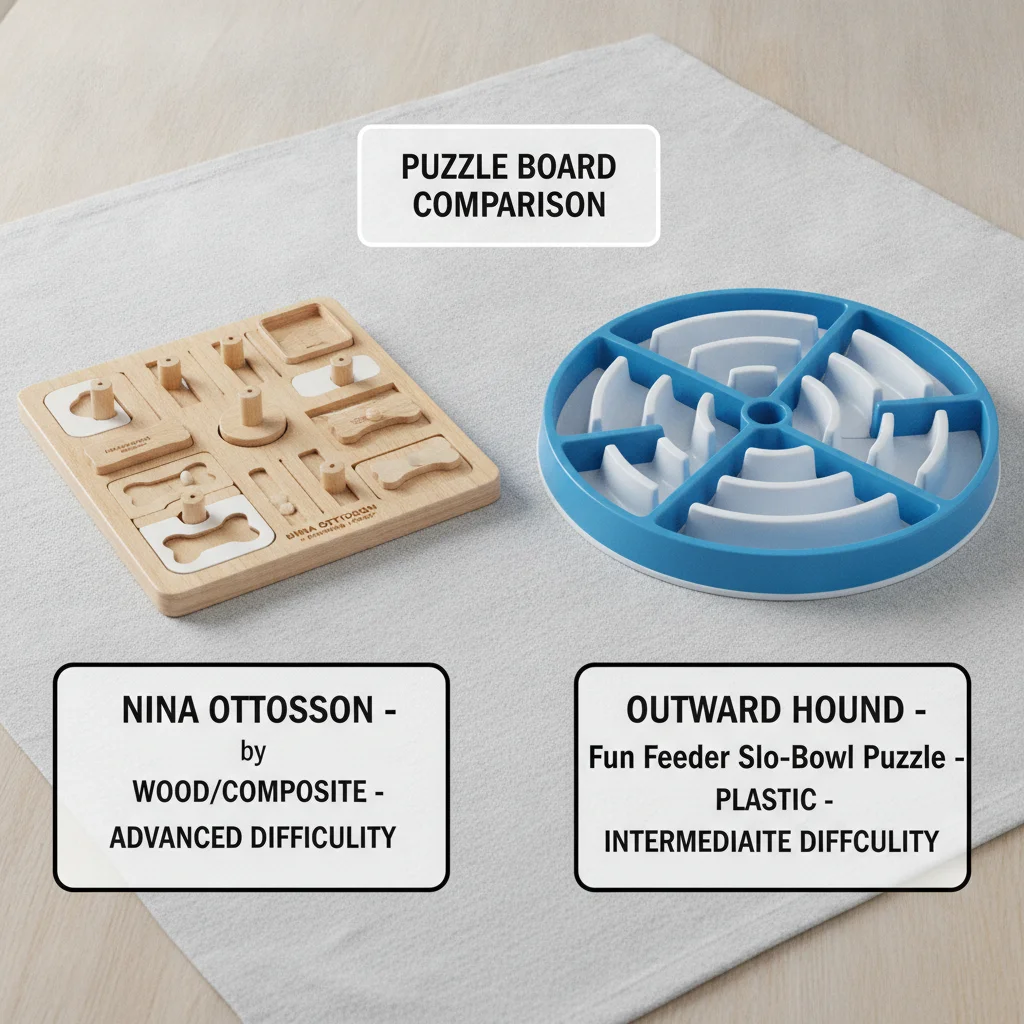
Outward Hound and Ottosson share retail shelf space but different plastic blends—budget clones copy the silhouette, not the flex profile. If you mix SKU families, every durability claim on this page will look contradictory. Keep three buckets: Ottosson composites, other Outward Hound puzzles, and geometry clones.
| Family | What you are actually buying | Typical apartment tell | Skip if |
|---|---|---|---|
| Nina Ottosson composites | Interlocking boards with sliders, blocks, and numbered levels (Worker, Brick, Tornado class) | Quiet if matted; wash time is the tax | The dog chews corners or you feed pâté into tracks |
| Other Outward Hound puzzles | Hide-A-Squirrel plush, Treat Tumble, Fun Feeder bowls, some plastic spinners | Plush sheds; bowls are quieter than sliders | You need a true multi-step board, not a squeaker pouch |
| Amazon geometry clones | Same “wood look” board, looser sliders, thinner tabs | Often louder on hardwood; cracks earlier | You expected a year of daily meals for $18 |
Representative Nina Ottosson composites
Ottosson boards are the product people mean when they say “the wooden puzzle.” They are not wood. They are layered plastic with sliding lids, spinning trays, and removable blocks. Levels 1–4 are a published ladder on this family, which is why listicles dump eight SKUs without telling you the dog already finished Level 2 in ninety seconds.
Worker-class boards (sliding bones, hidden wells) fit a food-motivated manipulator that will not lift the toy to chew the edge. Brick-class boards add more lids and more wash time. Tornado-class spinning layers add time-on-task for dogs that already know linear sliders. None of these are chew toys. If your dog’s first move is to take the board to the couch, you are shopping the wrong aisle.
Buy one board you can rinse in under five minutes. A galley kitchen with three half-washed composites is how enrichment dies in week two.
Outward Hound sliders and spinners
Once you leave the Ottosson line, Outward Hound is a different catalog. Hide-A-Squirrel is a plush hide-and-seek toy, not a meal board. Treat Tumble and similar dispensers roll. Fun Feeder is a slow bowl with ridges. Those SKUs can be the right apartment tool. They fail a “board vs board” test because they are not boards.
If your search was really “which interactive plastic lasts,” stay on Ottosson versus clones. If your search was “which Outward Hound toy occupies my dog,” you may want a slow bowl or a stuffable, not a slider grid. Mixing those answers is why Amazon reviews sound like they describe two different products with the same logo.
Spinners and rollers that walk off a mat are a 6 a.m. problem on laminate. A still board on a still mat is the quieter pattern, even if the brand on the box is the same parent company.
Amazon budget boards with same geometry
Clones copy the overhead photo: wood-grain plastic, numbered “levels,” sliding lids. They rarely copy slider tolerance. Lids bind, then the dog paws harder, then a tab snaps. Flex feels cheaper in the first week even if the listing title includes Ottosson as a comparison keyword.
Use a clone as a disposable Level 1 only if the dog is gentle and you accept a three-month life. Do not use a clone to “try the idea” with a chewer. You will teach the dog that boards are chew toys, then you will buy a real Ottosson and watch it die the same way.
If two listings look identical, check lid count, whether parts are captive, and whether the brand sells replacement sliders. No replacement parts usually means whole-board trash.
Build quality and chew-through after daily apartment meals
YouTube durability is a five-minute chew test. Apartment durability is thirty breakfasts, a dishwasher or a sink, and a dog that is hungry before work. Composite boards fail at tabs, slider tracks, and corners—not at the pretty center well.
Watch the first ten seconds. Nose-only work is a manipulator. Molars on the rim is a chewer. Paw-lift to dump the kibble is a shortcut artist. Those three dogs destroy the same SKU for three different reasons.
Plastic flex and tab breakage
Ottosson composites generally flex less in the slider plane than no-name boards of the same shape. That matters when a dog stands on the lid. Cheap boards dish, then the slider pops out, then you are fishing a sharp tab off tile.
Heat is the other killer. High-heat dishwashers warp thin lids. Warped lids rattle. Rattle on hardwood is the neighbor complaint, not the brand name. If the listing says dishwasher-safe, still pull the board after the first cycle and check whether sliders still seat flush.
Hand-wash the first week anyway. You will learn which grooves trap grease before you commit the board to a rack that hits the heating element.
Dogs that chew corners vs manipulators only
Manipulators finish the puzzle and look at you. Chewers finish the puzzle by converting it into fragments. Ottosson and Outward Hound both lose to unsupervised molars. Rubber stuffables lose slower and fail as torn rims instead of snapped sliders, which is safer on a small kitchen floor.
If you see tooth marks on day three, retire the composite. Do not “see if it holds.” A cracked slider is a GI foreign-body risk, and no enrichment minute is worth that. Move meals to a slow bowl or a thick lick mat, and keep the board as a supervised evening session only if the chewing stops when you are in the room.
Plush Outward Hound hide toys fail by stuffing and squeaker. That is a different mess: fiber on hardwood, not shards. Still not a breakfast board.
When to retire a board instead of superglue
Glue is a smell and a failure mode. Food-contact plastic plus adhesive is not a kitchen repair. Retire when a slider no longer seats, when a well has a crack you can flex open, or when a corner is missing. Keep the intact lids only if they still fit a remaining board in the same family—otherwise trash them so they do not become chew trophies.
Photograph the failure if you intend to claim a warranty. Most claims die because the photo shows chew marks and the policy excludes “destructive chewing.” That is expected. Budget for replacement the same way you budget toothpaste, not the same way you budget a crate.
Difficulty levels and honest time-on-task
Difficulty levels only matter if the board survives daily meals; a Level 4 board that racks on hardwood is useless at 6 a.m. Time the meal. If kibble is gone in under two minutes, you bought a snack tray with extra parts, not enrichment.
Ottosson’s numbers are the only ladder that is internally consistent. They still are not a promise. A clever dog on Level 3 can be faster than a novice on Level 1 if the pattern never changes.
Ottosson level ladder in real kitchens
Level 1–2: sliding lids and simple covers. Good first board if the dog already eats from a slow bowl without flipping it. Level 3: more lids, more sequence memory. Level 4: stacked or spinning layers that punish dumping. Start one level easier than the box that made you feel ambitious at 11 p.m. on Amazon.
Change the fill pattern before you buy the next level. Leave some wells empty. Put a few pieces under the hardest lid. If time-on-task jumps, you did not need a new SKU. If time-on-task stays at ninety seconds, then step up one level—not two.
Do not put a gulper on Level 3 as the first change. You will see flipping, barking, or a rage-finish that sprays kibble under the fridge. Control gulp speed first. Then add a board.
Outward Hound equivalents that finish too fast
Hide-A-Squirrel is often “done” as soon as the pouches are on the floor. That can still be useful as a five-minute scatter, not as a twenty-minute breakfast. Treat balls empty when the dog learns the roll. Fun Feeder bowls slow eating without adding foraging steps.
If your complaint is “Outward Hound is too easy,” check whether you bought a bowl or a plush. Comparing that to a Dog Worker is a category error. The parent brand sells both. Your dog only cares about steps per kibble.
For apartment boredom after a slow bowl already works, a Level 2 Ottosson on a mat is usually the next honest step—not another plush with a new animal shape.
Progression without buying every level
One board plus pattern changes beats a closet of levels. Freeze a smear of wet food in one well only if you will wash the same morning. Mix kibble sizes. Rotate which lids you leave unlatched. That is the ladder listicles skip because it does not sell eight ASINs.
Buy the next level when three breakfasts in a row finish under two minutes with your hardest pattern, and the board is still intact. If the board is already cracked, progression is irrelevant. Replace the family or leave composites.
Noise mess and wash time on hard floors
Apartment fit is not a vibe. It is bounce, scrape, and minutes at the sink. Composite sliders scrape when the dog stands on the board. Kibble ejects when a lid pops. Both sounds travel through laminate into the unit below.
Run one breakfast on a towel. Listen at one meter. If you would not want that sound at 6 a.m., change the hour or the device. Do not hope a different logo is quieter if the geometry is the same.
Sliding kibble at breakfast
Boards with loose lids throw kibble. Clones throw more because sliders overshoot. Ottosson tolerances are usually tighter, which is why the same silhouette can be quieter even when the dog works equally hard.
Put the board on a rubber mat with a raised lip. Feed a measured cup, not a heap that overflows the first open well. If kibble still reaches the hallway, the dog is dumping. That is a training problem and a SKU problem. A heavier board helps only if the dog cannot lift it. Many apartment dogs can lift Worker-class toys. Then you need a tray with a wall, or you need to stop using a board at unsupervised hours.
The apartment puzzle meal protocol is the ops page for mats, hours, and multi-dog layout. Use it once you have picked a family.
Dishwasher claims vs hand-wash grooves
Ottosson grooves hold pâté. That is the wet-food trap. If you feed wet food daily, a composite slider is a smell machine unless you brush every well the same morning. Wide rubber Outward Hound bowls and lick mats rinse faster because there is nowhere for paste to hide.
Dishwasher-safe is not dishwasher-wise. Top rack, away from the element, and inspect lids. If a lid warps once, that board is now a rattle toy. Hand-wash with a bottle brush for Level 3+ grids. Budget five minutes. If you will not spend five minutes, you will not use the board by week three.
Dry upright. Nested wet boards stay sour in a cabinet. Apartment kitchens punish that faster than houses with a mudroom.
Mats and trays that cut bounce
A $12 mat saves more neighbor goodwill than a $10 cheaper board. Choose a mat larger than the board on all sides. Smooth silicone is easier to wipe; nubby mats catch kibble and need a shake over the sink.
Skip rollers on lease-sensitive hours. A Treat Tumble at 6 a.m. is a different product class than a matted Brick. If you want Outward Hound and you want quiet, the Fun Feeder bowl on a mat beats any rolling dispenser.
Price per month of usable life
Sticker price is a trap. A $45 Ottosson that lasts nine months of daily dry-kibble dinners is cheaper than three $18 clones that die at month two. A $45 Ottosson that dies in ten days because you have a chewer is the most expensive toy on the shelf.
Count usable breakfasts, not stars on the listing.
Replacement parts vs whole-board rebuys
Ottosson sometimes sells or includes extra blocks; most clones do not. If a single slider is the wear part, a parts path extends life. If the track itself is cracked, parts will not help. Inspect the track, not just the lid.
Outward Hound plush puzzles are whole-toy rebuys. Once the pouches shred, you are done. Price them as consumables, like balls, not as furniture.
Do not mix lids across clone brands. They look interchangeable in photos. They bind in real tracks and teach the dog to pry harder.
When budget clones cost more over 12 months
Run the napkin math. Three clones at $20 with a 10-week life is $60 plus trash and a dog that learned to chew boards. One Ottosson at $40–50 with a 9–12 month life on a manipulator is the cheaper path if—and only if—the dog is a manipulator.
Clones win when you need a sacrificial Level 1 for a puppy that will outgrow the pattern, and you already know you will move to a slow bowl. They lose when you hoped to skip the name brand forever.
If cash is tight this month, buy the mat and a slow bowl first. Add a board when the gulp is controlled. That order saves more money than a coupon on a Level 4 clone.
Warranty and support reality
Chew damage is excluded almost everywhere. Warping from a high-heat cycle is argued as misuse. Keep the receipt and the first-week photos if a slider arrives already binding. That is the claim that sometimes works.
Parent-brand support does not mean Ottosson and Hide-A-Squirrel share a warranty desk experience you will enjoy. Plan as if you will not get a replacement. If that number still makes sense, buy it.
Verdict by dog type and links to apartment guides
Pick the row that matches this month’s dog, not the logo you saw in a YouTube thumbnail.
| Dog and constraint | Start with | Avoid |
|---|---|---|
| Gentle manipulator, dry kibble, can wash same morning | Ottosson Level 2 on a lipped mat | Plush hide toys as the only meal tool |
| Fast finisher, already has a slow bowl | Same Ottosson with harder fill patterns, then one level up | Buying Level 4 on day one |
| Chews corners or lifts boards | Supervised rubber or a slow bowl; composites only with you in the room | Unsupervised Worker/Brick/clones |
| Wet food, early breakfast, thin walls | Lick mat or wide rubber bowl; composites for daytime kibble only | Pâté packed into slider tracks |
| Wants “Outward Hound” because of a store display | Fun Feeder if the job is gulping; Ottosson if the job is foraging steps | Assuming the logos are rivals |
Gentle manipulators vs aggressive chewers
Manipulators get the Ottosson line and a pattern ladder. Chewers get composites out of the unsupervised morning slot. That is the whole brand war, resolved. Outward Hound’s non-Ottosson catalog still helps chewers only when you pick rubber bowls and skip plush if they ingest stuffing.
If you have both types in a multi-dog home, do not share one board. Visual barriers and separate stations matter more than which logo is on the plastic.
Wet-food households
Composite sliders and pâté are a hygiene mismatch in a small kitchen. Use silicone for wet rations. Keep Ottosson for measured dry kibble. If the household is wet-only, you do not have a board problem. You have a lick-mat and wash-time problem.
Freezing wet food in a composite well is a common hack and a common smell. If you do it, wash before you leave for work. Otherwise the board becomes furniture you avoid.
Link to best puzzle feeders and slow vs puzzle comparison
Once you know you want a board, stop comparing logos and start comparing SKUs for noise, chew-through, and wash. That shortlist is the apartment puzzle feeder shortlist. Once you own one, run it like an operation: mat, hour, wash, multi-dog layout on the apartment puzzle meal protocol.
If you still cannot tell whether you need a board at all, you are not in a brand comparison. You are in a job comparison: gulp speed versus foraging time versus wet-food calm. Resolve that before you spend $50 on numbered lids.
Your next step is one protocol. Put a mat down. Pick a family from the first table. Time three breakfasts. If it is still ninety seconds, change the pattern. If it is loud, change the hour or the device. If two dogs are involved, change the room before you change the SKU. If the rim is chewed, stop buying composites.
Frequently Asked Questions
Is Nina Ottosson better than Outward Hound?
They are not rival factories. Nina Ottosson is an Outward Hound brand. The Ottosson line is composite slider boards with numbered levels; other Outward Hound puzzles are often plush hide toys, tumblers, or slow bowls. Pick the mechanism, not the logo.
Are budget puzzle boards copies of Nina Ottosson?
Many clone the silhouette and level marketing but use different plastic that cracks or flexes more under door-lift style paw pressure. Treat ultra-cheap boards as disposable unless you have a gentle manipulator.
Which brand is easier to clean after wet food?
Wide-mouth rubber Outward Hound styles rinse faster than tight composite sliders from the Ottosson line. For pâté-heavy diets, prioritize wash geometry over brand badge.
Do Nina Ottosson levels match Outward Hound difficulty?
Not one-to-one. Ottosson levels are a published ladder on one product family. Other Outward Hound toys are not the same scale. Compare steps the dog must perform, not the number on the box.
When should I skip both and use a lick mat?
When noise, smell, or wash time dominate—common in apartments with wet food and early breakfasts. Mats are not a durability upgrade, but they solve different problems than composite sliders.
Related reading on our sister sites: Pet Camera Treat Dispenser Jamming: