New puppy owners often treat containment like a loyalty test: crate people versus playpen people. That framing wastes money and stalls house-training. The better question is which job you need in the next two hours—nap dens, short alone-time, or supervised freedom with a potty option.
Playpens and crates aren't rivals—they're different containment jobs in the same training week. This puppy playpen vs crate guide maps each tool to naps, potty practice, anxiety risk, and real apartment footprints so you stop forcing one product to do everything.
If you still need to buy a pen, start with our best puppy playpens for 2026 and the puppy playpen height and latch buying guide. Material durability belongs in the metal vs fabric puppy playpen comparison.
What each tool is actually for
A crate vs playpen puppy debate collapses once you define the jobs. Crates and exercise pens solve different problems in the same day. Mixing those jobs is how accidents, barking, and “my puppy hates the crate” stories start.
| Job | Better default | Why | Common mistake |
|---|---|---|---|
| Overnight sleep | Crate | Den-sized space encourages hold-it and deeper rest | Huge overnight pen with no toilet plan |
| Short nap while you shower | Crate | Predictable, small footprint, travel-ready later | Leaving a bored puppy in a giant pen unsupervised |
| Daytime freedom nearby | Playpen / exercise pen | Room to chew, play, and (if designed) toilet in a zone | Using the crate as an all-day holding cell |
| Car / hotel / vet travel | Crate | Safety and portability beat panel setups | Assuming a soft play yard replaces travel crates |
| Kitchen containment while cooking | Playpen | Eyes-on freedom without underfoot chaos | No mat, no chew plan, open gate “for a second” |
A crate teaches hold-it; a playpen teaches live-near-a-potty-zone—pick the job before you pick the product. That single line answers most playpen or crate for puppy searches.
Crate as den
- Sized so the puppy can stand, turn, and lie down—not roam and toilet in a corner
- Best for overnight and short rest blocks after play and potty
- Builds a portable skill you will reuse for travel and emergencies
- Fails when used for long daytime isolation without enough outs
Crate training is not punishment. It is scheduled rest with a bladder-friendly footprint. If your puppy screams every time the door closes, the problem is usually timing (too long, too abrupt) or energy (no prior play/potty), not the existence of a den.
Pen as supervised freedom
- Wire exercise pens or sturdy play yards create a mini-room inside your room
- Best for daytime practice: toys, water, bed, and optionally a defined potty pad
- Lets you cook, work nearby, or fold laundry without constant leash management
- Fails when the footprint is so big the puppy treats one corner as a bathroom forever
An exercise pen house training setup is not “more crate.” It is a small apartment with rules. You still supervise early. You still interrupt accidents. You still take the puppy outside on a schedule.
Shared-day reality for most households: crate for overnight and nap dens; pen for awake windows when you need hands free but eyes available. That hybrid is normal—not indecision.
House-training: potty zones vs hold it
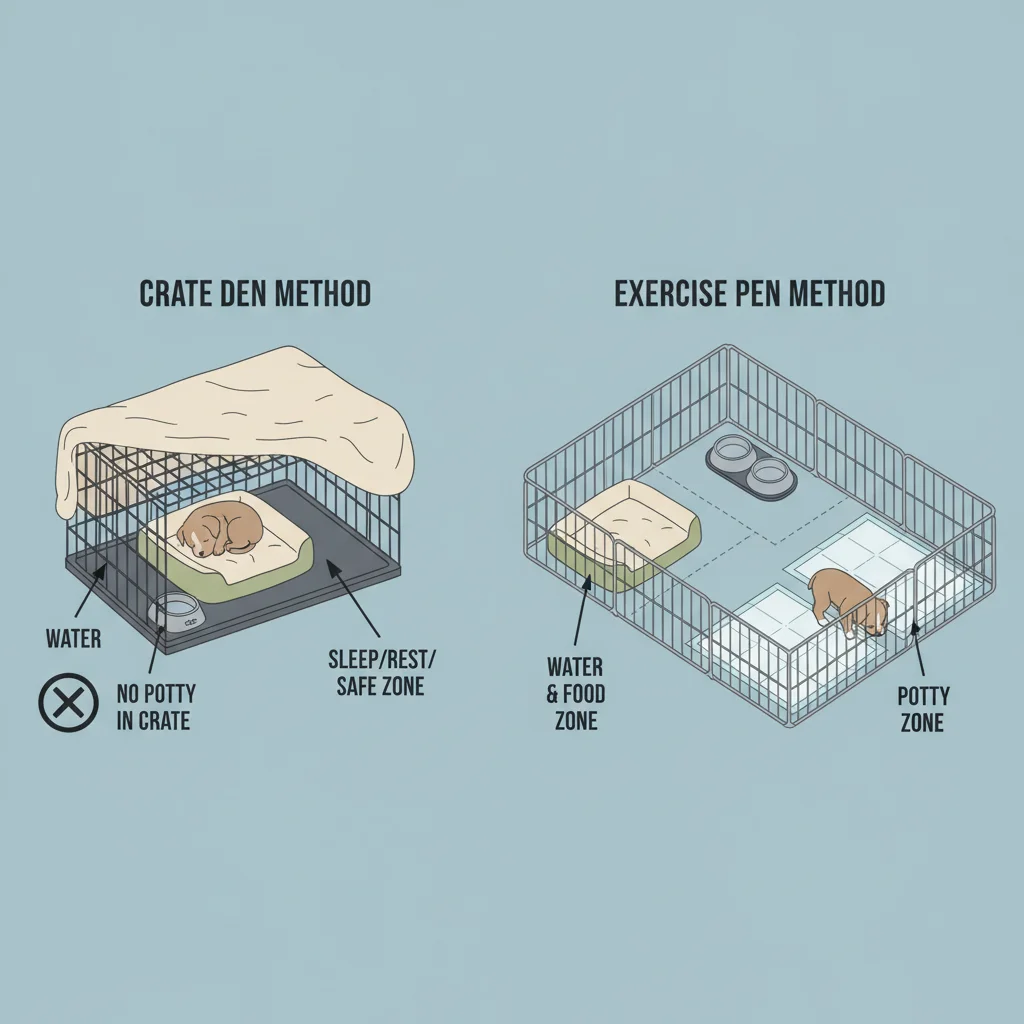
Puppy pen potty training and classic crate training teach opposite bladder strategies. Confusing them is the fastest way to create dirty crates or forever-pad habits.
| Approach | What you teach | Layout requirement | Best age window |
|---|---|---|---|
| Crate hold-it | Do not toilet where you sleep | Den-sized crate; no pad inside | From arrival, with age-appropriate outs |
| Pen potty zone | Toilet here, rest there | Clear pad/litter corner opposite bed/water | Young pups, high-rise apartments, long work blocks with care help |
| Pen without potty zone | Ambiguous—often becomes random indoor toileting | Small footprint only; frequent outdoor trips | Only with excellent schedule discipline |
Pen layout that actually works
- Bed and safe chew on one side
- Water where it will not soak the bed
- Potty pad or turf tray on the opposite side, visually distinct
- Shrink panels until the “middle” is not a mystery toilet alley
If the pen is so large the puppy can wander and forget where the pad is, you are not house-training—you are hosting accidents. Start tight. Expand only after clean days stack up.
Crate duration limits
A useful rule of thumb for daytime crate rests is roughly one hour per month of age, plus careful overnight management with a last potty and an early morning out. An eight-week puppy is not a four-hour crate project. Pushing past bladder capacity creates dirty dens and aversion.
- After play → potty → crate nap → potty again on release
- Never use the crate as a substitute for missed walks
- If accidents happen in the crate, check size (too big) and schedule (too long) before blaming the dog
Most house-training stalls come from using one tool for naps, freedom, and overnight when those jobs conflict. A crate that is perfect overnight can be the wrong tool for a three-hour midday stretch when a zoned pen (or a dog walker) would prevent a dirty crate battle.
Accident patterns to watch
- Corner pee in a large pen → shrink space or add a clearer potty zone
- Crate soiling after long confinement → shorten sessions; add outs
- Excitement pee on release → slower exits, immediate outdoor trip, less chaotic greetings
- Sneaky pad avoidance → move pad, raise contrast, supervise more
Treat accidents as data. The dog crate vs exercise pen choice should change when the data says the current job/tool pair is wrong—not when social media declares one method “pure.”
Apartment owners often need both strategies in one week: crate overnight for cleaner sleep, pen with pad during long work blocks if outdoor access is delayed. That is pragmatic puppy containment house training, not a failure of crate purity.
Alone time and anxiety risk
Containment can prevent chewed baseboards and still create a stressed dog. The playpen instead of crate impulse usually comes from guilt about “locking them in.” Bigger space is not automatically kinder if the puppy is alone, understimulated, and practicing panic.
Too much isolation
- Long unsupervised pen sessions teach barking at every hallway noise
- Under-exercised crate time teaches frantic exits and redirected chewing later
- Either tool fails if departures are abrupt and returns are chaotic
Build alone-time in minutes, not leaps. Start with you in the next room. Add short absences. Pair quiet containment with a food toy you only use for that job. End sessions before meltdown, not after.
Gradual freedom beats all-day containment
Neither crates nor pens replace training. They buy you safe windows while you teach settle, chew appropriate items, and outdoor toileting. A puppy that only knows walls will struggle when you open the living room.
- Practice short “open gate, still settle” moments while you are present
- Drag a leash indoors for supervised room access
- Expand freedom room by room after clean, calm samples
- Return to pen/crate when arousal spikes—reset, do not punish
If your puppy only settles in a closed crate and melts down in a pen, do not assume the pen is evil. Check height, chewing targets, and whether the pen is too stimulating (toys everywhere, family traffic, TV). Sometimes the pen is simply the wrong stage for that hour.
When pens backfire
- Escape artists climb short panels and learn the house is a puzzle
- Soft yards get chewed into escape routes (see metal vs fabric notes linked above)
- Giant pens become indoor yards with no structure
- Owners treat the pen as a full-time babysitter and skip outdoor schedules
A playpen that becomes an unsupervised daycare is not freedom—it is deferred training debt.
When to use playpen vs crate for alone time: prefer a well-introduced crate for short predictable absences once the puppy can settle; prefer a pen when you are home-adjacent and need eyes-on freedom. For long workdays, plan human help, daycare, or a hybrid schedule—do not invent an eight-hour miracle product.
Watch body language. Soft eyes and chewing a stuffed toy is progress. Screaming, frantic pacing, and self-injury are stop signs. Seek a qualified trainer or veterinary behavior guidance if panic is extreme—containment alone will not fix separation distress.
Cost, space, and multi-use reality
Shopping debates ignore the boring truth: many households eventually own both, because travel and overnight differ from daytime freedom. Budget for the jobs you actually have.
| Factor | Crate | Playpen / ex-pen | Own both? |
|---|---|---|---|
| Apartment footprint | Small; tucks beside bed or desk | Larger; needs a dedicated corner | Often: fold pen when guests arrive |
| Upfront cost | One solid crate sized for growth plan | Panels or yard; height upgrades add cost | Still cheaper than flooring repairs |
| Travel | Wins for car and lodging | Bulky; useful for hotel rooms if fold-flat | Crate first for trips |
| House-training clarity | Hold-it training | Zone training if laid out well | Yes when schedules conflict |
| Chew / escape pressure | Wire crates hold better than soft crates | Metal pens beat fabric yards for mouthy pups | Match material to the dog |
Apartment footprints
Measure the corner you can actually keep clear for three months. A beautiful eight-panel pen that blocks the only hallway will get abandoned. A crate that fits but never gets daytime support will create a puppy that only knows two states: locked or chaos.
- Protect floors under both tools with waterproof mats
- Keep pen panels off shared thin walls if neighbors complain about rattle
- Plan gate swing clearance so you do not stub toes every trip
Travel needs
If you fly, drive to family, or use pet-friendly hotels, a crate is non-negotiable skill practice. A playpen instead of crate plan collapses on travel week unless you also crate-train. Practice short car crate rides early so the first road trip is not the first confinement lesson.
Owning both math
Buy the crate you will still need at six months. Buy a pen you can expand or raise as the puppy grows—or accept that a short soft yard is a temporary stage. Spending twice on weak tools costs more than one decent crate plus one decent metal ex-pen.
For crate training vs playpen shoppers on a tight budget: prioritize a correctly sized crate first if overnight cleanliness and travel matter, then add a pen when daytime freedom becomes the bottleneck. Reverse that order only if you already have reliable overnight options and your main pain is underfoot chaos while you work from home.
Space-saving tip: many wire pens fold flat against a wall. Many crates double as a nightstand surface with a board on top (never block ventilation). Multi-use storage beats owning three half-used gadgets.
Recommended schedules by age
Age changes bladder capacity and chew intensity. Your puppy playpen house training plan should change with it—same tools, different ratios.
8–12 weeks
- Overnight: crate near your bed; last potty late, first potty early
- Day: short crate naps after play; pen for brief supervised freedom with a clear potty zone if outdoor trips are delayed
- Outs: very frequent; celebrate outdoor pees hard
- Alone time: minutes, not hours
This stage is about patterns, not perfection. Keep the pen small. Keep crate sessions short. Interrupt indoor accidents without drama, then reset outside.
3–6 months
- Overnight crate continues for most households
- Daytime pen windows can lengthen if the puppy settles and the layout stays clean
- Increase outdoor reliability; start fading pads if that is your goal
- Watch chewing: upgrade pen material/height before escapes teach bad lessons
Adolescence energy arrives early for some breeds. If the pen becomes a parkour gym, raise panels, add supervision, and lean on crate naps again. Freedom is earned in samples, not granted as a lifestyle overnight.
When to open more space
- Clean outdoor toileting is consistent for your schedule
- Chewing stays on approved items during supervised room time
- The puppy can settle on a mat without constant containment
- You can interrupt and redirect before accidents, not after
Open one room at a time. Keep the pen as a reset station. Keep the crate as a rest station. Retiring tools too early is how “we were doing fine” becomes ruined shoes and mystery pees behind the couch.
By six months, some calm dogs live mostly free with a crate for sleep/travel and a folded pen for visitors or rehab days. Others still need structured containment. Breed, age, and your home layout decide—not a viral schedule graphic.
Revisit the jobs monthly: overnight, naps, work blocks, travel. If a tool is unused, store it. If accidents return, shrink freedom before adding more gadgets.
Frequently Asked Questions
Can a playpen replace a crate completely?
Sometimes for calm dogs, but crates often win for travel, car safety, and short alone-time dens. Many households use both.
Does a larger pen slow house-training?
It can if the space is so big they toilet in a corner. Keep a clear potty zone or shrink the footprint early on.
Which is better for apartments?
Pens flex for daytime freedom; crates help overnight and when guests arrive. Floor protection matters for both.
How long can a puppy stay in a crate vs a playpen?
Crate naps should match bladder age (roughly one hour per month of age, plus overnight with a last potty). Playpens are for shorter supervised windows unless you have a defined indoor potty zone.
Should I use a playpen instead of a crate at night?
Only if the pen has a clear toilet area and you accept nighttime potty opportunities. Most young puppies sleep cleaner and safer in a properly sized crate overnight.
Your Next Step
Stop choosing a team. Choose the job. Use a crate for den sleep, short rests, and travel skills. Use a playpen for supervised daytime freedom and, when needed, a clearly zoned potty area. Adjust ratios as your puppy’s bladder and chewing change.
When you are ready to buy hardware, pick models from the best puppy playpens for 2026, lock sizing with the puppy playpen height and latch buying guide, and confirm material with the metal vs fabric puppy playpen comparison before checkout.
Related reading on our sister sites: Furbo 360