A backyard is not a kennel, and a folding octagon is not a fence. Shoppers comparing an outdoor dog exercise pen with a full yard run are usually trying to buy a short, supervised containment zone—not a place to leave a puppy while they go inside. The pen has to stay put in wind, stay cool in sun, and stay closed against diggers. If any of those jobs fail, you do not have an outdoor setup. You have a portable accident.
This guide is for yard use: staking, shade, heat, rust, and escape paths that indoor roundups skip. For brand-class indoor picks, start with our best puppy playpens 2026 list. For height math and latch failure modes, use the height, panel, and latch buying guide. When chewing starts, the metal vs fabric chew and escape test is the better next read than a mesh “outdoor play yard” listing.
This is practical containment advice for owners, not a veterinary or training prescription. Puppies that panic, overheat, or injure themselves on wire need a clinician in the loop—not a bigger Amazon cart. An exercise pen is a tool for supervised outdoor minutes. It is not a substitute for walks, shade, or a real fence.
When an outdoor pen makes sense (and when it doesn't)
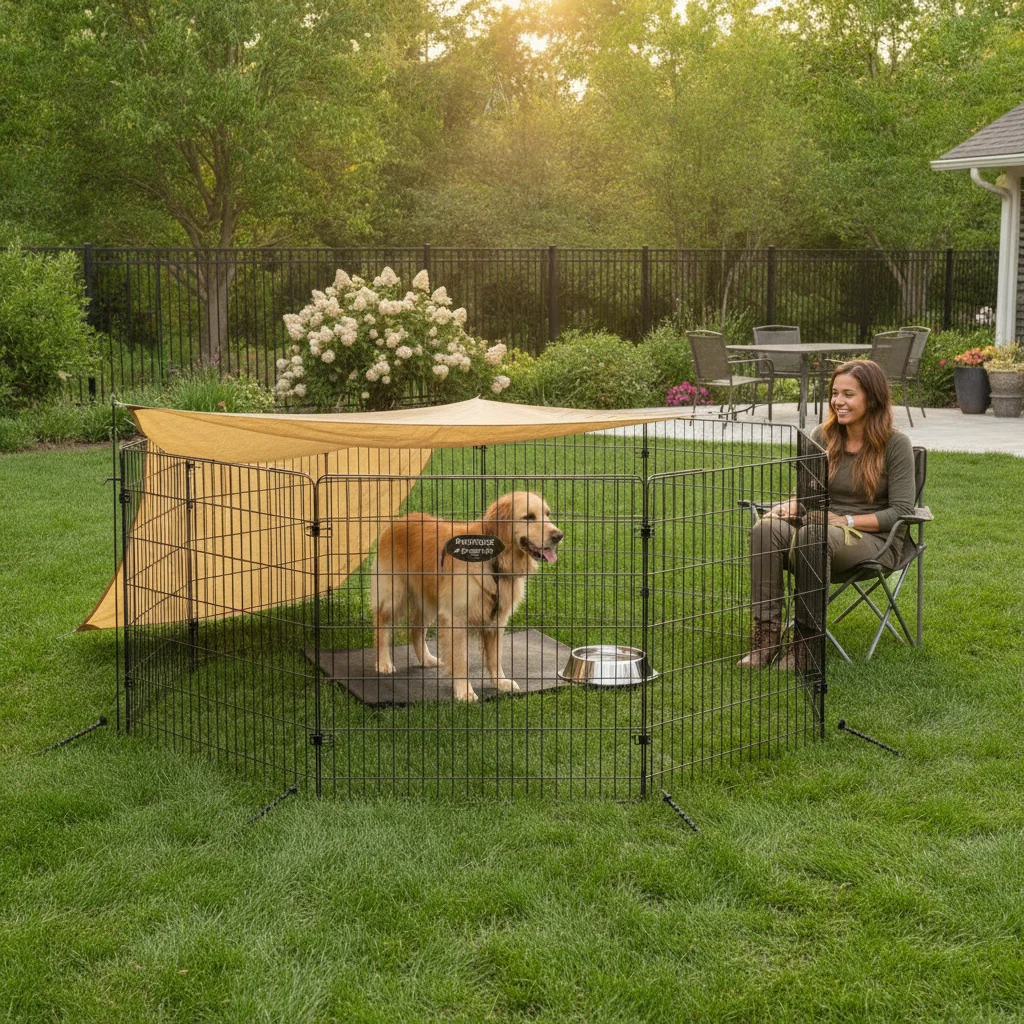
An outdoor pen earns its keep for a defined block: potty practice on grass, a shaded rest while you weed the same bed, or a hose-down after a muddy walk. It fails when it is asked to be a yard. Outdoor supervision still means you are in the yard: an ex-pen is a short containment tool, not a set-and-forget kennel while you go indoors.
If the job is overnight, commute hours, or “I’ll just check from the kitchen window,” skip the outdoor pen. Use a crate or indoor layout instead. For that indoor-versus-crate decision, read playpen vs crate for house-training and keep outdoor time as a separate, attended session.
- Yes: 10–30 minutes on grass while you stay in the same yard
- No: leaving the puppy while you run errands or take a call inside
- No: using fabric mesh as the only wall in wind or on a chewer
Supervised use only
Supervision is physical presence, not a camera app. A puppy can climb a corner, flip a water bowl, or work a latch in the time it takes to answer a delivery. If you cannot keep eyes on the pen, the session is over. Bring the puppy in. Fold the panels or leave them staked empty—empty metal in a yard is safer than an unattended dog in metal.
Neighbors, mail carriers, and other dogs change the risk. A pen that looks “fine” when the yard is quiet can become a launch pad when something exciting happens at the fence line. Stay close enough to put a hand on a panel before the puppy gets a paw over the top rail.
Puppy age and breed limits
Young puppies with unfinished vaccines still need a conversation with your vet about which grass, which parks, and which other dogs are reasonable. A backyard pen does not automatically make the ground “safe.” It only limits how far the puppy can wander while you watch.
Age also changes the hardware. A 10-week toy breed may respect 24-inch panels. The same mixed-breed at 16 weeks may bounce, brace, and climb. Buy for the jump they will have in eight weeks, not the sit they have today. Athletic herding and terrier mixes usually outgrow short outdoor pens first because there is no sofa blocking a corner.
Do not treat an outdoor pen as socialization. Other dogs sniffing through wire can spike arousal until the puppy climbs. If the goal is greeting practice, you need a trainer’s plan and a real barrier strategy—not a folding octagon at the sidewalk.
Weather that ends the session
Heat, hard rain, lightning, and wet-cold wind all end outdoor pen time. Wire does not insulate. Grass that looks green can still sit over radiating pavers. If you would not sit on that ground in that outfit for twenty minutes, the puppy should not either.
Wind is a hardware problem as much as a comfort problem. A tall, light pen becomes a sail. If gusts move the octagon, you do not add a heavier puppy. You add stakes or you pack up. Ice and standing water under panels make latches brittle and feet slide. Fold it and wait.
Staking and wind stability
Unstaked outdoor pens walk. The first shove from a puppy, a downhill slope, or a 15 mph gust turns linked panels into a moving cage. In suburban yards with typical lawn, four ground stakes plus linked panel pins stop a 24-inch wire pen from walking downhill in a 20 mph gust. That combination is the minimum, not a flex.
The pins that ship in the box are for joining panels, not for anchoring to soil. Treat them as hinges. Anchors are a separate SKU: long tent stakes, screw-in tie-out stakes, or U-shaped landscape staples through the bottom rail where the manufacturer allows it.
Ground stakes versus included pins
Push dedicated stakes at opposite corners, angled away from the pen so a shove tightens them instead of popping them. Add two more on the downhill side if the lawn grades. Check after five minutes of puppy motion; the first session is when you learn whether the soil is holding.
Hardpan and drought-baked clay laugh at short pins. Water the hole, wait, then drive a longer stake. Sandy soil needs still longer hardware or a screw-in stake. If you cannot get purchase, do not run the session. A walking pen is an escape with extra steps.
- Four corner stakes as the default
- Extra downhill stakes on any slope
- Longer hardware for sand; pre-soak for baked clay
Panel connectors that actually stay linked
Most eight-panel kits use rod-and-loop or pin connectors. They loosen when the octagon is not a true closed shape. If you run a straight line as a “fence,” every joint becomes a hinge that a puppy can accordion. Close the shape. Check that every pin is fully seated before the puppy goes in.
Replacement pins are cheaper than a lost puppy. Buy spares with the pen. Paint or zip-tie a bright marker on the gate pin so you can see from a few feet whether it dropped. A dropped pin looks like a closed gate until the first shoulder check.
Slope, hardpan, and sandy soil
On a slope, the downhill panels lift. That lift is a crawl-out for small puppies and a paw-hold for jumpers. Stake the downhill side first, then add a weighted board or paver on the outside of those panels if the manufacturer’s bottom rail allows it without creating a chew edge.
Do not set a pen on a deck with a gap under the rail unless you have a kickboard. Puppies go under before they go over. Grass that looks level can still hide a washout along a fence. Walk the perimeter on your knees once. If you can fit a fist under a panel, the puppy can too.
Shade, water, and heat safety
Backyard puppy training sessions work when the pen sits in partial shade with water inside the fence line, not as a substitute for a walk. Shade is a setup requirement, not a nice-to-have. Direct sun on wire plus dark fur plus still air is how “just ten minutes” becomes an emergency.
This is not a medical protocol. If the puppy is panting hard, drooling thickly, unwilling to move, or collapsing, get them into cool air and contact a veterinarian. An exercise pen does not treat heat illness. It can cause it if you ignore surfaces and shade.
Shade cloth that is not a climb ladder
Clip-on shade cloth works if it is taut, high enough that the puppy cannot mouth it, and tied to the outside of the top rail so it does not become a hammock. A drooping tarp is a climbing wall. Umbrellas inside the pen are worse: bases tip, ribs snap, and fabric is a chew.
Move the whole pen with the sun. A morning setup that was shaded at 9 a.m. can be a skillet at 11. If you cannot relocate in two minutes, the hardware is too fiddly for outdoor use. Practice teardown on day one.
Water placement that stays inside the pen
Put water inside, on a lipped tray, in a bowl that does not flip when a puppy hips it. A bottle mounted through the wire looks tidy and then leaks down a panel until the lawn is mud and the bowl is empty. Check the water when you check the latch—same interval.
Do not use ice cubes as a clever cooling trick without watching: some puppies gulp, some ignore the bowl entirely. Frozen water bottles to lie against are a household hack, not a guarantee. If the puppy will not drink, end the session and go inside.
Hot surfaces, metal bars, and when to stop
Press the back of your hand to the grass, the deck, and a sun-facing panel. If you pull away, the puppy’s pads and belly should not be there. Dark composite decking and asphalt next to a “yard” pen radiate after the air feels merely warm. Metal top rails in full sun can burn a mouth that tests them.
Stop for wet-cold as well as heat. A soaked puppy in wind chills faster in an open wire pen than on a walk with you moving. Towel, indoor pen, done. There is no prize for finishing a planned 20-minute block in bad weather.
- Hand-test ground and rails before every session
- Shade plus water plus a person in the yard
- End early; never “push through” panting or shivering
Best outdoor-ready metal ex-pens
Outdoor default hardware is a metal eight-panel exercise pen with a real gate, not a fabric play yard marketed with a picnic photo. Powder-coated steel kits in the Midwest-style class are the usual buy: reshapeable, tall enough options, and replacement parts that exist. Welded kennel panels are more stable and less portable. Fabric “outdoor” yards fail first on UV, chew, and wind.
Shop finish, height, and latch—not color. A white coating that chips to bare steel in month two rusts at every dew. A 24-inch pen that was “fine indoors” is a joke in open air once the puppy can see a squirrel. Confirm current latch design; connectors change by year more than brand loyalty admits.
| Setup class | Outdoor win | Outdoor fail | Use it when |
|---|---|---|---|
| Fabric / mesh play yard | Light to carry, folds into a bag | Wind sail, UV fade, chew-through, zipper escapes | Fully supervised patio minutes, travel, never as a yard |
| Powder-coated 8-panel ex-pen | Reshape, height options, stakeable, spare pins | Walks if unstaked; chips rust; rattle in wind | Default backyard training block for most puppies |
| Heavy welded kennel panels | Mass, harder to accordion, better dig resistance | Heavy, ugly, slow to move with the sun | Repeated same-spot use, strong diggers, larger adolescents |
Rust resistance and finish that survives dew
Overnight dew is harsher than a single rain. Look for a continuous coating, not paint that flakes at the welds. Wipe the bottom rail after wet grass; trapped mud holds moisture against the metal. Store panels off soil if you tear down daily. A rust bloom at a joint is a pinch hazard and a future break.
Stainless or heavily galvanized hardware lasts longer and costs more. For a puppy stage of a few months, a maintained powder-coated kit is usually enough if you are not leaving it staked through winter. If you want a multi-year yard fixture, you are shopping a kennel, not an exercise pen.
Panel height for jumpers in open air
Outdoor pens fail more on climb than indoor ones. There is sky, prey motion, and no furniture blocking corners. Most small-breed puppies start at 24 inches; athletic mixed breeds often need 30–36 inches once they can get a paw on a rail. If they already bounce at the top rail, go taller or stop using the pen as a yard.
Height without staking still fails. A tall, light octagon tips. Pair height with corner stakes. Do not stack boxes or boards inside to “add height”—those become launch pads. If the puppy is a climber, the answer is supervision plus a taller, staked pen, or indoor containment. Not a taller toy pile.
Gate latches that do not bounce open
The gate is the failure point. Gravity latches bounce when a puppy hits the door. Slide bolts walk open if the panel is not square. Choose a two-step latch you can hear click, then add a carabiner through the loop if the design allows it without creating a hang hazard. Check that carabiner every session; hardware migrates.
Open the gate into the yard, not into a fence corner that traps you. You need a path to pick the puppy up without climbing in. If entering the pen requires a yoga move, you will delay, and delays are how latches get “checked later.”
Escape and dig prevention
Outdoor escapes are under, over, or through. Under is a washout or a lifted downhill panel. Over is a climb at a corner. Through is a dropped pin, a bounced latch, or a puppy who learned to accordion two panels. Walk all three failure modes before you celebrate a quiet first session.
Chew is slower outdoors than on indoor mesh, but it still happens at vinyl coating, plastic feet, and any fabric shade. If teeth are on the hardware, redirect and shorten the session. A pen is not a chew gym.
Climb risk on wire and corner posts
Corners are ladders. Horizontal rails that a paw can pad on are worse than tight vertical wire. Watch the first time a squirrel appears. That is your climb test, not the empty-yard sit you filmed for a product review.
Do not hang toys on the walls. Do not drape blankets over the top “for privacy.” Both are footholds. If the puppy braces and walks up, end the session and move to a taller staked pen or indoor tools. Climbing is not a quirk you wait out in an unsupervised octagon.
Dig barriers that work on lawn
Diggers start at seams and downhill lift. A paver or board on the outside of the bottom rail, plus stakes, stops casual scraping. Buried hardware is a kennel project; most folding pens are not designed to be sunk. If you are burying wire, you have outgrown an exercise pen.
On fresh dirt or garden beds, skip the pen. The puppy will garden. Use grass you are willing to repair, or a patio with a kickboard so there is no under-rail gap. Check for holes after every session. A fist-sized start is tomorrow’s exit.
- Pavers or a board on the downhill outside rail
- No hanging toys or draped blankets on walls
- Inspect for holes and dropped pins after every use
Latch checks before every session
Make a four-point check: every panel pin seated, gate latched and clipped, four stakes in, water and shade in place. Say it out loud if you have to. The session that skips the check is the session that produces a lost puppy story.
After the puppy comes out, reverse the check before you walk away. An empty pen that blows into a pool, a grill, or a neighbor’s fence is still your hardware. Stake it empty or fold it. Do not leave a sail in the yard overnight because teardown felt like too much.
Frequently Asked Questions
Can I leave a puppy unsupervised in an outdoor exercise pen?
No. An outdoor pen is a short, in-yard containment tool while you are present, not a kennel you walk away from. Weather, digging, latch bounce, and overheating can turn a five-minute gap into an injury or an escape. If you cannot stay in the yard, bring the puppy inside to a crate or indoor pen.
How do I stake an outdoor dog pen so it does not walk?
Use four dedicated ground stakes at opposite corners, then add the manufacturer pins at every panel joint. Push stakes in at an angle away from the pen so a shove tightens them. On slope, stake the downhill side first. On sandy soil, use longer tent stakes or screw-in dog-tie stakes instead of the short pins in the box.
How tall should an outdoor puppy exercise pen be?
Buy for the jump they will have in eight weeks, not the sit they have today. Most small-breed puppies start at 24 inches; athletic mixed breeds often need 30–36 inches once they can get a paw on a rail. Outdoor pens fail more on climb than indoor ones because there is no sofa blocking a corner. If they already bounce at the top rail, go taller or stop using the pen as a yard.
Are fabric outdoor playpens safe in a yard?
Treat fabric yards as picnic or travel extras, not as primary outdoor containment. Mesh becomes a sail in wind, a chew toy in week three, and a UV-weak wall by midsummer. A metal eight-panel ex-pen with stakes is the outdoor default; keep fabric for indoor or fully supervised patio minutes.
Can an outdoor exercise pen replace a fenced yard?
No. A fenced yard is a property boundary with gates, buried wire, and room to move. An exercise pen is a temporary octagon you assemble for a training block. Use it for potty practice, a hose-down after a muddy walk, or a shaded rest while you garden nearby. Do not use it as the only outdoor access for a growing dog.
Your next step
Stake four corners, add real shade and water, and stay in the yard for the whole block. Choose powder-coated metal with a two-step latch over fabric marketed as outdoor. Buy height for the jumper you will have next month, not the sit you have this morning.
If chewing or indoor layout is still the bigger problem, use the metal-versus-fabric comparison and the apartment playpen guide before you add another yard SKU. The outdoor-winning pen is the one that still holds when the squirrel appears, still sits where you staked it, and still has a person standing next to it.
Related reading on our sister sites: Best Orthopedic Dog Bed Under