Most new owners buy panels first and invent zones later, then wonder why the puppy pees on the bed. A working exercise pen house training setup treats the pen as three rooms in one rectangle: a potty zone at one end, a bed at the opposite end, and water on a tray in the middle—not a nest with a pad tossed beside the cushion.
This is layout and scheduling advice for indoor containment, not a veterinary or behavior prescription. Puppies that panic, climb until they injure themselves, or cannot settle in a pen need a clinician and a trainer in the loop. For the crate-versus-pen decision, read our playpen vs crate for house-training comparison. For height and latch failures before you buy, use the height and panel buying guide.
Most failed house-training setups put the potty pad beside the bed because the pen is too small—puppies refuse to sleep where they eliminate when they have any choice. Fix the geometry before you swap brands. Product photos hide that the octagon in the listing is too short in one direction to create a real walk between sleep and potty.
Why zone layout matters more than pen brand
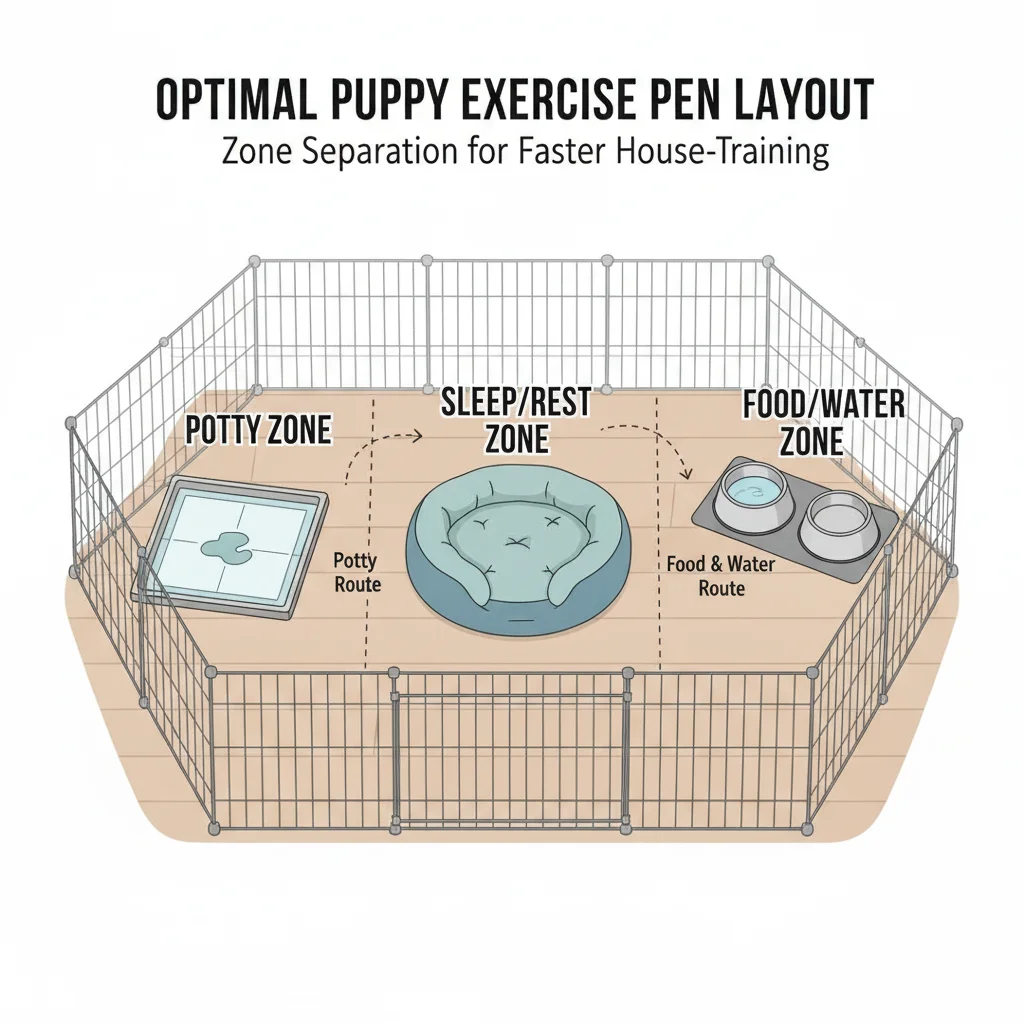
Brand stamps do not teach a puppy where to go. Distance does. When the pad is one body-length from the bed, the puppy treats the whole floor as one den, and den animals do not soil their sleep if they can help it—so they hold, then dump the moment you open the gate.
A 24–32 square foot rectangle with three distinct zones (potty far from bed, water on a tray, toys in the middle) matches what trainers recommend for supervised alone time. That footprint is a working minimum for a medium puppy, not a luxury. Soft play yards that look roomy in photos often collapse into a square that fails this test.
- Potty: lipped tray or holder at the far short wall
- Sleep: bed or crate-adjacent cushion on the opposite short wall
- Water: heavy bowl on a tray in the middle third, never on the pad
- Toys: two chew items in the middle, nothing hanging on the potty wall
Distance between potty and sleep areas
Aim for three to four feet of clear floor between the edge of the pad and the edge of the bed. That is a walk, not a shuffle. If your panels only allow a two-foot gap, reshape an 8-panel kit into a long rectangle along a wall instead of a tight octagon in the room’s center.
The walk is the training cue. The puppy has to leave the bed, cross the middle, and step onto a different surface. That surface change—pad, grass tray, or washable turf—is what you will later move toward the door. If bed and pad share one mat with no visual break, you never built a zone.
What a minimum footprint looks like
Measure inside the panels, not the box claim. A typical MidWest-style 8-panel pen at 24 inches per panel can be a 4×4 square (16 sq ft) or a 2×6 rectangle (~24–30 sq ft depending on how you join). The square is easier to photograph. The rectangle is what house-training needs.
Apartment owners can still zone-train in less space, but they must keep the long axis. See indoor apartment playpen setups if the only free wall is short. Do not “solve” a small room by stacking the pad against the bed and hoping the puppy is polite.
| Footprint | Typical panel layout | Zone training verdict |
|---|---|---|
| Under ~16 sq ft | Small square or 6-panel mini | Too tight unless a toy breed and a tiny pad; usually fails |
| About 24–32 sq ft | 8-panel rectangle along a wall | Working default for most medium puppies |
| Over ~40 sq ft | 10–16 panels or a room gate | Often becomes a bathroom unless you still fence a pad island |
When the pen is too small to succeed
If the puppy can reach the pad from the bed in one step, the pen is too small for zone training. You will see two failure modes: sleeping on the pad because it is the only dry-looking rectangle, or holding all night then exploding in the living room. Neither is a “brand problem.”
Height matters too. A layout that works at eight weeks fails when the puppy can jump the 24-inch panels at four months. Buy height for the adult, then use extra panels to lengthen the rectangle—not to make a taller cube with the same tiny floor. Material choice (metal vs fabric) is a chew-and-escape question covered in our best puppy playpens 2026 roundup, not a substitute for square footage.
Step-by-step setup for day one through week four
Build the pen on day one before the puppy arrives if you can. First-night chaos is a bad time to discover that the gate opens into a hallway or that the pad curls. You are installing a three-zone floor plan, then teaching a schedule. The hardware does not train by itself.
Keep the same layout for at least two weeks unless the puppy is clearly sleeping on the pad or eliminating on the bed. Random rearranging reads as a new room every day. Consistency is the point of a puppy playpen house training setup: same surfaces, same walk, same door.
Where to place the pen in your home
Put the pen in the room where you actually spend daytime hours—kitchen sightline or living-room wall—not in a basement the puppy never sees you from. Isolation plus a pad teaches “this is the bathroom warehouse,” not “this is my den with a toilet at the far end.”
Keep a walking path outside the panels. If you kick the gate every time you cook, the latch will fail and you will start leaving it unclipped. Face the gate into the room, not into a traffic jam. Avoid blocking a fire exit or the only path to the kitchen.
- Daytime: pen in the social room, you visible
- Naps and overnight: crate in a quiet corner (often the same room, not inside a chaotic play zone)
- Never: garage, balcony, or unattended yard as the only “house-training” space
Potty pad vs grass tray choices
Pads are the apartment default because they are cheap and washable. They also smell if you cheap out on changes, and some puppies shred them. A lipped tray stops the pad from becoming a soggy rug that wicked under the bed. Real-grass or turf trays help if your end goal is outdoor grass, but they add mess and you still need the same distance from the bed.
Playpen potty pad placement is always the far wall, never the center. Center pads get walked through and then the whole mat looks like a toilet. If you use washable pads, buy enough to rotate; a damp pad in the sleep zone is how you accidentally teach that beds can be wet.
Do not put food next to the pad. Dogs avoid eliminating near food when they have a choice, which sounds helpful until they simply hold and then go on the bed because that was the other option. Water is allowed in the middle on a tray. Food belongs at meal times, usually outside the pen or at the sleep end for a few minutes, then removed.
Bed, chew toys, and water bowl placement
The bed should be the most comfortable rectangle in the pen and still look nothing like the pad. A raised cot or a distinct cushion color helps. If you nest a crate inside the pen, put it at the sleep end with the crate door facing the middle so the puppy walks out toward toys, not onto the pad.
Water goes on a heavy bowl or a no-spill bottle, sitting on a tray so drips do not create a second “wet zone” the puppy might use. Steel bowls on bare floors rattle; plastic on a tray is quieter. Two chew toys in the middle are enough. A pile of toys on the pad teaches that the toilet is also the playroom.
Week one: show the puppy the pad after every nap, meal, and play burst, then return them to the pen if they do not go. Week two: they should start walking to the pad on their own when the schedule is tight. Week three and four: you are still escorting after sleep; you are not “done.” Owners who skip a schedule and only expand the pen when accidents stop usually regress at week six when teething and mobility spike.
Daily schedule: alone time, naps, and freedom windows
An exercise pen training schedule is a bladder clock plus rest, not a workday parking space. The pen holds the puppy while you cook, take a call, or shower. It does not replace walks, outdoor trips, or sleep in a den. If you need eight hours of unsupervised containment, you need a different plan and usually a human helper—not a larger octagon.
Pair every pen block with a potty opportunity at both ends. Out before in. Out after a nap. The layout only works if the puppy is empty enough to care about zones. A full bladder in a well-zoned pen still floods the nearest corner.
How long puppies can stay in a pen by age
Follow age-based bladder limits: roughly one hour per month of age plus one, and never more than you can tolerate an accident. A twelve-week-old puppy is not a four-hour dog. Night stretches can be longer because sleep slows the system, which is why overnight belongs in a crate more often than in a playpen with a pad.
| Age (approx.) | Awake pen block | What to do when it ends |
|---|---|---|
| 8–10 weeks | 45–90 minutes | Carry or leash to pad or yard; then rest |
| 11–14 weeks | 1.5–2.5 hours | Potty, short play, then crate nap |
| 4–5 months | 2–3 hours if empty | Outdoor trip; do not add hours just because the pen is bigger |
These are ceilings for a typical puppy, not a contest. Water intake, heat, and excitement shorten them. If accidents cluster right after you return, the schedule—not the latch brand—is the problem.
Pairing pen time with crate naps
You can house-train with an exercise pen for daytime zones and still use a crate for naps. That split is the usual winning combo: the pen teaches “toilet is over there” while awake; the crate teaches “this small space is for sleep, not for wandering to a pad.” Trying to replace both with one oversized pen often slows house-training because the puppy never gets a true empty-bladder rest.
After a pen session, potty, then crate for a nap if the puppy is rubbing eyes or mouthing out of fatigue. After the crate, potty again, then a freedom window in a puppy-proofed room while you watch. The pen is the middle tool, not the entire day.
Signs the pen is failing the training goal
Failure is patterned, not one accident. Sleeping on the pad, peeing on the bed, circling the whole floor then going everywhere, screaming for twenty minutes every time you leave the room, or chewing through a corner to escape all mean the current contract is broken. Fix one variable at a time: duration, footprint, supervision, or whether this puppy can be left in an open pen at all.
Climbing and latch attacks are hardware plus boredom. Shorten the block, add a chew that is legal, raise the panels, and stop using the pen as the only enrichment. A zone layout cannot outvote a puppy who has been left two hours too long.
Common mistakes that cause regression
House-training regressions at week four to six are usually owner schedule drift, not a mysterious “they forgot.” The puppy got more freedom, more water, more teeth, and the same or longer isolation. The pen still looks neat on Instagram. The zones have quietly merged because someone moved the pad “just for today.”
Oversized pens that become a bathroom
A huge exercise pen feels kind. It often becomes a yard the puppy lives in, so they pick a corner far from you and treat it as outdoors. Zone training needs a limited walk to a designated surface. If you must use a large footprint, fence the pad in its own small corral inside the pen so the toilet stays small.
Room-dividers that give the puppy half the kitchen have the same failure. The puppy has enough space to be “away” and still indoors. Keep the working rectangle until outdoor reliability exists, then expand on purpose.
Moving the potty zone too soon
Moving the pad toward the door is the right endgame. Doing it after three dry days is how you get a confused puppy who pees in the old corner. Wait for a streak measured in weeks of successful trips to the current pad (and outdoor trips if you are dual-training), then shift the pad one panel-width at a time.
If the puppy starts missing, slide the pad back. Do not scold and also change the map. The map has to be boringly stable while the schedule does the teaching.
Using the pen as all-day babysitting
All-day pen time is warehousing. Bladders fail, chewing explodes, and the puppy learns that humans appear at random. House training with exercise pen alone time only works when alone time is a known length the puppy can physically handle. If your workday is longer than that, hire help, use a midday walker, or accept that indoor pads will be used more—not that the puppy is stubborn.
Social isolation also creates scream-and-escape behavior that looks like “the pen does not work.” The pen may be fine. The duration is not. Trainers see this constantly in apartment dogs whose only job is to wait in a pretty enclosure until dinner.
When to shrink, expand, or graduate out of the pen
Graduation is earned with empty-bladder outdoor (or designated) success, not with a calendar. Expanding the pen because the puppy looks sad is how zones collapse. Shrinking it because of one accident can also backfire if you then skip potty trips. Change footprint when the data is boring: days of the same correct choice.
Accident-free streak benchmarks
Use the pen’s own record, not hopes. A useful indoor benchmark is several consecutive weeks with no pad-or-bed confusion during typical pen blocks—meaning the puppy walks to the pad or waits for you, rather than soaking the bed. Outdoor-only households should also see reliable yard trips after crate naps before they rip the pad out.
Count only supervised, scheduled blocks. A lucky Saturday does not erase weekday accidents. When the streak holds, shrink the pad first, not the whole pen. A smaller target is a clearer cue than a bigger playground.
Adding outdoor potty breaks
If the end goal is grass, start outdoor trips on a leash at the same times you would have used the pad: after sleep, after meals, after play. Praise the outdoor go. Do not punish the pad if you still offer a pad; you cannot be angry at a toilet you installed. Dual training is slower and honest. Pad-only apartments can stay on pads longer without shame; the layout rules do not change.
When outdoor success is consistent, move the indoor pad toward the door in steps, then offer it only for long absences. That is how you retire a pad without a week-six flood on the rug.
Transitioning to crate-only or free roam
Crate-only days come when the puppy rests in the crate without panic and can hold through reasonable absences. Free roam comes last, room by room, with the same bladder clock. Many households keep a folded pen for guests, illness, or a second dog. That is not failure; it is a tool staying in the closet.
If free roam produces sneaky pees behind furniture, you expanded too soon. Bring back the rectangle. The three-zone map still works at five months if you were using a forty-square-foot “kindness” pen that never taught a toilet.
Frequently Asked Questions
How big should an exercise pen be for house training?
Aim for enough space to keep the potty pad at least three to four feet from the bed on a washable mat. For most medium puppies that means reshaping metal panels into a rectangle of about 24–32 square feet, not the smallest square the listing allows. If the puppy can reach the pad from the bed in one step, the pen is too small for zone training.
Where should the potty pad go in a puppy playpen?
Place the pad at the far end from the bed, on a lipped tray if possible, with a clear walking path between zones. Never put food or water directly beside the pad. If the puppy sleeps on the pad repeatedly, the pen is either too small or the pad is too close to the bed—fix layout before blaming the brand.
Can I house-train using only an exercise pen without a crate?
You can use a pen for supervised containment and daytime potty training, but most trainers still use a crate for naps and overnight because puppies sleep more soundly in a den-sized space. The pen teaches zone separation during awake hours; the crate handles rest. Trying to replace both with one oversized pen often slows house-training.
How long can a puppy stay in an exercise pen while house training?
Follow age-based bladder limits: roughly one hour per month of age plus one, and never more than you can tolerate an accident. A pen is not a substitute for potty breaks. If accidents cluster right after you return, the schedule—not the pen model—is the problem.
When should I remove the potty pad from the exercise pen?
Shrink the pad only after a consistent streak of outdoor or designated-potty success during pen time, usually several weeks—not days. Remove it in stages: smaller pad, then pad only during long absences, then pen without pad while you are home. Rushing removal is the most common cause of week-six regressions.
Your next step
Reshape the panels into a long rectangle, put the pad on a tray at one end and the bed at the other, and park water in the middle. Then run a bladder-honest schedule for two weeks before you change anything. If you still need a product, shop height and latches first, not a prettier fabric yard that cannot hold a three-zone floor.
Keep a crate in the plan for sleep. Expand the pen only after the puppy walks to the toilet on purpose. The winning setup is the boring rectangle you can describe in one sentence: potty far, bed far, water in between, and you always come back before the clock runs out.
Related reading on our sister sites: Best Orthopedic Dog Bed Under