A backyard ex-pen and a puppy playpen for apartment living fail for different reasons: one fights weather and staking, the other fights square footage, landlord floors, and the neighbor on the other side of a thin wall. You are not shopping for the largest yard you can unfold. You are shopping for a containment footprint that still leaves a walking path, protects finishes, and stays quiet enough that the lease survives month three.
This guide ranks indoor setups by apartment constraints—floor protection, noise, fold-flat storage, and layouts that work in studios and one-bedrooms—not by which outdoor pen looks best on a patio. For brand-class picks across materials, start with our best puppy playpens 2026 list. For panel math and latch failure modes, use the height, panel, and latch buying guide. When chewing starts, the metal vs fabric chew and escape test is the better next read than another cute soft-yard listing.
This is practical containment advice for owners, not a veterinary or training prescription. Puppies that panic, climb relentlessly, or injure themselves on bars need a clinician and a trainer in the loop—not a bigger Amazon cart. A playpen is a tool for supervised freedom. It is not a substitute for walks, sleep, or human time.
What apartment owners actually need from a playpen
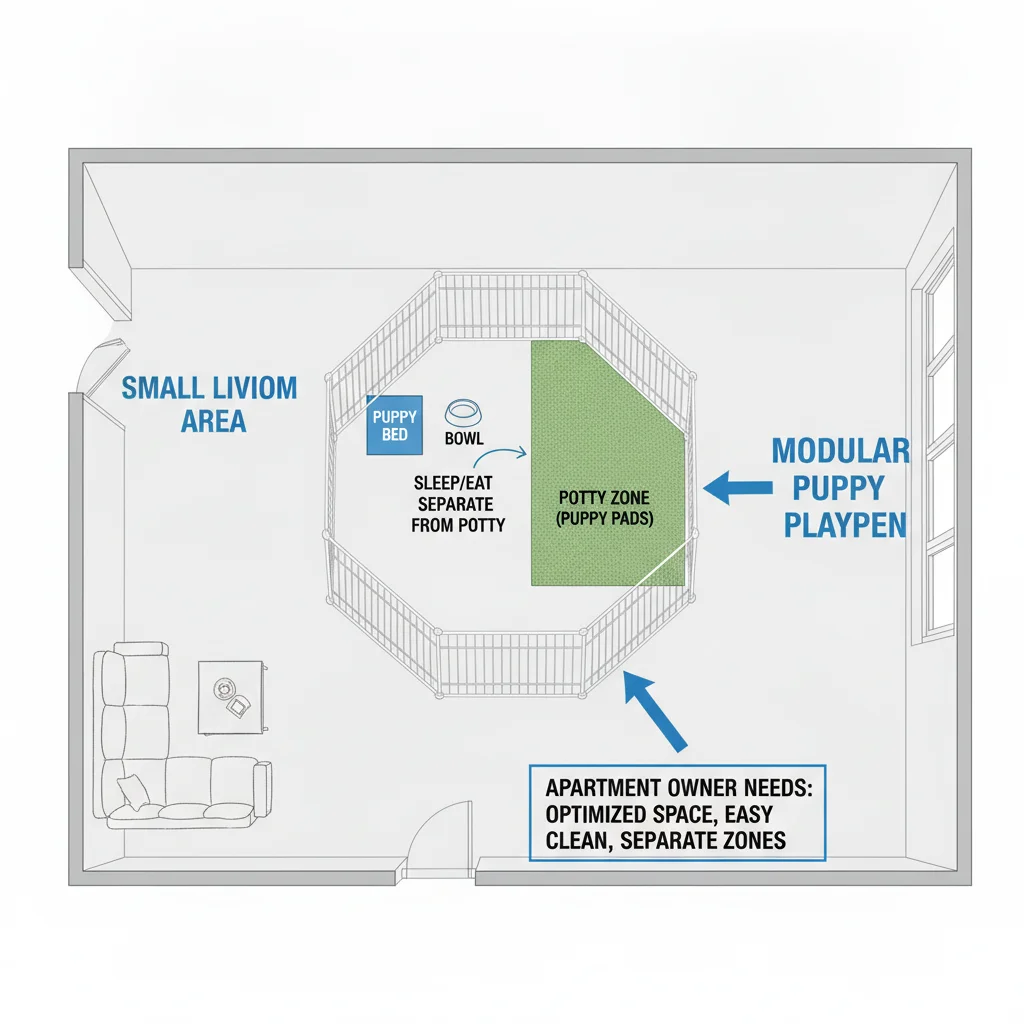
The apartment job is containment without claiming the whole room. In a typical studio, a 16–24 square foot playpen footprint is the largest most renters can keep without blocking the only walking path to the kitchen. That number is a ceiling, not a brag. Bigger pens that sit in the middle of the rug force you to step over panels every time you cook, and those panels get kicked, unlatched, and eventually folded into a closet forever.
Indoor success looks boring on a product page: a long rectangle along one wall, three zones inside, rubber under every foot, and a gate that opens into the room rather than into a hallway traffic jam. Outdoor “exercise pen” copy will not mention any of that. Ignore yard square-footage claims until the indoor geometry works.
- Floor protection: waterproof underlayment under the full perimeter, not a towel that wicks to the baseboards
- Footprint: enough to turn and lie down, not enough to become a second room
- Noise: damped feet and no metal-on-hardwood skate
- Storage: fold-flat or panel-stack that actually fits a closet
Floor protection that survives landlord inspections
Deposits die from urine rings, panel-foot dents, and black scuffs where metal walked the finish. A washable mat that extends a few inches beyond the outer panels is cheaper than a refinishing argument. Vinyl and laminate still scratch; they just hide it until light hits at an angle during move-out.
Skip felt furniture pads as the only defense. They compress, migrate, and leave metal edges exposed. Use a continuous waterproof layer, then rubber tips or silicone cups on each foot. If the puppy is a pacer, the mat has to stay put with rug tape that does not destroy the floor when you peel it—test a corner first.
Footprint versus crate in a small room
A crate is for rest and short absences. A playpen is for daytime containment when you are home but cannot watch every second. Apartment owners who try to make one product do both usually fail both jobs: the crate feels too small for play, and the pen is too open for unsupervised sleep. For the decision framework, read playpen vs crate for house-training and keep both tools if space allows.
Place the crate inside or flush against the pen only if the combined block still leaves a clear aisle. Nested setups look clever on Instagram and then trap you between a sofa and a gate. If you cannot open the crate door without climbing into the pen, the layout is already wrong.
Noise, neighbors, and fold-flat storage
Metal panel rattle against hardwood is a neighbor complaint; rubber feet plus a washable mat under the full perimeter cuts both noise and finish scratches. Toys that clang on bars—steel bowls, hard balls, metal rings—belong outside the pen if you have downstairs neighbors. Plastic water bowls on a tray rattle less than steel on bare floor.
Fold-flat storage is not a nice-to-have for renters. Guests, cleaning days, and move-outs all require the pen to disappear. Soft yards usually win that test. Metal pens win if they break into a flat panel stack that slides behind a door. If teardown takes tools and twenty minutes, you will never tear it down, and the living room will stay a kennel.
Best soft play yards for renters
Soft play yards—mesh walls, fabric floors, pop-up or zipper frames—are the default apartment search result because they photograph as furniture. They are the right best indoor puppy playpen answer for a short stage: a small, gentle chewer, a travel weekend, or a closet that will not hide metal panels. They are the wrong forever pen for a landshark mix that treats mesh like enrichment.
Soft play yards win on fold-flat closet storage for renters, then lose on chew months two through four unless you treat them as a short puppy-stage tool. Budget for a metal handoff instead of being shocked when zippers fail. That sequence is cheaper than replacing two destroyed yards and still buying metal in month three.
Who a fabric yard actually fits
Toy and mini breeds under a few months, puppies that mouth toys more than walls, and households that need the pen gone every evening are the fit. If your puppy already braces and climbs, fabric walls become a ladder. If you work from the same room, a quiet zippered yard can be less visually aggressive than a steel octagon—until the first escape.
Look for a removable, washable floor, a door that stays open with a clip (not only a zipper you will forget), and poles that do not punch through fabric at the corners. Interior pockets are a gimmick; they become chew targets. A simple cube or hex with a real gate beats a “palace” with windows the puppy can hang on.
- Use fabric for daytime, in-room supervision—not overnight alone
- Retire it at the first hole, not the fifth
- Keep it as a travel/guest tool after you upgrade to metal at home
Chew risk on mesh, zippers, and poles
Mesh fails at the lower twelve inches first. Zippers fail where the puppy worries the pull tab. Poles fail when the dog uses a corner as a chew and the frame collapses inward. None of those failure modes show up in five-star reviews written in week one.
If you still want fabric, add a chew-resistant mat over the floor (not a thin blanket), remove hanging toys, and never leave stuffed chews that encourage wall grabbing. Redirect chewing to approved items outside the mesh. A fabric pen is not a chew gym. The moment you see fray, the containment contract is over.
Portability and closet storage
A fold flat puppy playpen that actually fits a standard closet is the renter feature that metal often cannot match. Weigh packed size, not marketing “portable.” If the carry bag is the size of a duvet, you will not take it to a friend’s house, and you will resent storing it.
Practice teardown once on day one. If you need a YouTube video and both hands plus a knee, it will not be a Tuesday-night guest solution. Soft yards that pop up in seconds earn their keep for that reason alone—even if you already own metal for weekday containment.
Best metal ex-pens for apartment corners
Metal exercise pens—linked wire or tube panels, typically 8-panel kits you reshape—are the apartment workhorse once chewing and jumping start. They look less like nursery furniture and more like a kennel, which is honest. You can run them as a long wall-hugger, an L that gates a dead corner, or a small hex if you truly have center-room space.
IRIS-style plastic-panel pens sit between fabric and steel: more chew resistant than mesh, quieter than some wire kits, and often easier to wipe. They still flex at latches and can be climbed if height is short. Treat plastic as a medium-chew, short-to-mid stage option, not as proof against a determined jumper. Confirm current latch design before you buy; connector quality varies by year more than brand loyalty admits.
| Setup class | Apartment win | Apartment fail | Best stage |
|---|---|---|---|
| Soft fabric play yard | Fold-flat storage, low visual bulk, travel | Mesh chew-through, zipper escapes, climb holds | Early weeks, gentle mouths, guest days |
| Plastic panel pen | Wipeable walls, quieter than bare wire | Flexing latches, short heights, chew on edges | Small-medium puppies, moderate chewing |
| Metal ex-pen | Height options, reshape to a wall, durability | Rattle, scratches without a mat, heavier storage | Chewers, jumpers, multi-month indoor use |
Panel height for growth in a tight footprint
Height is the apartment trap: you buy short panels because they look less industrial, then the puppy plants rear feet and vaults onto the sofa. Use the same height rules as any indoor pen—err tall, especially for athletic mixes—then compensate with a narrower footprint instead of short walls. A 30–36 inch wall along eight feet of unused wall is usually smarter than a 24-inch cube in the middle of the rug.
Wire spacing matters when paws become climbing holds. Tight grids reduce toe-holds; wide decorative spacing invites parkour. Recheck after growth spurts. A pen that worked at ten weeks can be a jungle gym at sixteen, even if the square footage never changed.
Floor pads, rubber feet, and wall-safe setups
Never let bare metal feet sit on finished floors. Rubber tips, plus the full mat, plus keeping the pen a few inches off painted baseboards if the puppy rams corners. Some owners pad the wall-facing panels with a folded yoga mat zip-tied high enough that it cannot be eaten. If you pad, inspect daily; loose foam becomes a GI emergency, not a design detail.
Corner placements work when two walls already exist. Do not pin a pen so tightly into a corner that you cannot reach the puppy without climbing. You still need a gate you can open with a coffee cup in one hand. Emergency access is a safety requirement, not a convenience.
Latch safety when the gate faces a hallway
Hallway-facing gates get hit by hips, bags, and delivery people. Face the gate into the room when you can. Double-check latches that open with casual thumb pressure; those open under a 20-pound body slam. Slide bolts and two-step latches beat single plastic clips.
Collapse-prone hinges are an injury risk if a panel folds onto a puppy. Shake the assembled pen. Gaps at connectors predict escapes and finger pinches. If the kit has no spare clips, assume you will hunt for replacements in month two—buy a brand whose hardware is still sold, or keep spare carabiners rated for the job as a temporary backup, not as the only lock.
A playpen that unlatches when you bump it with a laundry basket will unlatch when the puppy hits it from the other side.
Floor protection and potty-zone setups
Apartment house-training inside a pen only works if the pad is a distinct room, not a soaked corner of the bed. Split the rectangle: sleep and water at one end, potty at the other, toys in the middle if space allows. If the puppy sleeps on the pad, the pad is too close or the pen is too small.
This is where indoor diagrams beat product dumps. Competitors list SKUs; they rarely tell you that a square pen with one pad in the middle teaches the puppy that the whole floor is a toilet. Linear layouts along a wall make the “bathroom” obvious.
Washable pads versus trays on vinyl and hardwood
Washable pee pads with a waterproof backing, set in a low tray or holder, contain the inevitable miss better than a naked pad that wicks under panels. On hardwood, that wick is the deposit killer. Holders with a lip beat clips that the puppy peels in one evening.
Litter-style indoor potty trays exist for small breeds and for owners who will actually scoop. They fail when the tray is too interesting as a chew or too high for a tiny puppy. If you use a tray, park it at the far end and keep bedding far enough that sleepy accidents still hit the tray, not the fleece.
- Waterproof mat under the whole pen
- Lipped pad holder at the far wall
- Bedding that cannot drag onto the pad overnight
Spill containment that does not smell like a kennel
Apartments concentrate smell. A “washable” pad that stays damp for twelve hours will announce itself to anyone who opens the front door. Have two pads in rotation. Wash on hot according to the product, and dry fully. Baking-soda theater does not replace laundry.
Enzyme cleaner on the mat and on any seep at the perimeter after accidents. If you smell it, the floor may already be holding it. Daily sniff-checks at panel feet are unglamorous and more useful than another toy.
Where water bowls belong in a small pen
Water next to the potty pad creates a swamp. Water next to bedding creates a wet bed. Center the bowl on a tray, or clip a no-spill bowl high enough that it cannot tip but low enough to drink. In a tiny footprint, a smaller bowl refilled more often beats a gallon that dumps once.
Metal bowls on bare floors are percussion instruments. Plastic or ceramic on a silicone mat is quieter. If the puppy tips water as a game, switch to a spill-resistant design before you blame the pen for a ruined floor.
Sizing for studio vs one-bedroom layouts
Studios force wall-hugger rectangles. One-bedrooms often let you steal a dead corner in the living room or a spare slice of bedroom if the puppy sleeps there. Do not automatically put the pen in the bedroom if you work in the living room all day; isolation plus a new home is how you manufacture screaming. Proximity during daytime, crate for night, is the usual apartment pattern—adjust if the puppy actually rests better in a quiet room.
Measure the aisle you must keep. Fire exits, the path to the bathroom, and the fridge door swing are not optional. A pen that makes you sidestep with groceries will be hated by week two, and hated equipment gets folded away while the puppy chews baseboards instead.
Minimum footprints that still allow a turn
The puppy should stand, turn a circle, lie fully on one side, and still have a pad that is not also the bed. For many small-to-medium puppies that means roughly a 4×4 to 4×6 foot usable interior, reshaped to 2×8 along a wall if needed. Giant-breed puppies need more length sooner; they outgrow cute cubes while still being babies.
If the only way to hit that area is to block the room, you need a different layout—or you need to accept that unsupervised freedom happens on leash and walks, not in a giant indoor cage. Apartments have limits. Honest sizing admits them.
Expandable panels when the only spare wall is short
An expandable panel kit is useful when you start with six panels along a short wall and add two later when furniture moves. Buy panel systems that accept extra sections from the same line. Mixing brands is how you get height mismatches and failed latches.
Expanding into a walkway is not expanding. If growth requires more space, steal it from underused furniture first: a slim console table leaves, a bulkier coffee table stays. The pen should lose the furniture fight only when safety or exits are at stake.
Doorway clearance and fire-exit paths
Do not span a doorway with a pen unless you have a plan for a human to exit fast without unclipping four carabiners in the dark. Building codes and lease rules aside, you need a path you can use with a puppy in your arms. Keep at least one full-width route to the exit clear at all times.
If the only “good” pen location is in front of a radiator, heater, or blinds cord, it is not a good location. Heat, chewable cords, and window-blind loops are apartment-specific hazards listicles skip because they are not SKUs. Walk the perimeter at puppy eye level before you lock the layout.
Frequently Asked Questions
What size puppy playpen works in an apartment?
Most studios do well with a reshaped rectangle of about 16–24 square feet along a wall, not a giant octagon in the room’s center. The puppy needs space to stand, turn, lie down, and keep a potty pad away from the bed. If the pen blocks the only path to the kitchen or a fire exit, it is too large no matter what the listing says.
Is a soft play yard or a metal exercise pen better for apartments?
Choose a soft yard if you need fold-flat closet storage, travel, and a short window with a gentle chewer. Choose a metal ex-pen if you expect chewing, jumping, or several months of indoor containment. Many renters start soft, then switch to metal once teeth and athleticism show up—plan for that handoff instead of treating the first buy as forever.
How do I protect hardwood floors under a puppy playpen?
Put a washable, waterproof mat under the entire pen perimeter so panel feet cannot walk the finish. Add rubber tips or silicone pads on metal feet. Keep water on a tray and the potty pad in a lipped holder. Wipe accidents immediately; trapped urine under a pen is how deposits get denied even when the furniture looks fine.
Will a metal playpen bother downstairs neighbors?
It can, if bare metal feet skate on hardwood or the puppy rams panels. Rubber feet, a full-coverage mat, and keeping toys that bang the walls out of the pen reduce the drum effect. Soft yards are quieter but often fail as chew containment. Quiet and escape-proof are different jobs; you may need metal plus damping, not fabric alone.
Can a playpen replace a crate in an apartment?
Not for unsupervised naps, overnight, or when you cannot see the puppy. A playpen is a supervised freedom zone with room for a potty pad and play. A crate is a smaller, den-like tool for rest and travel. Apartment owners usually need both: crate for sleep and short absences, pen for daytime containment when you are cooking or on a call.
Your next step
Measure the wall you can actually give up, including the aisle you must keep. Pick fabric only if you accept a short stage and have a closet for it. Pick metal (or sturdy plastic) if chewing or jumping is already in the picture, then add a full-coverage mat, rubber feet, and a lipped potty zone before the first accident hits the finish.
Shop height and latches with the buying guide, confirm material limits with the chew-and-escape comparison, and keep a crate in the plan for sleep. The apartment-winning pen is the one that still contains the puppy, still lets you walk to the kitchen, and still looks like a floor your landlord would recognize at move-out.
Related reading on our sister sites: Best Self-Cleaning Litter Box for