Shoppers comparing an IRIS playpen vs MidWest exercise pen are usually picking a fold-flat fabric yard against a wire panel kit, not two versions of the same product. Catalog photos hide that one is a zipper-and-mesh room and the other is livestock-style containment you reshape with extra panels.
This is buying and setup advice for indoor puppy containment, not a veterinary or behavior prescription. Puppies that panic, chew until they swallow fabric, or climb until they injure themselves need a trainer and a clinician in the loop—not a taller listing photo.
IRIS soft play yards dominate apartment listings for fold-flat storage; MidWest metal ex-pens dominate chew-heavy puppies past month three. If you need a shortlist across brands first, start with our best puppy playpens 2026 roundup. For the material test that sits under this brand fight, read the metal vs fabric chew and escape test.
Quick verdict: who should buy which
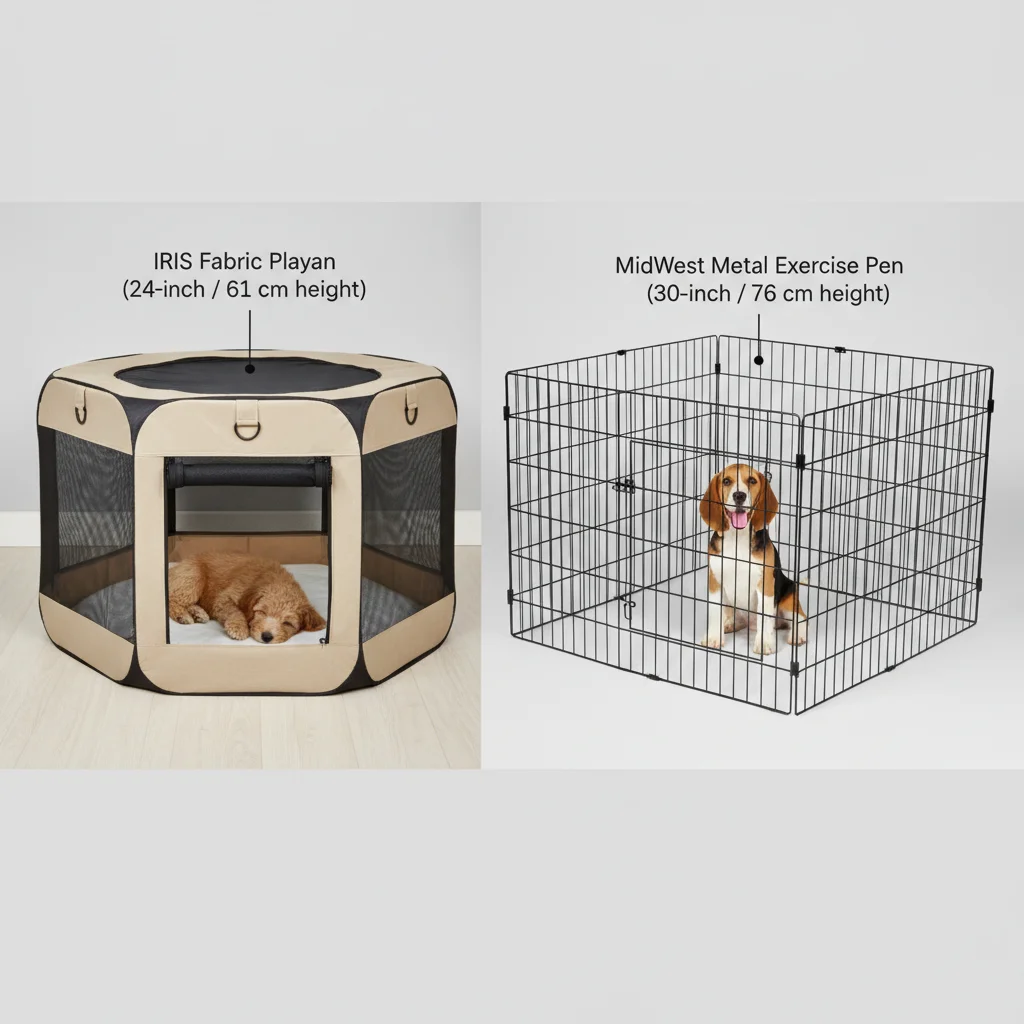
Buy IRIS when you need a quiet, packable indoor yard for a gentle puppy and you will be home enough to watch zippers. Buy MidWest when the job is months of daily containment under chewing, climbing, or jumping pressure. Treat “which brand is cuter” as a week-one question; treat chew and height as the month-three question.
SKU confusion is common. IRIS USA also sells plastic interlocking playpens that look nothing like the mesh yards Amazon shows next to MidWest wire pens. This comparison is the fabric/mesh IRIS play yard versus the MidWest Homes for Pets metal exercise pen. Mixing those families in one cart is how you get a product that does not match any review you read.
| Puppy / home profile | Better default | Why | Watch-outs |
|---|---|---|---|
| Gentle apartment pup, short supervised windows, closet storage | IRIS fabric play yard | Lighter, quieter, folds flat | Upgrade at first mesh nibble or zipper slip |
| Mouthy, teething, or “destroys fabric” puppy | MidWest metal ex-pen | Welded wire survives chewing that shreds mesh | Needs a mat, rubber feet, and enough height |
| Climber, jumper, or paw-flipper | Tall MidWest (match adult jump height) | Rigid walls do not compress when leaned on | Too-short metal still fails; pins must be fully seated |
| Travel weekends, hotel rooms, car trunks | IRIS (or a fold-flat metal kit if the dog chews) | Packability beats six-month durability | Never leave unsupervised in a fabric yard |
| House-training rectangle you reshape weekly | MidWest 8-panel kit plus extras | Panels reconfigure into a long zone layout | Fabric octagons often stay too square to zone-train |
Choose IRIS if…
Choose IRIS if the puppy is a light chewer, you live in a small apartment, and you tear the pen down most nights. Soft yards win when the constraint is closet space and neighbor noise, not a determined mouth. They also win as a stage tool for the first weeks while you decide whether this dog even accepts a pen.
IRIS is a poor forever buy if you already see mesh fray, pole sleeves tearing, or a zipper that only closes if you hold the track. Those are not “break-in” quirks. They are the start of an escape hole. For indoor footprints in tight rooms, the indoor apartment playpen guide covers layout before brand.
Choose MidWest if…
Choose MidWest if you expect three to six months of daily use, you need extra height as the puppy grows, or you want to add official panels instead of buying a second whole yard. Wire pens are louder and heavier. They are also the default for owners who already replaced a fabric yard once.
MidWest wins house-training geometry. An 8-panel kit can be a square in a listing photo or a long rectangle along a wall. That reshape is how you keep a potty pad far from a bed. Fabric yards can do a rectangle too, but they fight you with zipper corners and sagging walls.
When to buy neither and mix setups
Buy neither as a solo system if the puppy cannot settle, screams until it injures itself, or needs a crate for sleep. A playpen is containment and a training floor, not a den. Many working setups are MidWest for daytime zones and a crate for naps—not “one enclosure forever.”
Mixing brands in one ring is a bad idea. Connectors do not match. Overlapping an IRIS yard against MidWest panels creates a gap puppies exploit. If you keep both, use them as separate tools: IRIS for travel and visitor days, MidWest as the home footprint.
Build quality and chew durability
Durability is not “which feels nicer on day one.” It is what still holds at week ten when molars and boredom arrive together. Fabric fails at seams, zippers, and pole sleeves. Metal fails at latches, bent corners, and undersized height. Those are different failure clocks.
Do not treat Amazon “chew-proof” claims as a test. No consumer playpen is chew-proof if you leave a bored puppy unsupervised with the wall as the toy. The useful question is whether a nibble becomes a hole this week or just spit on powder coat.
Mesh, zippers, and poles on IRIS yards
IRIS fabric play yards use mesh walls, zipper doors, and fiberglass or similar poles in sleeves. That architecture is light. It is also a chew menu: mesh threads, zipper tape, and the fabric where the puppy leans. Once a hole exists, some puppies treat the wall like a puzzle toy.
- Mesh holes enlarge from one exploratory nibble into a head-sized exit
- Zipper tracks separate after repeated door cycles or when a puppy paws the pull
- Pole sleeves tear where the puppy bounces, then the wall sags and climb-outs get easy
- Attached floor mats get shredded and swallowed in strips
Patching with zip ties or a second cover buys days, not months. If chew pressure is already visible, stop spending on fabric repairs and move to wire. That is the honest IRIS playpen chew durability story for mouthy breeds.
Welded wire and powder coat on MidWest panels
MidWest exercise pens are welded-wire panels with a powder-coat finish, hinged into an 8-panel (or similar) folding kit. Mouthing leaves saliva and the occasional bent wire if a large puppy charges a corner. It does not usually open an exit the way mesh does.
Metal still fails. Horizontal rails teach climbing if the pen is short. Thin-gauge kits can bow. Powder coat chips on cheap copies more than on the name-brand panels, then rust shows in damp rooms. Buy the kit that lists height in inches and a door you can operate with one hand while holding a leash.
- Wire spacing should not let a puppy wedge a collar or jaw
- Panel pins must drop fully; half-set pins are an open hinge
- Floor gaps after a move are dig-outs waiting to happen
Three-to-six-month puppy chew timeline
Week one is sleepy. Month three is when returns spike. A fabric IRIS yard that looked perfect at eight weeks often dies between teething and the first confident jump. MidWest kits that were “too industrial” at eight weeks look correct when the puppy can see over a 24-inch wall.
| Failure mode (3–6 months) | IRIS fabric yard | MidWest metal ex-pen |
|---|---|---|
| Chew-through escape | Common on determined mouthers | Rare; mouthing does not open a hole |
| Climb or tip | Soft walls compress; lightweight frames tip | Climb if short; tip if unanchored on slick floors |
| Closure failure | Zippers and clips wear fast | Pins and slide-bolts last if fully seated |
| Replacement pattern | Often replace the whole yard | Keep panels; add height or extra sections |
Budget the timeline, not the unboxing. A cheaper IRIS yard plus a rush MidWest at month four is more expensive than a decent wire kit first. Gentle, small-breed puppies in apartments can still finish the IRIS stage without drama—if you watch the mesh like a smoke alarm.
Height, panel count, and escape risk
Both brands sell multiple heights—comparing default SKUs without matching panel inch counts is how shoppers buy a pen the puppy outgrows in six weeks. “Large” on an IRIS listing is not the same measurement as a MidWest 36-inch panel. Measure the wall the puppy will face at four months, not the sleepy eight-weeker in the crate photo.
Height math belongs in the height, panel, and latch buying guide. The brand fight only matters after you refuse to buy a 24-inch wall for a future jumper.
Matching SKUs by inch count
Write the number on a note before you open two tabs: 24, 30, 36, 42, or 48 inches for MidWest-style pens. Then find the IRIS yard’s stated wall height, not the floor footprint. A wide octagon with short walls is still a jump-out.
Match the adult (or adolescent) jump more than the current shoulder. Toy breeds can live in 24-inch walls longer. Athletic herding and terrier mixes often need 36 inches or more before you trust unsupervised minutes. If you cannot guess, buy taller and use extra panels to keep floor area, not a tall tiny cube.
Climbers vs diggers
Climbers use horizontal wires and sagging mesh as ladders. MidWest is more climbable than a blank fabric wall if the height is marginal, because rails give footholds. IRIS is more climbable if the wall compresses when the puppy stands on the rim. Diggers go under: gaps at thresholds, curled floor mats, and unweighted fabric bottoms.
- Climbers: raise height, remove nearby furniture as launch pads, stop using the pen as the only toy
- Diggers: full-coverage mat, no gap under the door, weight the corners
- Paw-flippers: latch type and gate orientation matter more than mesh color
A “more escape-proof” brand is the one whose failure mode you can actually fix. You can add MidWest height. You cannot make chewed IRIS mesh rigid again.
Adding panels without unstable geometry
MidWest kits are designed to add matching panels. Keep the same height and the same connector family. A 24-inch extra panel in a 36-inch ring is a step-stool. Too many panels in a floppy oval without corner bracing lets the ring collapse into a kidney shape a puppy can squeeze.
IRIS expansion is usually “buy a larger yard,” not mix-and-match poles from a different generation. If the zipper door is already the weak point, a bigger fabric ring still has the same zipper. Do not solve escape risk with more mesh.
Latches, gates, and collapse safety
Latch design differs more than marketing suggests: side-squeeze gates vs vertical pin latches change escape risk for climbers and paw-flippers. Photos show a closed door. They do not show a roommate who leaves a pin half-up or a zipper that looks shut until the puppy leans.
Collapse risk is real on both: an IRIS frame that loses a pole, and a MidWest ring that someone unclips to vacuum and forgets to re-pin. Neither is a crib. Do not put the pen where a falling panel can trap a puppy against furniture.
IRIS zipper and clip failure modes
IRIS doors are typically zipper-plus-clip. Zippers fail dirty, bent, or when the puppy learns to paw the pull. Dual zippers help only if both are closed and the extra clip is on. A single zipper with a decorative tie is not a lock.
- Close zippers fully, then add the backup clip every time
- Face the door away from the puppy’s favorite bounce wall
- Replace the yard when the track skips; do not “just be careful”
Side-squeeze or plastic clip gates on some fabric yards pop when a puppy hits them at speed. If your model uses those, treat them as a convenience latch for humans, not a containment latch for a charged-up adolescent.
MidWest vertical pin and slide-bolt quirks
MidWest panels join with vertical pins. The door often uses a slide-bolt or similar hardware. The failure is almost always human: pin not dropped, bolt not thrown, door hung so it swings into a high-traffic kick.
Paw-flippers work slide-bolts that sit too low or too loose. Mount and orient the door so the bolt is awkward for a paw and easy for you. After every clean, walk the ring and look down at every pin. A pen that “opened itself” usually had one unseated connector.
If you cannot tell from the doorway whether every pin is down, the layout is already unsafe for an unsupervised minute.
Gate orientation in tight rooms
In apartments, the gate should open into the room you stand in, not into a hallway you squeeze through with groceries. Kicked gates become unlatched gates. Give the door a swing path that does not hit a chair every time.
Do not put the gate in a corner the puppy can brace against. Corner pressure pops clips and teaches climbing. Center the door on a long wall when you can. Keep a walking path outside the panels so you are not constantly unclipping to pass.
Indoor floors, noise, and storage
This is where IRIS wins renters and MidWest wins people who keep the pen up for months. Hardwood, vinyl, and downstairs neighbors change the math as much as chewing does. A “better” pen that you hate deploying will sit in a closet while the puppy free-roams.
Both need a waterproof mat. Pee wicks under fabric floors and under metal feet. Finish damage is a lease problem, not a brand loyalty test.
Rubber feet and mat requirements
MidWest needs rubber feet or caps plus a mat that covers the entire footprint. Bare wire ends scratch. Caps without a mat still rattle. The mat should be large enough that the puppy cannot drag a panel onto bare finish.
IRIS is kinder to floors when the included mat stays flat and clean. Curled mats become dig toys. If the yard has a non-removable plush floor, skip it for house-training—odor lives there. A separate washable pad inside either brand is easier than pretending the wall material cleans itself.
Midwest exercise pen floor protection is not optional in rentals. Budget the mat in the same cart as the panels. IRIS still needs the same mat if you care about finish; it just starts quieter.
Fold-flat closet storage vs panel stacks
IRIS fold-flat storage is the apartment listing advantage. You can hide the yard after evening play. That habit also means you rebuild latches every day, which is when zippers get sloppy.
MidWest folds into a flat panel stack you stand in a closet or along a wall. It is heavier. You will not pack it nightly unless you have to. That is a feature for training: a stable footprint the puppy recognizes. It is a bug if you truly have no wall to park eight panels.
Neighbor noise on hardwood
Wire pens click, rattle, and ring when a puppy body-slams a panel. Fabric yards thud. Downstairs neighbors complain about the ring, not the thud. Rubber feet, a thick mat, and not placing the pen in the noisiest center of the room are the MidWest apartment kit.
If noise is the lease-limiting factor and the puppy is a gentle chewer, IRIS is the rational default. If chewing is already happening, do not keep a quiet fabric yard that fails containment to keep the peace. A mat-damped MidWest is still quieter than a puppy loose with a shoe.
Price, accessories, and long-term value
Upfront, IRIS fabric yards often look cheaper for a small footprint. MidWest kits cost more and then ask for feet, a mat, and maybe extra panels. Year-one cost includes the replacement you buy when the first choice was a stage tool you treated as permanent.
Shop current listings for height and panel count, not nostalgia for a SKU from two years ago. Accessory ecosystems change. The durable pattern does not: metal parts, extra panels, and floor protection beat a second fabric yard.
Replacement parts availability
MidWest-style pens are easier to keep alive: extra panels, replacement pins, feet, and doors exist as a category even when a specific colorway disappears. IRIS fabric yards are harder to repair at the zipper or mesh. You usually replace the unit.
Do not count on mixing a random Amazon “universal” panel into either brand. Wrong height or wrong pin diameter is an escape. Stick to the same family and the same height.
When IRIS is a short-stage tool
IRIS is a short-stage tool when you need containment this weekend, you travel, or you are still deciding whether this puppy accepts a pen at all. That is a valid purchase. It becomes a bad purchase when you insist the stage tool must survive adolescence because you already spent the money.
Set a kill criterion on day one: first mesh hole, first zipper skip you cannot reset, or first climb where the wall folds. Then you already know you are moving to MidWest, not debating in the comments of a listing.
Total cost if you need both over year one
Many households end up with both: IRIS in the car, MidWest at home. That can be cheaper than two failed fabric yards plus emergency overnight shipping on a wire kit. It is more expensive than buying MidWest first if you already knew the puppy was a chewer.
| Year-one scenario | Likely cheaper path | Why |
|---|---|---|
| Gentle toy breed, apartment, nightly teardown | IRIS plus a good mat | You use the fold-flat feature; chew risk stays low |
| Medium mouthy puppy, pen up most days | MidWest first | Avoids a dead fabric yard at month three |
| Travel plus home containment | MidWest at home, IRIS for trips (if chew is mild) | Two jobs, two tools; skip hybrid rings |
| Unknown chew + tight budget | Used or basic MidWest 8-panel, correct height | Resale value beats a shredded yard |
Accessories that actually matter: a waterproof mat, rubber feet for metal, a door you will latch, and enough panels for a rectangle. Cute hammocks and hanging toys that turn the wall into a climbing gym do not matter. If you need house-training zones, buy floor area and height before you buy a brand story.
Frequently Asked Questions
Is IRIS or MidWest better for puppies?
IRIS soft play yards work best for gentle chewers who need fold-flat storage and short indoor containment. MidWest metal exercise pens fit puppies who chew mesh, climb, or need months of daily use. Many owners start with IRIS for portability, then switch to MidWest when teeth and jumping show up—plan for that instead of treating either as a forever pen.
Which is more escape-proof, IRIS or MidWest?
MidWest metal panels generally hold climbers and paw-flippers better when height and latch orientation are correct. IRIS yards fail escape tests when zippers, mesh, or flexible poles give way to chewing or leaning. Escape-proofing still depends on buying enough height and anchoring corners—not brand alone.
Can IRIS and MidWest panels connect together?
Usually no—connector styles and wire spacing differ. Some owners place pens adjacent with overlap barriers, but mixed-brand modular builds are unreliable for escape artists. Pick one system and add official extension panels rather than improvising hybrids.
Which brand is better for apartment hardwood floors?
IRIS is lighter and often quieter on mats but less chew-proof. MidWest needs rubber feet and a full-coverage mat to protect finish and reduce rattle. For renters, IRIS wins storage; for chewers, MidWest wins durability even if it needs more damping.
How do IRIS and MidWest prices compare in 2026?
IRIS soft yards often cost less upfront for small footprints; MidWest metal kits cost more but survive longer with chewers. Factor replacement yards, extra panels, and floor mats into year-one cost—cheapest first buy is not cheapest if you replace it at month four.
Your next step
Write down the puppy’s likely jump height at four months and whether you have already seen mesh chewing. If the answer is “chews or jumps,” start with a MidWest-style metal kit at the matching inch count, a full mat, and rubber feet. If the answer is “gentle, fold-flat, I am home,” IRIS is a fair first yard—with a kill switch the first time a zipper or hole appears.
Do not connect the two brands into one ring. Do not buy a default height because the listing photo looked roomy. Measure inches, latch the door every time, and treat the pen as a stage that can change when the puppy does.
Related reading on our sister sites: Pet Camera Night Vision Comparison: