Shopping for the best gps dog tracker usually starts after a scare: an open gate, a bolt at the trailhead, or a “he never leaves the yard” dog who suddenly did. Hardware ads promise live maps and peace of mind. What they bury is the technology split that actually decides whether that map works where you walk.
Rank GPS dog trackers by technology type first—cellular LTE, off-grid radio, or Bluetooth—before comparing brand marketing claims. An LTE collar that thrives in a suburb can go silent in a canyon. A Garmin handheld kit that shines off-grid is overkill—and overpriced—for a fenced lot with solid cell coverage. A $30 tag is not a GPS collar.
Include a 3-year total cost of ownership for every LTE pick so membership tiers matter as much as the collar sticker price. This listicle ranks by category fit, escape-alert usefulness, battery under live track, and multi-year membership math—not by who bought the loudest influencer placement.
How we ranked GPS dog trackers in 2026
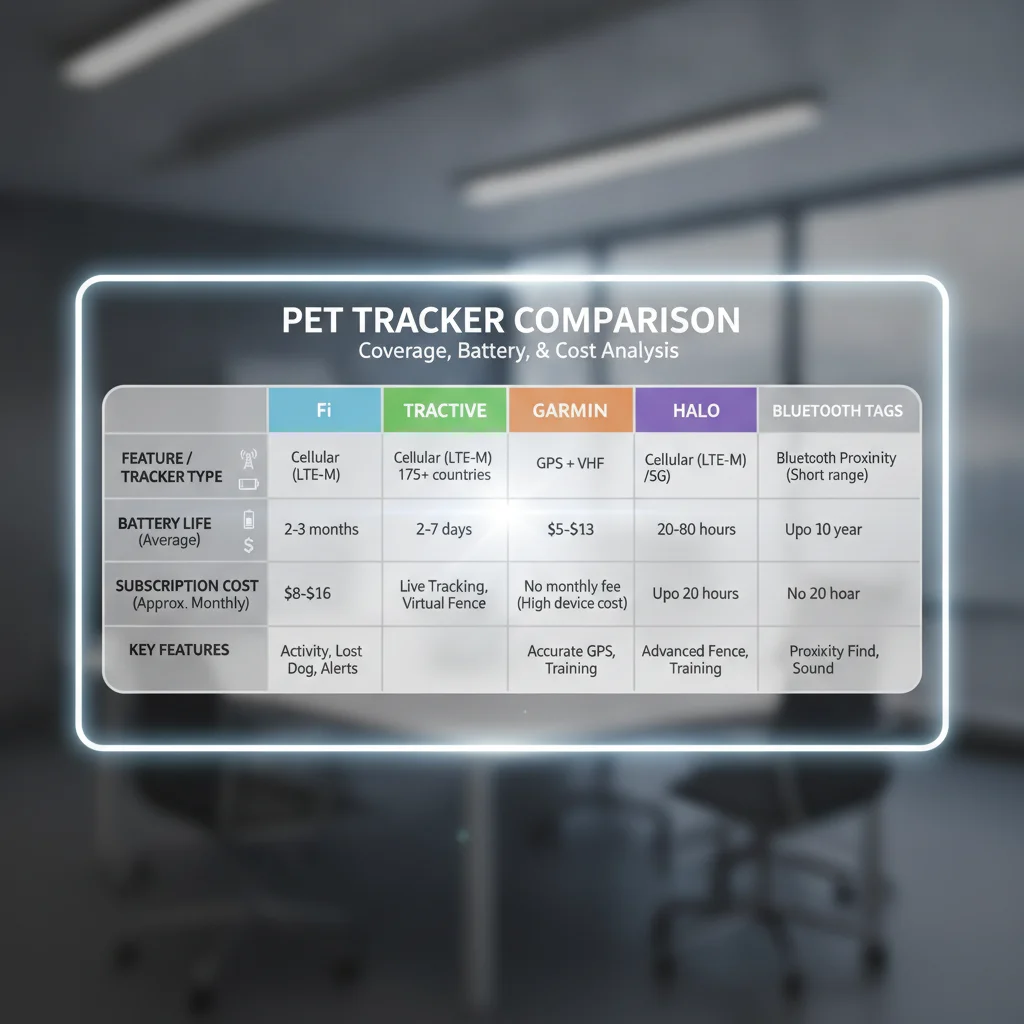
We scored candidates as a best gps tracker for dogs 2026 shortlist only when the product clearly belongs to one of three buckets:
- Cellular LTE collars — phone app + live map when the dog has cell coverage (Fi, Tractive, and similar).
- Off-grid radio / hybrid systems — handheld + collar that can work without phone towers (Garmin Alpha / Astro class).
- Bluetooth / crowd-find tags — AirTag, SmartTag, and clones. Useful backups, not primary escape tools.
Products that blur those lines in marketing without explaining coverage limits ranked lower. “GPS” on a listing is not the same as live cellular tracking, and Bluetooth proximity is not wilderness recovery.
Cellular vs off-grid vs Bluetooth taxonomy
Cellular LTE trackers stream location through carrier networks. Strengths: live phone maps, escape geofences, activity histories. Weaknesses: dead zones, roaming fees or hard geographic limits, and membership renewals that dwarf the collar price over three years.
Off-grid systems trade the always-on phone map for radio links between a handheld and the collar. Strengths: forests, canyons, hunting grounds, and hiking routes where LTE fails. Weaknesses: higher hardware cost, a learning curve, and less “open the app on the couch” convenience.
Bluetooth tags ping nearby phones in a crowd network. Strengths: cheap, light, no monthly fee. Weaknesses: no live chase map when the dog leaves crowd density. An AirTag or SmartTag is a backup finder, not a primary GPS dog tracker for escape recovery beyond crowd-find range.
Escape-alert latency scenarios
We care more about “how fast you know they left” than idle-battery marketing. Useful scenarios to pressure-test any best dog gps collar claim:
- Suburban bolt — dog leaves a geofence while you are indoors; seconds matter more than meter-perfect trails.
- Trailhead scatter — dog runs into brush with intermittent LTE; live track drain and reconnect behavior matter.
- True dead zone — canyon or deep forest with no cell; only off-grid radio (or a backup plan) still works.
Brand pages rarely publish timed escape tests with reproducible steps. Treat “instant alerts” as a claim until you verify notification permissions, geofence size, and how the collar behaves when signal flickers.
3-year subscription TCO weight
LTE memberships are the real product. A collar that looks affordable at checkout can cost more than a Garmin kit after two renewals. We weighted gps dog collar subscription cost heavily: monthly vs annual tiers, multi-dog discounts, and what features disappear if you cancel.
| Category | Typical hardware | Ongoing cost pattern | Best when |
|---|---|---|---|
| LTE collar (Fi / Tractive class) | Mid | Membership required for live tracking | Reliable cell coverage at home and walks |
| Off-grid Garmin class | High | Often lower/no monthly for core radio tracking | Wilderness, hunting, hiking dead zones |
| Bluetooth tag | Low | Usually none | Backup ID / dense urban crowd-find only |
| Fence + GPS hybrids (Halo class) | Mid–high | Membership often tied to fence + track features | You want virtual fence and tracking in one system |
Exact dollar rows change with promos. Rebuild the math with your plan before you buy: (collar + mounts + spare battery if needed) + (36 × monthly) or (3 × annual), then subtract multi-dog discounts. If a brand will not show renewals clearly, assume the expensive tier.
Best overall LTE: Fi Series 3
For most US suburban and urban owners who want a live map after an escape, Fi Series 3 is our default lte dog tracker pick. It earns “best overall” here for polished live tracking, escape-oriented alerts, and a membership model that is easy to understand—even when the bill still stings over three years.
Live tracking strengths
Fi’s value is the chase experience when coverage holds: open the app, see the dog move, tighten the search instead of walking random blocks. That matters after a gate left ajar more than a weekly sleep-score chart does.
Geofence and escape alerts are only as good as your setup. Draw a fence that matches how your dog actually uses the yard—not a tiny circle that false-alarms every squirrel sprint, and not a huge blob that notifies you after they are already two streets away.
Battery marketing usually quotes idle or low-update modes. Ask what happens under live track. Owners who leave live mode on for an hour-long search learn the honest number the hard way. Charge habits beat brochure days.
US coverage limits
Fi is a US-first product decision. If you regularly travel abroad with your dog, do not buy Fi hoping roaming will “just work” like a phone plan brochure. That is the clearest Fi vs Tractive fork in this niche: domestic live tracking strength versus international roaming breadth.
Inside the US, still walk your real routes mentally: river bottoms, parking garages, metal barns, and rural dead pockets can drop updates. An LTE collar is not magic; it is a radio that needs a network.
Membership tiers that matter
Price the membership you will actually keep—not the intro screen. Confirm whether live tracking, location history depth, and multi-dog pricing sit on the tier you planned to buy. Cancel-to-save strategies that brick the tracker’s core job are not savings.
For multi-dog homes, run TCO per dog. Discounts help, but two collars and two memberships still dominate the three-year spreadsheet. If only one dog is an escape artist, tracker the flight risk first and use cheaper ID backups on the homebody.
Who should skip Fi: wilderness hikers with chronic no-bar trails, international travelers, and shoppers unwilling to fund membership for the life of the collar.
Best for travel: Tractive DOG 6
Tractive DOG 6 is the travel pick when your dog’s life is not limited to one country’s cell footprint. If “best gps tracker for dogs 2026” for you includes flights, long road trips, or months abroad, roaming reality outranks US-app polish.
International roaming
Tractive’s headline advantage is broad country coverage for live tracking while traveling. That is the practical answer to owners who tried a US-centric collar and discovered the map dies at the border.
Still verify the countries on your itinerary, not a marketing total. Coverage lists change, and rural regions abroad have the same dead-zone physics as rural regions at home. Roaming breadth does not invent towers.
Battery under live track
Same rule as Fi: ignore idle-day brag numbers until you know live-track drain. On vacation, you may run live mode longer—unfamiliar streets, jet-lagged attention, higher panic if a dog slips a hotel courtyard.
Pack the charger like a leash. A dead LTE collar is jewelry. If your trip includes long off-leash wilderness days without charging access, pair or replace with an off-grid plan instead of hoping the percentage holds.
App alert quirks
Every tracker app has notification quirks: OS permission prompts, battery optimization killing background refresh, geofences that need redrawing after a move. Before you trust Tractive on day one of a trip, run a controlled “leave the fence” test at home and confirm the alert hits the phone you will carry.
Also decide what “good enough” location history means for you. Some owners want tight breadcrumbs; others only need last-known plus live chase. Buy the membership tier that matches how you actually search—not every toggle in the feature list.
Who should skip Tractive: owners who never leave strong domestic coverage and prefer Fi’s ecosystem, and hikers who need collar-to-handheld radio when there is no cell anywhere.
Best off-grid: Garmin Alpha LTE / Astro class
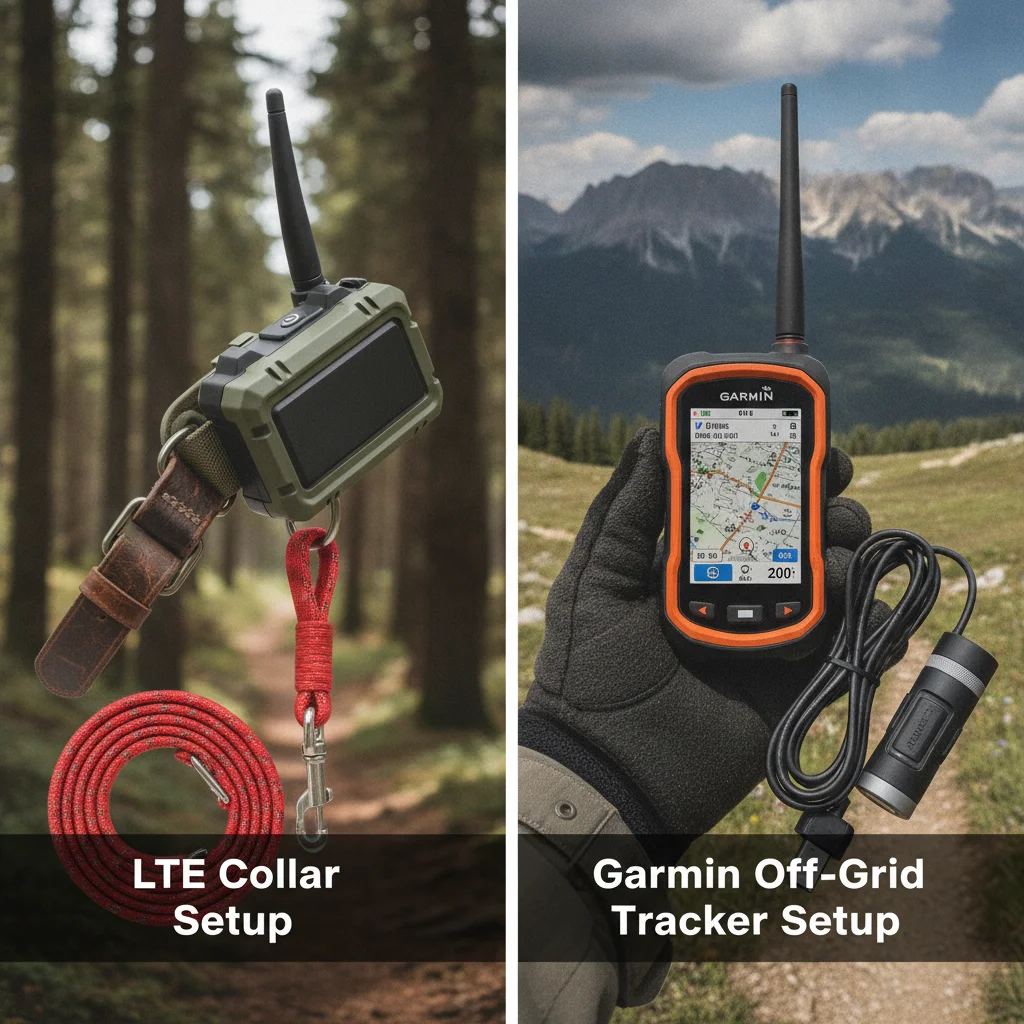
If your dog works or plays where phones show zero bars, the best dog tracker for hiking is not another LTE collar with optimistic marketing. Garmin Alpha LTE / Astro-class setups exist for no-cell wilderness, hunting, and long backcountry days where a phone map cannot be the only plan.
No-cell wilderness use
Off-grid systems keep a link between a handheld and the dog’s collar when cellular networks disappear. That is a different product category than Fi or Tractive, even when a Garmin SKU also mentions LTE features for hybrid use.
Which tracker works with no cell signal? Garmin-style off-grid systems. LTE collars can fail in wilderness dead zones. If your trail photos are full of “no service” screenshots, stop comparing app icons and start comparing handheld workflows.
Training matters. A tool you only power on after a disaster is a tool you will fumble. Practice marking, tracking, and swapping batteries on a calm day.
Hardware cost vs membership
Garmin-class kits often look expensive at checkout and cheaper across three years if you are not paying LTE memberships for features you cannot use off-grid anyway. Flip that math if you mostly walk suburban sidewalks—then you bought wilderness hardware for neighborhood jobs.
Budget for the full kit: collar, handheld, charging, mounts, and any mapping subscriptions that apply to your exact model line. “Dog GPS tracker no subscription” searches often lead here—or to Bluetooth tags—but those two answers are not interchangeable.
Who should skip Garmin
Skip it if you want one light collar and a phone-only workflow for city escapes. Skip it if you will not carry a handheld. Skip it if your dog’s risk profile is “slipped the patio gate” rather than “vanished into national forest.”
Hybrid shoppers sometimes want LTE for town and radio for trails. That can be valid—just be honest about complexity and cost. Two systems (LTE collar for home + off-grid for hunt season) can be clearer than one compromised device.
Budget and Bluetooth caveats
Budget shelves are crowded with tags marketed like GPS collars. Some are honest Bluetooth finders. Others borrow “GPS” language until you read the fine print.
AirTag / SmartTag limits
Apple AirTags and Samsung SmartTags help when someone else’s phone walks past your lost dog in a dense area. They do not give you a live chase map across empty farmland. Can an AirTag replace a GPS collar? No for escape recovery beyond crowd-find range. Use it as a backup, not a primary GPS tracker.
Put durable holders on properly. A tag that falls off in brush teaches the wrong lesson: you track the collar accessory, not the dog.
When a $30 tag is enough
A cheap tag can be enough as secondary ID for a dog who is microchipped, supervised, and not a chronic escape artist—especially in dense urban neighborhoods. It is also a sane add-on clipped beside a real LTE collar.
It is not enough as the only plan for a door-dasher, a fence climber, or a trail dog who can cover miles before you notice.
False GPS marketing
Read listings for: cellular plan requirements, whether live tracking needs a membership, update frequency under motion, waterproof ratings that match swimming dogs, and collar weight for small necks. Cellular vs Bluetooth dog tracker confusion is how shoppers burn a return window.
Halo-style fence + GPS hybrids deserve a separate evaluation if virtual fencing is your main goal. Do not assume a fence collar automatically wins a pure tracking shortlist—or that a tracker collar replaces training and physical fencing.
Quick picks by dog and terrain
Use this as a decision tree, then verify coverage on your routes.
| Situation | First pick direction | Avoid |
|---|---|---|
| Suburban escape artists (US) | Fi Series 3-class LTE | Bluetooth-only as primary |
| International travel / roaming | Tractive DOG 6-class LTE | US-only membership assumptions |
| Hiking / hunting dead zones | Garmin Alpha / Astro class | Phone-only LTE as sole tool |
| Small dogs / puppies | Light LTE mini SKUs + fit check | Heavy hunting collars |
| Backup ID only | AirTag / SmartTag | Calling it a GPS tracker |
Suburban escape artists
Prioritize geofence alerts, reliable LTE at home, and a membership you will keep funded. Practice a family response plan: who grabs the phone, who checks the road, who calls neighbors. Technology is slower than a rehearsed thirty seconds.
Hikers
Match the tool to the trail’s cell reality. Popular state-park loops with bars can use LTE; ridge lines and canyons lean Garmin-class. The best gps dog tracker for hiking is the one that still reports when your phone does not.
Small dogs
Collar bulk and weight matter. A tracker that is fine on a Lab can torque a terrier’s neck or encourage pawing. Look at mini SKUs, strap width, and how the pack sits when the dog shakes dry. Best gps tracker for small dogs is a fit decision as much as a feature decision.
Puppies grow. Adjustable straps help; chewing charge ports is a real failure mode—supervise early wear.
Multi-dog homes
Tracker the flight risk first. Price multi-dog memberships honestly. Identical collars for every dog look tidy on Instagram and waste money if only one animal leaves the property.
Frequently Asked Questions
Do GPS dog trackers need a subscription?
Most LTE collars do. Garmin off-grid kits and Bluetooth tags often avoid monthly fees but trade live phone maps or range.
Is Fi better than Tractive?
Fi is strong for US live tracking; Tractive usually wins for international travel. Compare coverage where you walk, not ads.
Can an AirTag replace a GPS collar?
No for escape recovery beyond crowd-find range. Use it as a backup, not a primary GPS tracker.
Which tracker works with no cell signal?
Garmin-style off-grid systems. LTE collars can fail in wilderness dead zones.
What matters more than battery claims?
Battery under live tracking, alert latency, and 2–3 year membership cost usually matter more than idle-day ratings.
Your Next Step
Pick the technology bucket first, then the brand. If you have solid US cell coverage and a door-bolter, start with Fi-class LTE and price three years of membership. If you cross borders, start with Tractive-class roaming. If your trails show no service, start with Garmin-class off-grid and train the handheld before you need it.
Include a 3-year total cost of ownership for every LTE pick so membership tiers matter as much as the collar sticker price. Add a Bluetooth tag only as backup ID. For deeper model-by-model tradeoffs, use the sibling Fi vs Tractive vs Garmin comparison and the cellular vs off-grid buying guide once those drafts are live—keep this page as your category shortlist for the best gps dog tracker decision in 2026. While those GPS siblings finish, our live home-gear pilots cover mealtime gear: best elevated dog bowls 2026 and elevated bowl vs slow feeder.
Related reading on our sister sites: Best Orthopedic Dog Bed for