Shoppers running a slow feeder vs puzzle feeder search usually already own a bowl that empties in seconds—and Amazon parks lick mats in the same aisle as if they were the same tool.
Searchers mix slow feeder, puzzle, and lick mat as synonyms; matching SERP format means a side-by-side table, not a product roundup. Gulping, boredom, and wet food are three jobs. One SKU almost never does all three well on hardwood in a small kitchen.
This is a meal-hardware comparison for apartment dogs, not a veterinary behavior plan and not a substitute for walks. If breakfast already triggers staring or fights, separate the dogs first with a playpen versus crate for house training setup, then pick the feeder.
What each tool actually solves (gulping, boredom, wet food)
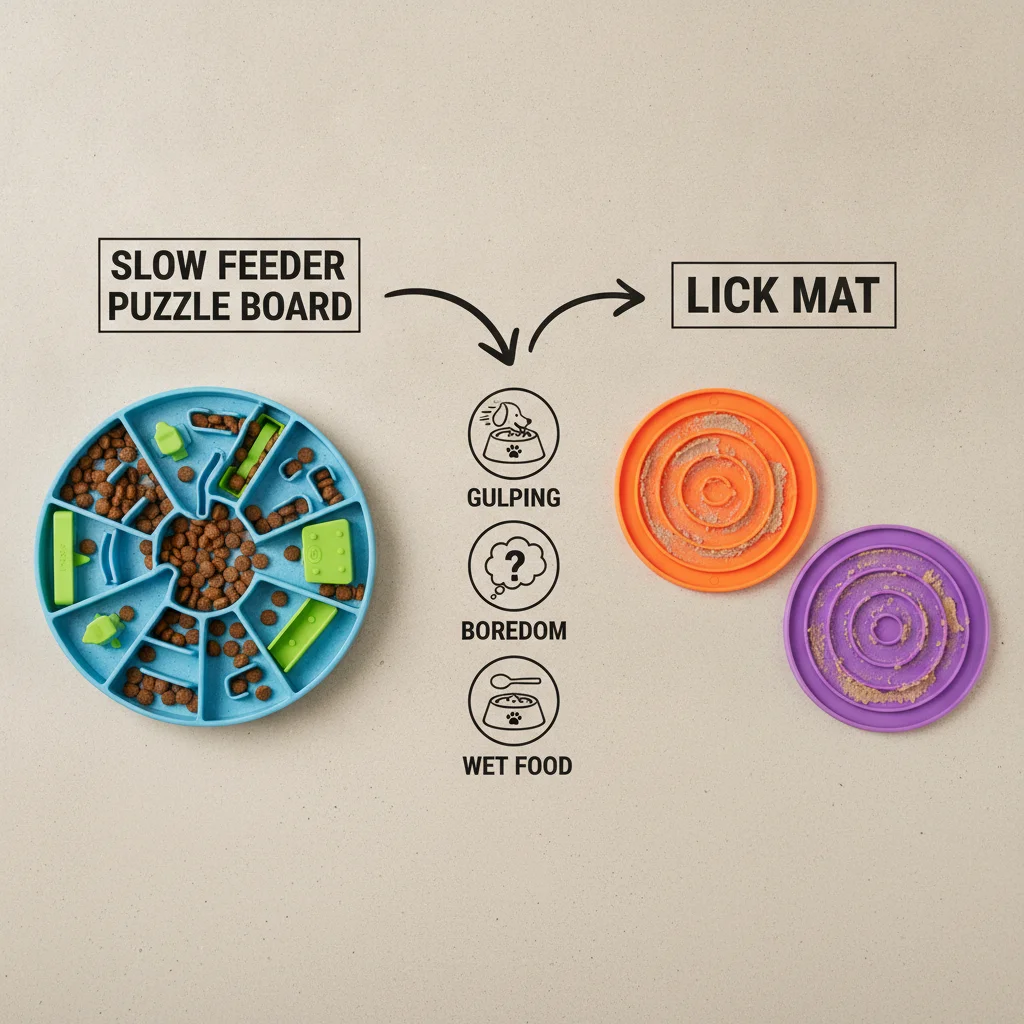
Gulpers who inhale kibble need a slow bowl first; bored dogs who finish and pace need foraging hardware—not the same SKU. Watch the first ten seconds after the dish hits the floor. Face-down vacuum with no pause is a speed problem. A dog that finishes, then paces, vocalizes, or dismantles shoes is a duration problem.
Wet food is a third problem. Pâté in a slider track is not “enrichment.” It is a smell you will still find at noon in a galley kitchen. Match the ration to a surface you can rinse in two minutes, or you will skip the wash and retire the toy.
| Job | Start with | What it is not | Apartment tell |
|---|---|---|---|
| Stops inhaling dry kibble | Ridged or maze slow-feeder bowl on a mat | A cognitive board or a frozen smear | Quiet; grooves still need a brush if you add wet food |
| Occupies a bored finisher | Level 2–3 slider puzzle on a mat, pattern changes | Another identical bowl with deeper ridges | Daytime if it slides or rattles |
| Wet, fresh, or mixed rations | Thick silicone lick mat; freeze for duration | Layered composite sliders | Quietest 6 a.m. option; rinse the same morning |
| Scent work without kibble bounce | Snuffle mat or towel forage for a measured scatter | A breakfast bowl replacement for wet food | Needs a washable mat; skip if the dog eats fabric |
Slow feeders for speed eaters
A slow feeder is a bowl with obstacles. Ridges, spirals, and maze walls force the muzzle to work around food that would otherwise vanish in a swallow. Fun Feeder-class grooves are the common apartment pick because they sit still, they are quiet, and they do not scatter kibble across tile if you do not overfill.
That is gulp control, not foraging. The dog still eats from a dish. Meal length might move from 30 seconds to two or three minutes. A bored apartment dog will still pace after that. If you mainly needed height for a large dog’s neck, that is a different split—read elevated bowl versus slow feeder before you buy a raised maze that does not add thinking time.
Use a slow bowl when:
- The dog inhales kibble and then looks for more food in the same spot.
- You hear retching, coughing, or “empty too fast” after dry meals.
- You need a 6 a.m. tool that will not skate into a shared wall.
Skip a slow bowl as your only device when the dog finishes, then hunts shoes. Ridges did their job. The brain is still unemployed.
Puzzle boards for foraging time
A puzzle feeder adds manipulation: sliders, lids, bottles, wobble chambers. The meal lasts because the dog has to move parts, not because the kibble sits in a groove. Nina-style composite boards are the usual example. They occupy a smart dog that mapped a slow bowl in two days.
They also move. On hardwood that motion is the review. Rubber feet polish smooth. Kibble bounces out of spinning layers. A board that looks clever on carpet can travel a dinner-plate width on vinyl before you finish coffee.
Use a puzzle when the dog finishes a bowl (even a slow one) and then paces, vocalizes, or dismantles the apartment. Do not use a hard puzzle as the first tool for a vacuum-mouth gulper. Frustration plus speed is how boards flip and sliders get chewed.
Lick mats and snuffle mats for scent work
A lick mat is a textured silicone slab you smear. It is quiet. It does not skate like a hard board. You can freeze a measured wet ration and buy back 5–15 minutes without kibble percussion. It is not a Nina-style puzzle. Treat it as the wet-food and calm-down half of the system.
A snuffle mat hides dry kibble in fleece. It is scent work, not a bowl. It can stretch a dry meal without plastic sliders. It fails as a wet-food tool, and some dogs eat the fabric. Wash it, or it becomes a sour rug in a studio.
If breakfast is pâté, fresh, or mixed, start here even if the dog is “smart.” Composite sliders plus fat is the apartment smell trap listicles skip.
Pick the failure mode you saw this week—gulp, pace, or smear—then buy that surface. Category names on Amazon are not jobs.
Side-by-side: cleanup, noise, and apartment fit
Hard floors amplify three sounds: kibble bounce, the device sliding, and hollow plastic ringing when a paw hits it. Carpet product videos hide all three. Your lease does not. Phone-meter scores are a neighbor check, not a lab certificate. Stand about one meter away and listen for lick versus percussion.
Wet-food apartments should default to lick mats and wide rubber; composite puzzle sliders are a smell and wash-time trap on galley counters. There is often one sink and no yard hose. A toy that needs a bottle brush and a 40-minute soak will sit in the dish rack and perfume the room.
Hardwood bounce and early-morning meals
Early-morning sliding kibble is the usual complaint. A spinning layer or a wobble toy that dumps pieces onto tile reads as play in a video and as a broom job plus a tap on the ceiling. If you would not run it at 6 a.m., it is not a weekday breakfast tool.
- Quiet enough for 6 a.m.: frozen lick mat, stuffed rubber on a towel, grooved slow bowl on a mat.
- Daytime only: composite slider boards, bottle games, anything with loose parts.
- Ban for thin-wall buildings: treat balls, rolling tumblers, spinning “tornado” layers used as feeders.
A yoga mat, rubber sink liner, or towel over a non-slip pad kills most travel. Rubber feet on boards help until they polish smooth; the mat is the real fix. Placement still matters: interior wall, not the party wall. For the full neighbor protocol on hard floors, use the apartment puzzle meal protocol as the ops companion to this comparison.
Dishwasher-safe parts vs hand-wash grooves
Top-rack logos do not clean the underside of a sliding bone. Fat packs overlapping layers. You cannot see the grease, and you will smell it. Rinse kibble boards the same morning you use them. Keep wet rations off those tracks.
Time yourself once:
- Under two minutes: silicone lick mat rinsed and stood on edge; wide-mouth rubber stuffable; most slow bowls with a dedicated brush.
- Five-plus minutes: Nina-style boards with sliders, Trixie bottles, lid stacks.
- Fail: you skip a wash and the toy still smells at the next meal.
Slow bowls are not automatic wins for wet food. Groove fat behaves like puzzle-track fat. For warping, wobble, and dish-rack wear on raised slow bowls, the slow-feeder wash and wobble after 90 days notes are the closer long-term check.
Footprint on a small kitchen mat
A wide strategy board needs a yoga-mat rectangle so it cannot skate into the kickplate. A wobble toy needs a low-lip tray unless you like kibble in the heating vent. A lick mat hangs on the dish rack. A slow bowl lives where the old bowl lived.
Counter storage is part of apartment fit. If the device does not air-dry without occupying the only drying space, you will use it less. That is how expensive boards become cabinet clutter while the $15 mat stays in rotation.
| Spec | Slow feeder bowl | Puzzle board | Lick mat |
|---|---|---|---|
| 6 a.m. on hardwood | Usually pass on a mat | Often fail if it slides or rattles | Pass; licking is quiet |
| Wet-food wash | Brush the grooves or skip wet food | Poor; tracks trap fat | Best; rinse and stand to dry |
| Floor footprint | Bowl-sized | Wide rectangle plus mat | Flat; stores on edge |
| Primary job | Slow the gulp | Add foraging steps | Smear, freeze, scent, calm |
Difficulty and frustration: when puzzles backfire
Smart apartment dogs burn through easy layouts fast. The dog did not “get bored of enrichment.” The dog mapped a single pattern. Buying a harder chew is how you get shards. Duration comes from freezing, empty wells, and a second device.
A frustrated gulper on a hard puzzle can guard, flip the board, or swallow plastic. Slow the swallow first. Then add an easy puzzle on a mat. Do not skip the bowl step because a listicle called every toy a puzzle.
90-second finishes on Level 3 boards
Numbered difficulty is a starting point, not an IQ score. Level 1 is snuffle-adjacent sliding. Level 2–3 is weekday kibble for most food-motivated dogs. Level 4 and spinning layers scatter more and rattle more. A Level 3 board used the same way twice a day is empty by Friday.
If the meal is over before you finish the kettle, the puzzle is a bowl with extra parts. Change the pattern before you buy the next listing. Leave some wells empty. Swap slider positions. Split the ration: half in the board, half on a frozen mat.
Progression ladder before you buy harder SKUs
Change one variable at a time:
- Layout: empty wells, new slider order, food under a different lid.
- Split: slow bowl for gulp control, then a short puzzle for the rest—or the reverse only if the dog panics when food disappears into sliders.
- Freeze: lick mat or stuffed rubber for duration without a harder plastic wall.
- New mechanic: a bottle game or stuffable only after the current board lasts several minutes.
Do not escalate chew toughness to add time. A thicker marketing claim is not a training plan. If the dog lifts the board and chews the rim, that SKU is the wrong class, not the wrong “level.”
Signs to drop back to a slow bowl
Watch for paw-slamming that flips the board, frantic biting of sliders, vocalizing that is not a polite request, or walking away from a still-full device. Those are not “more difficulty.” Drop a level, smear a starter layer so the dog gets a win, or switch that meal to a lick mat or slow bowl.
Gulping that returns when you add a puzzle is a signal the dog is frantic, not clever. Put the maze bowl back. Keep the puzzle for a calm afternoon session. Many dogs need both devices on a weekday, not a compromise SKU that does neither job.
If the board makes the dog frantic, you did not buy the wrong brand. You skipped the gulp step or jumped a level.
Multi-dog and guarding around enriched meals
Food on the floor between two dogs is a conflict machine. Puzzles make it worse because the food lasts longer and moves. Slow bowls last longer than a steel dish too. If either dog stiffens, eats faster when the other approaches, or blocks the station, you have a management problem. Hardware will not treat it.
This is not a diagnosis. It is a layout rule. Separate first. Add enrichment second.
Separated stations and visual barriers
Feed in crates, behind baby gates, or in a bathroom with the door cracked so you can listen. Start with ordinary bowls in those spaces. Add slow bowls, then puzzles, only when both dogs can finish without staring through the gap.
In a studio, an indoor playpen for apartments can hold one dog’s station while the other eats in a crate. Keep water outside the food zone so you are not stacking resources in one rectangle.
Why two slow bowls beat one shared puzzle
Shared “take turns” on one board is a human game. Dogs read it as a contested object. Two identical cheap slow bowls in two rooms beat one premium puzzle in the hallway. Two lick mats in two rooms beat one frozen mat in the kitchen doorway.
- Green: each dog already eats in a separate space without hovering.
- Yellow: one dog finishes and immediately goes to the other’s station—add a door, not a harder puzzle.
- Red: growling, body blocking, or stolen food—back to separated bowls; get qualified behavior help if it escalates.
Crate or pen setups for breakfast
Crate meals are the default for dual-dog apartments, not a last resort. A slow bowl inside a crate is quiet and contained. A puzzle inside a crate only works if the board fits without becoming a chew against the bars. Many boards are too wide. Then the crate gets the slow bowl, and the puzzle waits for a gated room later in the day.
Supervise the first week of any new feeder even with one dog. In a studio, “unsupervised puzzle” often means the board is next to the couch. That is still supervision. Closed-door plus a power chewer is how sliders become foreign bodies.
Cost and replacement: 12-month reality by type
Amazon rankings hide replacement cost. A $28 composite board that lasts six weeks of dual duty (kibble plus rim chewing) is more expensive than a $15–20 thick lick mat that lasts a year of smeared wet food. Count the year, not the checkout.
There is no honest “indestructible puzzle” for a power chewer in an apartment. Supervised rubber and frozen lickables last longer than hollow sliders. Retire at first crack. Composite splinters are a GI foreign-body risk, not a badge of a smart dog.
Chewed rubber mats vs cracked composite sliders
Thick silicone usually fails at suction cups or torn nubs, not as sharp shards. Cheap thin mats tear in a week. Buy thickness. Stand them to dry so they do not stay sour under plates.
Composite “wood look” boards dent and split at slider tracks when a dog lifts the toy to chew the edge. Food-grade rubber stuffables flex. They still need replacement when the rim is shredded, but they do not explode into slider pieces on a kitchen floor.
Slow bowls crack at thin maze walls and warp in high-heat dishwashers. A simple ridged bowl with a replaceable insert, if the brand sells one, beats a one-piece maze you throw away when a wall snaps.
When a $15 mat outlasts a $45 board
The mat wins when you feed wet food daily, when you need 6 a.m. quiet, and when the dog’s hobby is dismantling edges. The board wins when dry kibble is the ration, you will rinse the same morning, and the dog uses a nose—not molars—on the sliders.
A $45 board can still be the right buy for a gentle, food-motivated dog that needs foraging time. It is the wrong buy as a chew toy, a wet-food plate, or an unsupervised 6 a.m. roller. Budget clones that copy the silhouette and skip slider tolerance usually fail before month three.
Link to durability long-term review
Brand-level wear (which lids warp, which sliders crack, which rubber smells) belongs on the buying guide, not in a three-way decision tree. Use the apartment puzzle feeder shortlist when you already know you need a board and want noise, chew-through, and wash notes by SKU.
If you are still choosing among a bowl, a board, and a mat, stay on this page. Buying three devices “to be safe” is how galley counters fill with sour plastic. Buy the job you have this month. Add the second device when the first job is stable.
Decision tree and links to apartment puzzle guides
Walk the tree in order. Do not skip to the clever toy.
If you gullet—start here
If the dog inhales kibble, start with a dishwasher-safer slow bowl on a mat. Time three breakfasts. If gulp speed drops and the dog does not then pace, you may not need a puzzle at all. If gulp speed drops and pacing starts, keep the bowl and add an easy puzzle or a frozen mat for part of the ration.
Do not put a gulper on a Level 3 board as the first change. You will see flipping, guarding, or a 90-second rage-finish. The bowl is the first door. The board is the second.
If you need quiet enrichment—start here
If the constraint is neighbors, not IQ, start with a lick mat or a slow bowl. Frozen smears and licking are the quietest minutes you can buy. Add a slider board only for daytime dry kibble on a mat, after you have listened at one meter.
If the ration is wet, stay on silicone or wide rubber. If the ration is dry and the dog is bored, a board can be the afternoon tool. If the dog destroys plastic, skip hollow sliders and use supervised rubber plus walks. A harder listing will not fix panic when you leave.
Internal links to buying guide and apartment protocol
Once the tree says “puzzle,” stop comparing categories and start comparing boards. The shortlist is the apartment puzzle feeder shortlist. Once you own a board, run it like an operation: mat, hour, wash, and multi-dog layout live on the apartment puzzle meal protocol.
Default weekday pair for one non-destroyer on hard floors: slow bowl or matted slider for dinner kibble, lick mat for breakfast wet food. Swap in stuffed rubber when you need a smaller footprint. Keep rollers off lease-sensitive hours.
Your next step is one protocol, not a cart of eight toys. Put a mat down. Pick the row in the first table that matches this week’s failure mode. Time the meal for three days. If it is still 90 seconds, change the pattern. If it is loud, change the hour or the device. If two dogs are involved, change the room before you change the SKU.
Frequently Asked Questions
Is a slow feeder the same as a puzzle feeder?
No. Slow feeders mainly reduce gulp speed with ridges or mazes in a bowl. Puzzle feeders add manipulation steps so mealtime lasts longer and engages foraging. Many dogs need one before the other.
Should apartment dogs use lick mats instead of puzzles?
Lick mats are quieter on hard floors and easier to wash after wet food, which makes them a strong default in small homes. Puzzles still win when you need longer foraging time and your dog tolerates sliding parts.
Can I use a puzzle feeder for a dog that gulps?
Only after gulping is under control. A frustrated gulper on a hard puzzle can guard, flip the board, or swallow plastic shards. Start with a slow bowl, then introduce an easy puzzle on a mat.
Which is easiest to clean after wet food?
Silicone lick mats and wide rubber bowls rinse fastest. Composite puzzle sliders with tight grooves trap smell in apartment kitchens unless you hand-wash the same day.
What should I buy first on a budget?
A dishwasher-safe slow bowl for gulpers, a freezer-friendly lick mat for wet food or calm-down meals, and one entry-level puzzle only after those routines stick.
Related reading on our sister sites: Pet Camera Night Vision Comparison: