Most elevated slow feeder dog bowl review pages stop at unboxing photos and a week of “my dog eats slower now.” That is not enough. Hybrids that raise the meal and force a maze create two failure modes Amazon listicles skip: biofilm in the grooves and stand wobble once a large dog leans.
We ran a 90-day ownership window on a typical stainless-insert elevated slow feeder: tile and hardwood kitchens, dry and wet food, dishwasher cycles, and deliberate tip tests. This is not veterinary advice and not a GDV cure claim—just durability, cleaning, and whether the hybrid stays worth the counter space.
Long-term wobble on tile and hardwood shows up after weeks of leaning—not in the unboxing photo. Keep that lens while you read.
Setup and first-week expectations
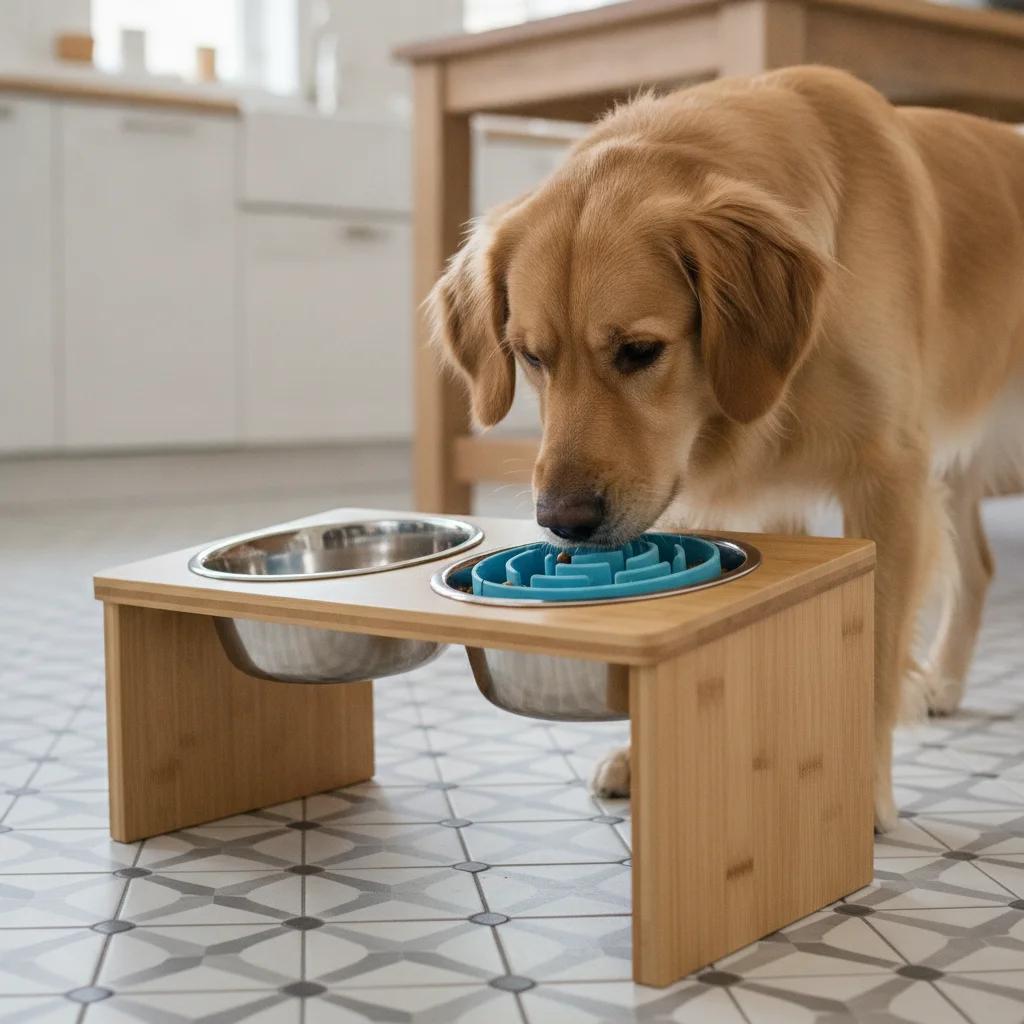
Assembly was straightforward: stand frame, rubber feet, removable maze bowl. The parts that matter on day one are footprint width, bowl lock-in, and whether the maze depth matches your dog’s frustration tolerance—not the brand’s “anti-bloat” marketing line.
We set rim height near the lower-chest / withers zone for a large adult, then confirmed posture with a side photo. If you need a full measurement protocol, pair this review with a height guide rather than guessing from the carton size label.
Assembly checks that predict month-three problems
- Footprint vs height: tall skinny stands look premium and tip sooner.
- Bowl retention: inserts that rattle on day one will walk out under paw pressure later.
- Maze aggressiveness: deep labyrinths slow gulpers but spike early frustration and food scatter.
- Floor contact: hard plastic feet skate on tile; rubberized pads buy you weeks of quieter meals.
Do a tip check before the first full meal. Press the rim with your forearm the way a large dog leans. If the stand rocks onto two feet, stop shopping for colorways and start shopping for a wider base.
Dog adjustment to the maze
Our test dog needed three meals to stop pawing the rim and about a week to finish without quitting mid-bowl. That range matches most slow-feed reports: a few meals to a week, not “instant calm.” Very food-motivated dogs adapt faster; anxious or easily frustrated dogs may need a milder insert first.
Watch for these first-week signals:
- Finishing time rises from under a minute toward several minutes without quitting.
- Pawing drops after the novelty wears off.
- Neck angle stays neutral—no hard crouch, no chin-high stretch against the stand.
If the dog abandons the bowl, flatten the challenge (shallower maze or temporary remove-and-replace of the insert) before you abandon elevation. A hybrid only works when both jobs—height and pace—are tolerable on the same night.
Initial tip checks on real flooring
We ran the same lean test on tile and hardwood. Tile exposed sliding; hardwood exposed rocking when feet were not fully seated. A wide rubberized base beats a tall skinny stand when a large dog presses the rim at mealtime. That sentence is the whole stability thesis of this review.
Write down day-one wobble notes. You will need them at day 90 when screws loosen and you try to remember whether the stand was always this lively.
Also check clearance under the stand. Tall dogs kick water bowls and mats into the frame legs; a feeder that looks stable empty can snag a mat corner and rock once the kitchen gets busy. Keep the footprint clear for the first week while you learn the dog’s approach path.
Weeks 2–6: gulping, mess, and meal time
By week two the novelty faded and the real pace math showed up. Dry kibble slowed meaningfully—roughly 2–4× longer meals depending on maze depth and portion size. Wet food slowed less because it packs into channels and becomes a paste the dog can scrape faster.
That is the honesty gap in many “slow feeder elevated bowl” listings: they show dry-kibble demos and leave wet-food households surprised.
Pace changes that stuck
Gulp-and-vomit episodes dropped on dry food once the dog stopped fighting the maze. We did not treat that as medical proof of anything—just a practical mealtime change. If your dog has a history of regurgitation or suspected GDV risk, talk to your veterinarian; elevation and mazes are tools, not treatment plans.
Meal duration plateaued around week three. After that, improvements came from cleaning discipline and stand stability, not from further “training” the maze.
Food scatter and kitchen mess
- Dry kibble: moderate scatter outside the bowl rim when the dog shook food free from deep channels.
- Wet food: less floor scatter, more sticky residue in grooves.
- Mixed meals: worst of both—crumbs plus paste.
A silicone mat under the stand reduced cleanup time more than any “spill-proof” marketing claim. Elevated mazes still fling food; they just fling it from a higher plane.
Noise and sliding
Weeks 2–6 are when cheap feet announce themselves. On tile, the stand crept a few inches per week unless we reseated it. On hardwood, the issue was clatter when the insert was not fully locked. Neither problem is fatal, but both erode the “set it and forget it” promise.
If your kitchen is all tile, prioritize rubber feet and a wide base over adjustable height gimmicks you will never use. Sliding is the silent reason hybrids get demoted to the garage by month two.
Portion size changes the maze math. Smaller meals can finish too fast in a shallow pattern; oversized portions turn deep mazes into frustration machines. Match the insert difficulty to a typical dinner, not the holiday leftover bowl.
Cleaning reality: mazes, biofilm, dishwasher
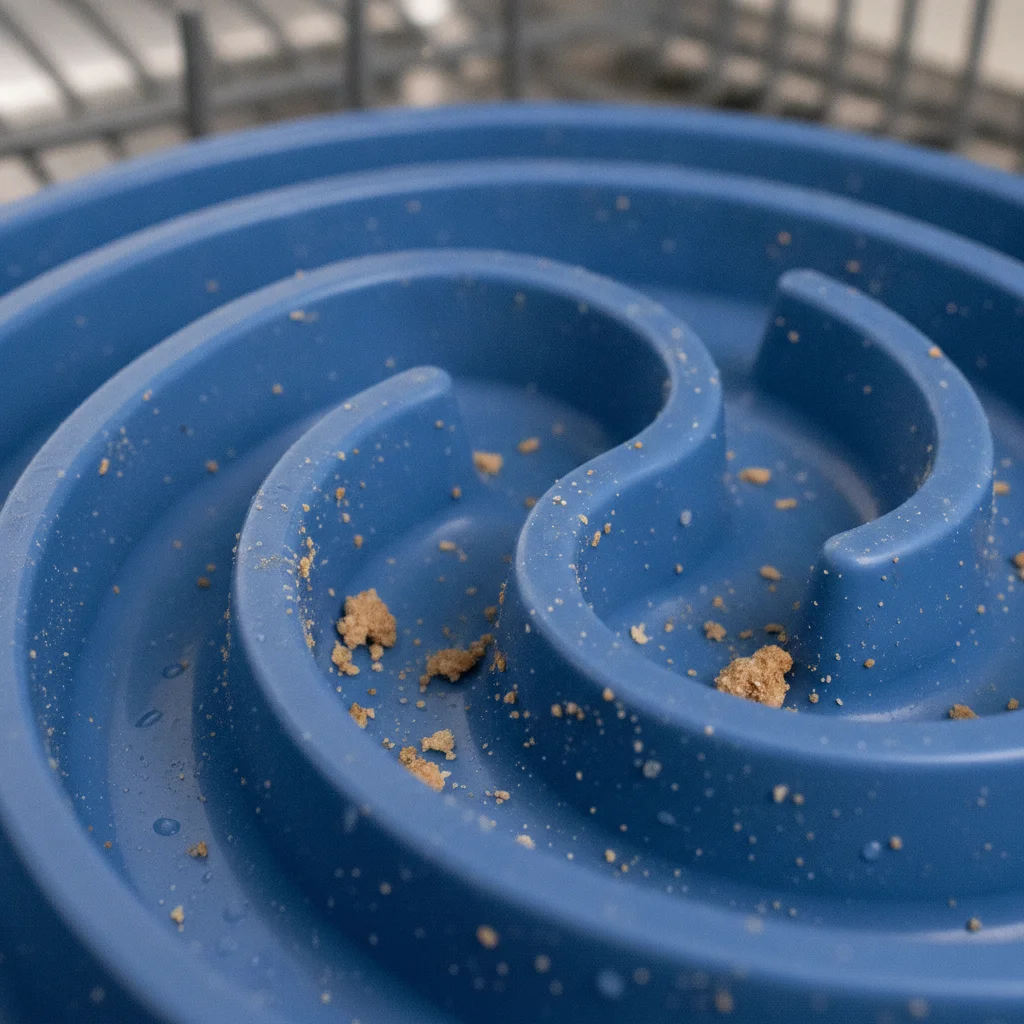
Elevated plus slow-feed hybrids fail when maze biofilm and dishwasher warping outpace the gulp control they promised. Cleaning—not height charts—decided whether we still liked this feeder at day 90.
Hand-scrub vs dishwasher rack fit
The insert was labeled dishwasher safe. It fit the bottom rack, but deep grooves stayed cloudy unless we pre-scrubbed. A bottle brush or soft detail brush for the channels mattered more than the “dishwasher safe” badge.
Practical routine that worked:
- Rinse immediately after meals so paste does not set.
- Brush the maze grooves twice a week minimum (daily with wet food).
- Dishwasher for the stainless bowl shell and stand parts that actually clear the spray arms.
- Air-dry fully—nested damp mazes smell within a day.
Owners who only run the dishwasher without brushing will hit slime faster. That is not a brand mystery; maze geometry traps film.
Odor after wet food
Wet food was the stress test. By week four, skipped brush days produced a sour smell in the deepest channels even after a hot cycle. Stainless surfaces recovered quickly; plastic maze ridges held odor longer.
If you feed wet food daily, prefer stainless maze patterns or simpler raised ridges over ornate plastic labyrinths. Complexity looks clever in product photos and loses on Tuesday night cleanup.
Replacement parts and long-term cost
Ask before you buy: can you replace the insert without buying a whole new stand? After 90 days our insert was still intact, but dishwasher haze and micro-scratches were visible. Replacement-part availability is the difference between a durable system and a landfill special.
| Cleaning factor | What we saw by day 90 | Buyer implication |
|---|---|---|
| Dry food only | Manageable with rinse + weekly brush | Most hybrids survive |
| Wet food daily | Biofilm risk without groove scrubbing | Favor simpler stainless mazes |
| Dishwasher only | Cloudy grooves, trapped grease | Pre-scrub is mandatory |
| Replaceable insert | Stand reusable if maze wears | Lower long-term cost |
A dishwasher safe elevated dog bowl claim is a starting filter, not a hygiene plan. Treat the maze like a cutting board with crevices: heat helps, mechanical scrubbing finishes the job.
We also washed the stand frame, not just the bowl. Food spray and drool collect on crossbars that never see a rinse if you only pull the insert. A quick wipe of the frame after messy meals kept odor from migrating into the legs.
90-day stability and tip-test results
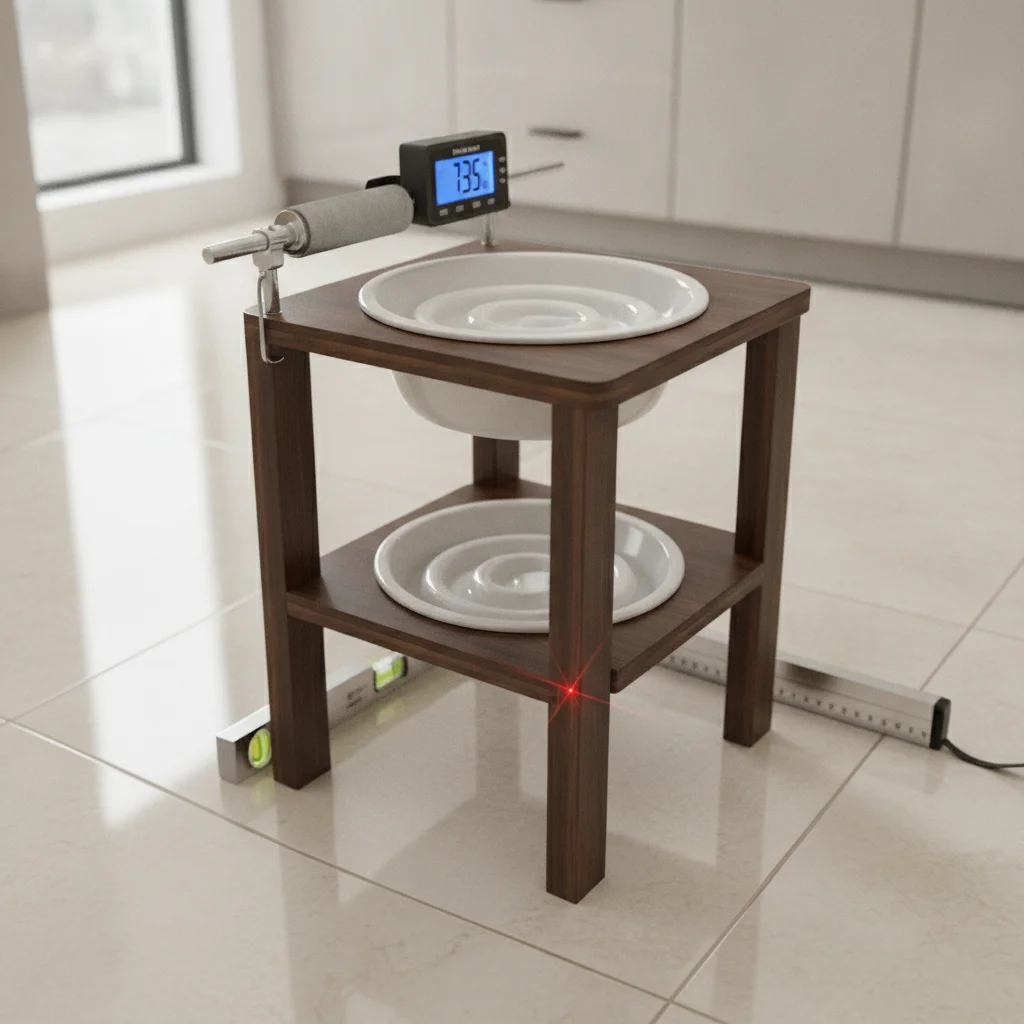
Stability is why this page exists as a long-term review instead of another week-one roundup. We retested tip resistance every two weeks with the same lean protocol: forearm pressure on the rim, then a large-dog shoulder lean during an actual meal.
Tile vs hardwood
On tile, early sliding was worse than tipping. Rubber feet that looked fine at unboxing compressed and glazed; the stand traveled toward the wall unless we wiped grit from the pads weekly. On hardwood, tipping risk rose when one foot sat on a transition strip or rug edge.
Flooring changes the failure mode. Tile → migrate. Hardwood with edges → rock. Soft mats under a narrow stand → both.
Large dog leaning
Lean pressure is the real world. Dogs brace on elevated rims when mazes frustrate them. Our stand stayed upright on a wide base through day 90, but a narrower competitor stand we spot-checked in the same kitchen tipped onto two feet with moderate lean. Footprint beat brand reputation.
Signs the stand is losing the fight:
- Visible rock when the dog starts the meal
- Screws that need retightening every few weeks
- Feet that no longer sit flat without a shim
- Insert that lifts on one side under pawing
Stand screws and feet at day 90
We retightened frame screws twice in three months. That is normal wear, not a crisis—unless the hardware rounds out or the wood/composite legs compress. Metal frames with locking hardware aged better in feel than lightweight tubular kits.
Feet mattered as much as screws. Worn rubber becomes hard plastic. Hard plastic becomes a skateboard on tile. Budget a pad replacement or a grippy mat if you hear the stand chirp across the floor.
Ninety days is enough to catch early wobble, cleaning pain, and whether the hybrid still earns its height. It is not a multi-year fatigue study. Treat five-star “still perfect after years” claims with the same skepticism you give day-one influencer unboxings.
If you share the feeder between dogs of different sizes, expect tip risk to rise. The taller dog’s lean force is what the stand must survive, even if the smaller dog is the gulper you bought the maze for. Separate stations remain the safer default for mismatched pairs.
Who should buy it — and who should skip
An elevated slow feeder dog bowl is a fit when you have both a posture reason to raise the meal and a pace reason to slow it. If you only have one problem, a simpler tool usually cleans easier and tips less.
Best fit
- Medium-to-large dogs that gulp dry food and also crouch uncomfortably at floor bowls
- Owners willing to brush maze grooves on a schedule
- Kitchens where a wide-base stand can sit fully on one flat surface
- Homes that can buy replaceable inserts
Dealbreakers
- Daily wet food with zero interest in scrubbing channels
- Giant breeds that lean hard on narrow “modern” stands
- Multi-dog homes forcing one hybrid height on mismatched dogs
- Anyone buying elevation primarily as a GDV prevention device from marketing copy
Smarter alternatives when the hybrid is wrong
| Your main problem | Better first buy | When to upgrade to hybrid |
|---|---|---|
| Gulping only | Floor maze / slow feed insert | Dog also needs height for comfort |
| Bending / senior comfort only | Stable elevated bowl, simple insert | Gulping returns after elevation |
| Both, but hate cleaning | Elevated bowl + separate simple slow bowl | You accept maze maintenance |
| Multi-dog height mismatch | Separate stations | Never force one shared hybrid |
If you are still comparing elevated bowl vs slow feeder as categories, decide the job first. The hybrid is a convenience product for dual-need dogs—not automatically “twice as good.”
Frequently Asked Questions
Do elevated slow feeders get slimy?
Mazes can hold biofilm—especially with wet food—unless you scrub grooves regularly between dishwasher cycles.
Will the stand tip on tile?
Narrow bases tip under lean pressure; look for wide rubberized feet and test with deliberate shoulder lean before you trust it daily.
Are they dishwasher safe long term?
Many claim it; warping, cloudy plastic, and trapped grease still show up after months of hot cycles.
How long until a dog adapts to a maze?
Often a few meals to a week; very frustrated dogs may need a milder insert or shallower pattern first.
Is 90 days enough to judge durability?
It catches early wobble, screw looseness, and cleaning pain; multi-year stand fatigue still needs longer ownership notes.
Your next step
Buy the hybrid only if you need height and gulp control in one station—and you will maintain the maze. Tip-test the stand on your actual floor, brush the grooves on a calendar, and skip tall skinny frames that look good in photos. Ninety days of cleaning and wobble notes beat another star-rating roundup when you are choosing a slow feeder elevated bowl for real kitchens. For height-stable stands without a maze, cross-check our best elevated dog bowls 2026 shortlist after you finish this review.
Related reading on our sister sites: Litter-Robot Review After Months (2026)