Apartment shoppers hunting the best dog puzzle feeders are usually past the cute Amazon grid. The dog inhales breakfast in under a minute, the board skates across hardwood, and leftover pâté in the sliders still smells at noon in a galley kitchen.
Hardwood and thin walls mean a puzzle that sounds fine in a product video can register as neighbor noise at 6 a.m.—we score bounce and sliding before recommending. A plush “hide the squirrel” toy can look like enrichment in a living-room photo and still fail as a daily feeder: squeakers, fabric shreds, and zero wash path for wet food.
This is a buying guide for mealtime that has to do two jobs: slow the gulp and occupy a brain that does not get a yard. It is not a veterinary behavior plan. If meals trigger fights, skip shared floors and use crate or pen setups for separate meals until you can feed one dog at a time.
How we test noise, chew-through, and dishwasher reality
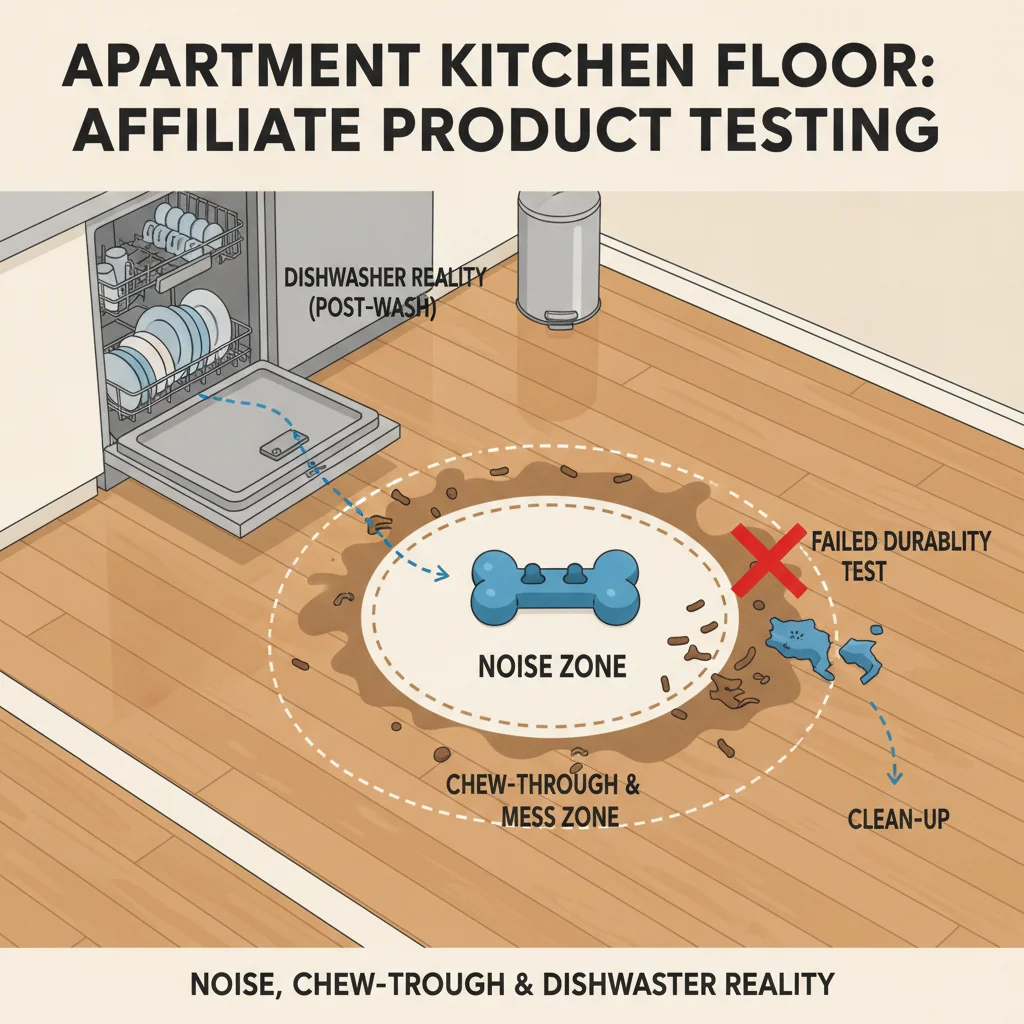
We treat a puzzle as apartment-ready only if it survives a weekday breakfast on hard flooring, not a single YouTube demo on carpet. The protocol is kitchen-scale, not a sound lab: phone meter at about one meter, notes on sliding distance, and a stopwatch on the first meal versus day seven.
Hard-floor bounce is the first fail. Kibble that jumps out of a spinning layer and hits tile reads as “play” in a product video and as a lease complaint at 6 a.m. We also watch whether the whole board travels. If it crosses more than a dinner-plate width on tile, it needs a mat or it is out for early meals.
- Bounce and slide: kibble scatter plus how far the device walks on tile or vinyl.
- Chew-through: can a molar catch a thin tab, slider, or hollow wall in one supervised session?
- Wash time: minutes to rinse, plus whether fat stays in seams after a dishwasher cycle.
Plastic crack versus rubber flex is the second fail. Composite “wood look” boards (the Nina Ottosson family) dent and split at slider tracks when a dog lifts the toy to chew the edge. Food-grade rubber (West Paw Toppl, thick Kong stuffables) flexes; it is not immortal, but it rarely sheds sharp shards on a kitchen floor.
Dishwasher-safe claims versus actual crevices is the third fail. Many apartment owners feed wet or fresh food; kibble-only roundup advice fails the smell-and-wash test in a galley kitchen. Top-rack logos do not clean the underside of a sliding bone. If you cannot see the fat, you will smell it.
We also time difficulty honestly. Without a yard, mealtime has to carry enrichment load—boards that finish in 90 seconds do not replace a walk. A device that is empty before you finish coffee is a slow bowl with extra parts, not a puzzle.
Score the floor first: if you would not run the toy at 6 a.m. on hardwood, it is not an apartment feeder no matter how many Amazon stars it has.
If you mainly want gulp control rather than a cognitive board, read the slow feeder versus puzzle feeder split before you buy a $35 slider set. Grooved bowls and true puzzles solve different mornings.
Best overall puzzle feeders for apartment enrichment
For most apartment dogs that are not dedicated destroyers, the winning setup is a rotating pair: one composite strategy board on a mat for dry kibble, plus one quiet wet-food surface. Buying a single “best” SKU and running it twice a day is how smart dogs finish in 90 seconds by Friday.
Footprint matters on a galley floor. A wide Nina-style board needs a yoga mat or towel so it cannot skate into the kickplate. A wobble toy needs a low-lip tray unless you like kibble in the heating vent. Counter storage should fit a dish rack, not a second closet.
Nina Ottosson Dog Worker (Level 3) — daily kibble board
The Dog Worker is the composite board we would actually use for weekday kibble: sliding blocks over wells, numbered as Level 3 in the Nina system. Street price in 2026 usually sits in the mid-$20s to mid-$30s depending on colorway. It is not wood. It is a molded composite that looks like a toy kitchen, and that matters for chew-through.
On tile it will slide unless you park it on a mat. Rubber feet help until they polish smooth. Kibble bounce is low if you fill wells rather than piling the surface. Difficulty lasts past week one only if you change the block pattern and hide a few empty wells. Dogs map the “always the same three slides” layout fast.
Wash: rinse immediately. A dishwasher cycle can warp thin sliders if you run high heat. For wet food, skip this board. Fat packs the tracks and the smell lives in the apartment.
Silicone lick mat (LickiMat-class) — wet and fresh food
If breakfast is pâté, fresh, or mixed, a textured silicone mat is the apartment enrichment tool Amazon listicles keep pretending is optional. It is quiet. It does not skate like a hard board. You can smear a measured ration, freeze it, and buy back 5–15 minutes without kibble percussion.
It is not a “puzzle” in the Nina sense. Treat it as the wet-food half of the system. Cheap clones tear at suction cups; buy a mat thick enough that nails cannot shred the nubs in a week. Hand-wash or top rack, then dry standing up so the rubber does not stay sour on a drying rack stacked under plates.
West Paw Toppl (or similar rubber stuffable) — duration without sliding boards
A rubber, dishwasher-friendlier stuffable sits between a Kong and a bowl. Fill with kibble plus a smear of wet food, or freeze a lickable layer. On hardwood it can still knock, so use a towel. It wins when you need minutes of work without a 14-inch composite rectangle occupying the only clear floor.
Chewers get further with rubber than with hollow sliders, but “further” is not “unsupervised with a power chewer.” If the dog’s hobby is dismantling toys, this is still a sit-with-you breakfast, not a closed-door plan.
Trixie Mad Scientist / strategy games — when Level 2 is already trivial
Trixie’s bottle-and-base games (Mad Scientist and cousins) add a different motor pattern than sliding blocks. They are mostly kibble devices. Bottles rattle. On hardwood that rattle is the whole review. Use a mat, skip 6 a.m., and expect more wash steps than a lick mat because kibble dust packs the bottle necks.
Difficulty can outlast a Level 1 Nina board if you do not leave every bottle half-open. Once the dog learns “knock until empty,” you have a noisy slow bowl. Rotate with a board or freeze a mat on alternate days.
- Default apartment pair: Dog Worker (or similar Level 2–3 board) on a mat + silicone lick mat for wet meals.
- Small-floor swap: rubber stuffable instead of the wide board.
- Smart-dog ladder: empty wells, pattern changes, then a Trixie-style game—not a harder chew.
Outward Hound’s Fun Feeder slow bowl is a gulp tool, not a cognitive puzzle. It earns a place next to these only if your dog still inhales kibble after the board is solved. For wobble and dish-rack wear on raised slow bowls, the slow-feeder wash and wobble after 90 days notes are closer to that product class than this page.
Best for aggressive chewers and destructive finishers
If the dog already cracked a plastic slider or ate a corner off a “wood” board, stop buying hollow composite. Those toys are designed to be manipulated with a nose, not held like a chew. A molar on a thin tab is a failure mode, not a training gap.
Materials that survive past month three in real kitchens are thick rubber and, for some dogs, very thick solid composite used only while you watch. Hollow budget clones (generic “interactive slow puzzle” trays with needle-thin walls) usually fail before month three. Replacement cost then exceeds a LickiMat rotation.
When to skip hollow plastic
Skip it when the dog lifts the entire board, carries it to the couch, and chews the rim. Skip it when you find white dust or sharp edges. Skip unsupervised use the first week with any new puzzle, even “tough” marketing copy.
Rolling plastic wobble toys (Bob-A-Lot class, many treat balls) add noise and still get punctured by dedicated chewers. They can stretch mealtime for a gentle dog. They are a poor apartment pick for a destroyer at 6 a.m. on tile.
Replacement cost versus lick mats
A $28 Nina board that lasts six weeks of dual duty (kibble plus the dog chewing the edge) is more expensive than a $15–20 thick lick mat that lasts a year of smeared wet food. Rubber stuffables cost more up front ($15–30 typical) and still need replacement when the rim is shredded, but they do not explode into slider shards.
There is no honest “indestructible puzzle feeder” for a power chewer in an apartment. The adult choice is supervised rubber, frozen lickables, and a walk. If destruction is panic after you leave, a harder toy is not treatment—fix the welfare plan before you escalate hardware.
- Watch-and-feed: rubber stuffable or lick mat only while you are in the room.
- Do not buy: plush puzzles, thin-wall Amazon clones, squeaky hide-and-seek toys used as feeders.
- Retire at first crack: composite splinters are a GI foreign-body risk, not a badge of a “smart dog.”
Nina Ottosson vs Outward Hound vs budget boards
Shoppers treat these as three brands. In practice Nina Ottosson is Outward Hound’s numbered strategy-board line. Outward Hound also sells slow-feeder bowls and plush hide-and-seek toys that behave nothing like a Dog Worker. Budget clones copy the silhouette and skip the slider tolerance.
| What we check | Nina Ottosson boards | Other Outward Hound toys | Budget clones |
|---|---|---|---|
| What you actually get | Composite strategy boards with Level 1–4 labeling (Worker, Tornado, Brick, and cousins) | Fun Feeder bowls, plush squirrels/puzzles, mixed “interactive” SKUs | Unnamed “wooden” plastic trays, often shared OEM molds |
| Level system honesty | Useful as a ladder if you change layouts; dogs still map a single board in days | No equivalent ladder on plush or the Fun Feeder | Printed “advanced” means nothing; sliders bind or dump |
| Apartment noise | Low bounce if wells are filled; board slide on hardwood unless matted | Plush squeaks; Fun Feeder is quiet; rolling toys are loud | Loose parts rattle; thin trays skate farther |
| Chew / 12-month wear | Tracks crack if lifted and chewed; no spare inserts | Plush dies in one session with a chewer; bowls scuff | Hollow walls split early; dye rub on light floors |
| Wet-food hygiene | Poor—seams hold fat | Fun Feeder grooves need a brush; plush is not a feeder | Worse seams, cheaper plastic odor |
| Street price class (2026) | Roughly $18–$40 per board | Bowls ~$15–$25; plush often under $20 | Often $12–$22, then replace |
Level system honesty: Level 1 is a snuffle-adjacent slide. Level 3–4 can occupy a food-motivated dog if you do not telegraph the solution. Listicles that dump eight SKUs without saying “rotate or they finish in 90 seconds” are selling inventory, not a ladder.
Composite versus single-layer wear: Nina boards are thick enough to last a non-chewer for a year of kibble if you do not high-heat the dishwasher. Single-layer budget trays flex, then crack at screw bosses or painted “wood grain” films that peel into the food.
Where budget clones fail: sliders that jam when wet, wells too shallow for a kibble piece, no mat-friendly feet, and marketing photos on carpet. If the listing will not show the underside and the slider gap, assume the mold is the same as last year’s cracked one.
The Dog Tornado (spinning layers) is a Nina SKU we would not lead with for apartments. It is a legitimate difficulty bump and also a kibble-scatter machine. Save it for evenings on a mat, not for a thin-floor breakfast.
12–18 month ownership: cracks, smell, and spare parts
Plan for the board to be a consumable if your dog is mouthy. Nina does not sell a meaningful spare-parts kit for cracked sliders the way a vacuum brand sells filters. When a bone-shaped slider warps, you retire the board or live with a jammed well.
Which lids warp in dishwashers: thin Trixie bottle pieces and some Nina sliders deform on high-heat cycles. If the claim is dishwasher-safe, use the top rack and skip heated dry. Hand-washing a lick mat is faster than fishing pâté out of a warped track with a bottle brush.
Wet-food odor traps: any puzzle with overlapping layers will hold fat. In a closed apartment that becomes the “dog food hallway” smell by day three. Limit wet food to silicone or wide-mouth rubber. Rinse composite boards the same morning you use kibble only.
When to retire versus replace inserts: retire at the first through-crack or sharp edge. Replace the whole board rather than taping a slider. For lick mats, retire when nubs tear into strips. For rubber stuffables, retire when the rim is thin enough to swallow.
- Month 1: confirm the dog cannot lift-and-chew; add a mat; time the meal.
- Month 3: inspect tracks and rubber rims; if you are buying a second identical board because the first is destroyed, change materials.
- Month 12: expect cosmetic scuffs on composite; do not expect spare sliders; budget a replacement or a rubber pivot.
A 12-month cost picture for a typical apartment pair (one board + one mat, non-destroyer) is roughly $40–$70 in hardware plus dish soap, not $15 once. Destroyers should not be in the “buy three cheap clones a year” loop; that is how you subsidize landfills and still get a 90-second meal.
What we skipped (and why)
Amazon toy roundups with no protocol: if the article never mentions hardwood, wash time, or what happens after the dog learns the pattern, it is a merchandising page. Star clusters do not measure neighbor noise.
Kibble-only mats for wet feeders: grooved slow bowls and kibble boards sold as “puzzle feeders” to wet-food households. You will lose the hygiene argument by Wednesday. Use silicone for wet rations.
One-and-done YouTube demos: a single fill on carpet with a calm dog is not a test. We care about day-seven speed, tile slide, and whether you can clean the thing before work.
Plush hide-and-seek toys used as meal feeders: they are play objects. Squeakers and stuffing fail apartment chew rules and they do not portion breakfast.
Treat-dispensing cameras as a substitute for a puzzle meal: a camera can occupy a different welfare problem. It is not a feeder, and it is not quieter than a lick mat if the motor runs while you are gone.
If a listing leads with “indestructible” and shows a board in a grassy yard, it is not written for your kitchen. Buy the pair that you can wash, park on a mat, and rotate—then spend the saved minutes on an actual walk.
Frequently Asked Questions
Are dog puzzle feeders too noisy for apartments?
Sliding composite boards and rolling wobble toys are the usual complaint, not quiet licking. Put the board on a yoga mat or towel, skip bouncing kibble toys at 6 a.m., and treat phone-meter scores as a neighbor check—not a lab certificate.
Can I use a puzzle feeder with wet or fresh food?
Use a textured silicone lick mat or a rubber Toppl-style stuffable, not grooved kibble boards. Composite sliders trap fat in seams, smell after a few days in a galley kitchen, and the dishwasher claim rarely reaches the undercuts.
Which puzzle feeder survives an aggressive chewer?
Supervised rubber stuffables last longer than hollow Nina-style sliders. If the dog can lift the board or get a molar on a thin tab, treat composite puzzles as training tools, not chew toys. Budget hollow clones usually crack before month three.
How long should a puzzle meal take?
Aim for several minutes of work, not a 90-second dump. Step up Nina/Trixie levels, freeze lick mats, or split the ration across two devices. A fast finish means the puzzle is a bowl with extra steps, not enrichment.
Is Nina Ottosson different from Outward Hound?
Nina Ottosson is Outward Hound’s composite strategy-board line with numbered difficulty. Outward Hound also sells slow-feeder bowls and plush hide-and-seek toys that fail apartment chew and noise tests. Buy the board you can wash and rotate—not the brand name on a squirrel.
Related reading on our sister sites: Best Escape-Proof Dog Crates for