The internet’s favorite cabin argument is sleepypod air vs sturdibag, usually with a Mr. Peanut’s tab open for the price shock. Wirecutter names the first two without living in the three-way frequent flyers actually fight: a bag that keeps its box, a bag that squishes under a seat that was never 11 inches tall, and a Sherpa-class tote whose zipper is the whole review.
Sleepypod Air vs SturdiBag is usually a rigidity fight: one keeps its box, the other squishes under a seat that was never 11 inches tall. Mr. Peanut's copies the Sherpa silhouette at a lower zipper spec; frequent flyers pay for hardware, not branding. This page is that comparison, not a sixth Amazon bestseller grid.
Policies change. Confirm your ticketed airline’s live pet page. Nothing here is a crash-test certificate or a veterinary clearance. If the pet cannot stand and turn in a bag that fits the under-seat box, none of these three SKUs is the answer.
What this three-way actually decides
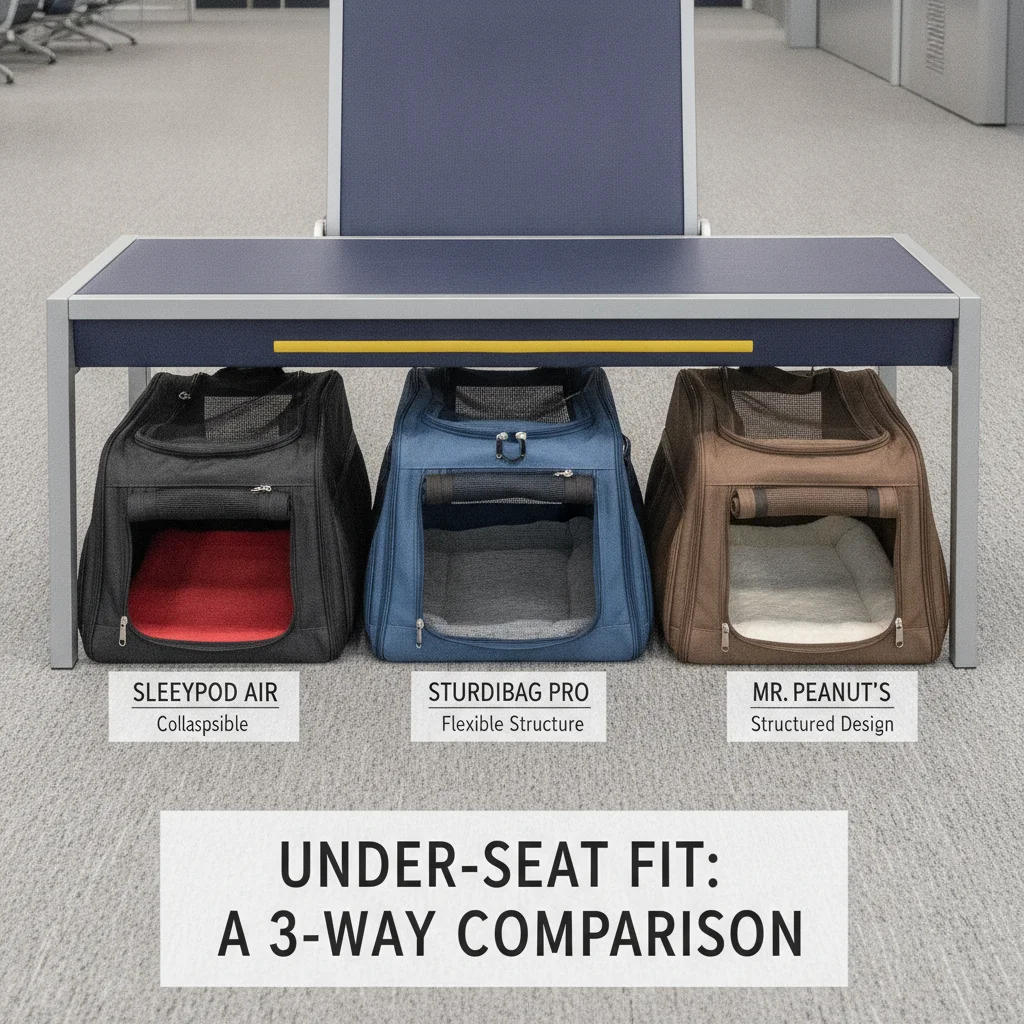
You are not choosing a lifestyle brand. You are choosing which failure you prefer when the gate agent brings the measuring template.
Sleepypod Air is the padded, structured soft bag. It behaves like a small piece of luggage that happens to hold a pet. SturdiBag (Large and Pro in the conversations that matter) is fabric-first: it can lose height under a seat and still leave mesh for air. Mr. Peanut’s is the Amazon tote that looks like a Sherpa Original Deluxe in a listing thumbnail.
- Rigidity versus compress-to-fit: Air wins when the published box is close to 18 × 11 × 11 and you want walls. SturdiBag wins when one dimension is stingy and you must mash.
- Price versus flight count: Mr. Peanut’s is rational for a rare round trip. It is a false economy if you fly quarterly.
- Species: cave-seeking cats often prefer Air walls. Panting dogs often prefer SturdiBag mesh. Budget mesh on a Mr. Peanut’s is brighter than Air and weaker than a Pro SturdiBag.
Who each bag is not for: a 22-pound dog, a pet who cannot turn in an 18-inch class interior, a brachycephalic animal on a heat-risk itinerary without a veterinarian’s sign-off, or anyone planning to unzip an expandable panel to “make it cabin-legal.” None of these three is a cargo kennel.
If the animal still treats every closed box like a thunderstorm, hardware will not finish the behavior plan. Work calming a stressed dog at home, and treat the carrier as a trained object the way you would a crate in a crate versus playpen training routine.
Specs and money: Sleepypod Air vs SturdiBag vs Mr. Peanut's
Numbers below are the shopping class, not a caliper certificate. Sleepypod’s Air is sold around an 18 × 11 × 11-inch exterior and a few pounds empty. SturdiBag Large is a fabric rectangle whose empty photo can look similar and whose loaded height is the actual spec. Mr. Peanut’s airline totes cluster in the same marketing inches as Sherpa-class bags, with more variation SKU to SKU because Amazon colorways are not one mold.
Street prices in 2026 typically land Air in the low-to-mid hundreds, SturdiBag below that (Pro above the older bags), and Mr. Peanut’s in the impulse-buy band. If a “Sleepypod style” clone is $35, it is not an Air.
| What we check | Sleepypod Air | SturdiBag Large / Pro | Mr. Peanut's (Sherpa-class) |
|---|---|---|---|
| Shape under a seat | Keeps a padded box; height is the usual fail | Compresses in height; pet must still turn | Soft tote; sagging base adds mystery inches |
| Empty weight class | Heavier structured soft bag | Lighter fabric, hardware depends on Pro vs older | Light; strap hardware is the weak point |
| Typical 2026 street price | Low-to-mid hundreds | High tens to low hundreds | Impulse / under a hundred |
| Walls and floor | EVA-style padding, stable floor | Fabric + mesh, floor insert quality varies | Thin foam; hammock sag after weight cycles |
| Ventilation | Windows in padded walls; den-like, warmer | Lots of mesh; brighter, cooler | Mesh windows; quality of binding varies |
| Zipper story | Serviceable; still the year-two wear item | Pro pitch is better tape/sliders than budget fabric bags | Tape separation is the usual retire-the-bag event |
| Who it flatters | Cats who hide; flyers who want a predictable box | Dogs who pant; stingy under-seat height | Rare trips; backup bag; tight budget |
| Who it punishes | Tall pets on short regional boxes | Pets who panic when the cave flattens | Monthly flyers and dedicated clawers |
What the spec sheet hides: wheels and proud handles on some totes, interior length versus “fits 15 pounds” marketing, and whether the floor insert is cardboard theater. Weigh pet plus bag together against the airline’s combined limit. A structured Air plus a dense small dog can surprise you even when inches look legal.
Sleepypod also sells other shapes (including smaller Air-adjacent sizes in some years). Match the SKU, not the brand. SturdiBag size names are not airline sizes. “Large” has boarded and been rejected depending on aircraft and how high the pet sits. Mr. Peanut’s listings multiply; measure the one in the cart, not the review photo from 2021.
Under-seat compression versus rigid walls
Mainline U.S. published boxes often cluster near 18 × 11 × 11 inches. That is a cluster, not a law. Southwest-class and regional jets routinely kill one dimension. Copy the number from your aircraft, tape it, and load the bag. Empty Sleepypod photos look cabin-perfect because the bag is a rectangle. Loaded, the pet’s spine is the height.
Sleepypod's fixed box is a feature when the seat hole is honest: the pet keeps headroom, the bag does not become a fabric wedge, and you are not compressing a cat into a pancake. It is a trap when the hole is short. You cannot politely ask EVA foam to lose two inches. You change seats, flights, or brands.
SturdiBag squash is the opposite bet. Frequent flyers like it because the top yields. The pet’s comfort depends on remaining interior after the yield. A cat in a flattened mesh cave may vocalize the entire climb. A dog who already accepted crates may not care. Do not celebrate mash until you have done the turn test with the top pushed down to the taped height.
- Air: measure once, loaded. If you are over, stop. There is no “I will push harder at the gate.”
- SturdiBag: measure loaded, then push the top to the tape and re-check turn/lie-down.
- Mr. Peanut’s: measure loaded, then lift the bag by the handle. If the floor hammocks past the tape, the listing inches were a suggestion.
Gate agents measure the bag with the pet inside; lab dimensions on an empty listing are a different product. Arguing Wirecutter at the desk does not resize the seat.
Mesh, zippers, and escape points at TSA
TSA is the exam these bags actually sit. The protocol is the same for all three: harness on, leash in hand, pet out, bag on the belt, then reverse. The differences are who can bolt and what fails if they do.
Sleepypod Air’s padded opening and interior tether are the containment story. A clipped harness inside the bag is still required. The den walls reduce “see a gap and pour through it” compared with a lantern of mesh, but a determined cat at a half-open zipper is faster than your dignity.
SturdiBag mesh is airflow and a visual circus. Dogs push. Cats spike. Zipper pulls must be clipped together. Pro hardware exists because older fabric bags taught people that lesson the expensive way. If you cover a panel to darken the cave, use breathable fabric and do not block the only vent on a hot concourse.
Mr. Peanut’s is the Sherpa-class risk: zipper tape, a dangling pull, and a shoulder strap that swings the bag into a bin corner. Backup clips are not optional. Practice the bin drill in a hallway so the first unzip is not under fluorescent lights and a queue.
- Escape artists: two zipper sliders meeting under a clip, harness worn, no “just the top third open so they can see.”
- Jet bridge: carry as a box. Shoulder-strap-only carry is how sliders catch and walk open.
- Claw holes: a finger-wide mesh hole at a corner is a retire-or-repair event before the next security line.
Containment at home still matters more than brand. A pet who already accepts a closed indoor playpen transfers better than a pet whose only closed space is the Uber to the airport.
After ten flights: what still looks cabin-legal
First-trip comfort is what review sites sell. Year-one wear is what Facebook groups describe. Zipper tape and mesh usually tell the truth between flight 8 and 15.
Sleepypod Air still looks like a product after a year if you wipe the interior and do not use the shoulder strap as a suitcase haul for a 20-pound combined load every week. Mesh windows scuff. Sliders can be serviced. The padded shell is why people keep paying: it does not become a shapeless tote.
SturdiBag fabric will show dirt and claw snags. That is cosmetic until a snag becomes a hole. Pro-level zippers are the reason to pay up if you already destroyed a cheaper fabric bag. Wash and dry on the manufacturer’s terms; a sour bag in a galley kitchen is how people “accidentally” gate-check a cabin pet because they cannot stand the smell.
Mr. Peanut's copies the Sherpa silhouette at a lower zipper spec; frequent flyers pay for hardware, not branding. A handful of round trips can be fine. A year of monthly flying often means a second purchase. Count that second purchase in the original budget. The same math applies to household consumables that leak: a $45 tote that dumps at TSA is not cheaper than a $150 bag that still zips.
- Retire immediately: separated zipper tape, floor hammock that changes the loaded height, strap bartack walking out of the fabric.
- Repair if you can: slider replacement on an otherwise sound Air or SturdiBag.
- Do not fly: any hole at the zipper-mesh junction, even if last month’s agent did not notice.
Cabin-legal also means the bag still matches this year’s published box. Airlines shrink templates. A bag that boarded in 2024 can fail in 2026 without the fabric tearing. Re-tape before a new itinerary, not after you are in line.
If accidents are the wear you actually fear, pack like an apartment owner, not like a brochure. A spare pad in the personal item is ops, and our notes on washable pee pads for apartments are about leak layers at home—the same instinct applies to a carrier liner you can wash after a delay.
Who should buy which bag
Buy Sleepypod Air if your published box actually matches an 18 × 11 × 11-class bag, you want den walls for a cat or a noise-sensitive small dog, and you will fly enough times that zipper service beats replacing totes. Skip it if you already know the aircraft is a short regional hole or if your pet overheats in padded caves.
Buy SturdiBag Large or Pro if you need mash, mesh, and a frequent-flyer reputation more than a padded sculpture. Pay Pro if you have already killed zippers. Skip it if flattening the cave makes your cat inconsolable in the living-room drill. Do the push-down turn test before you congratulate yourself.
Buy Mr. Peanut’s if this is a rare trip, the loaded bag fits the tape, you will clip the zippers, and you accept that mesh and tape may not see a second holiday season. Skip it as your only bag if you already travel quarterly or your pet is a dedicated zipper worker.
Buy none of them if the pet cannot stand and turn in any under-seat interior, if the airline forbids the species or snub-nosed type on that route, or if the only way to “fit” is cargo. Soft cabin bags are not hard kennels. Cargo is a different product and a different risk.
Your next step is a taped rectangle on the floor and a loaded measurement, not another star cluster. Pick the failure mode on purpose: too-tall box, flattened cave, or budget zipper.
Frequently Asked Questions
Is Sleepypod Air smaller than a SturdiBag Large?
The Air is a fairly fixed ~18×11×11-inch class box. SturdiBag Large is a fabric rectangle that can look similar empty and then compress in height under a seat. Empty listing photos are not the same product the gate agent sees.
Which bag is quieter and more cave-like for cats?
Sleepypod Air's padded walls feel more den-like, which many cats prefer, but they also trap heat. SturdiBag's mesh is brighter and airier; cover one panel with a breathable cloth if the cat panics at the terminal.
Does Mr. Peanut's actually get accepted as airline approved?
Many agents accept a Mr. Peanut's bag when it fits the published box with the pet inside, the same as a Sherpa-class tote. They do not accept a stretched expandable, a broken zipper, or a pet that cannot turn around.
Which carrier lasts more than a year of flying?
Sleepypod Air and a well-made SturdiBag usually outlast budget zippers if you do not overload the shoulder strap. Mr. Peanut's can survive a handful of round trips; zipper tape and mesh are the usual year-one fail, not the brand name.
Can I take two pets in one of these bags?
Most U.S. majors want one pet per carrier and still require each animal to stand and turn. Doubling up to save a pet fee is how people get turned away at the desk, not a clever hack.
Related reading on our sister sites: Pet Camera Treat Dispenser Jamming: