Shoppers comparing a gel vs fabric dog cooling mat are usually looking at a split weld and a smear on vinyl, not at another star-rating carousel. The useful question is which construction still cools a panting dog after claws, naps, and a summer of apartment accidents.
Gel and fabric are the two objects Amazon puts in the same photo. Water mattresses and elevated mesh cots sit in other aisles, which is why so many “versus” posts never mention them. This page puts all four on one table, then tells you when bathroom tile already does the job.
None of these products treat heatstroke. Water, shade, airflow, and a vet plan still come first. A cooler surface is a comfort layer you can wash, empty, or hose—not a substitute for a room that is actually cooler than the dog.
Four cooling builds, not two Amazon photos
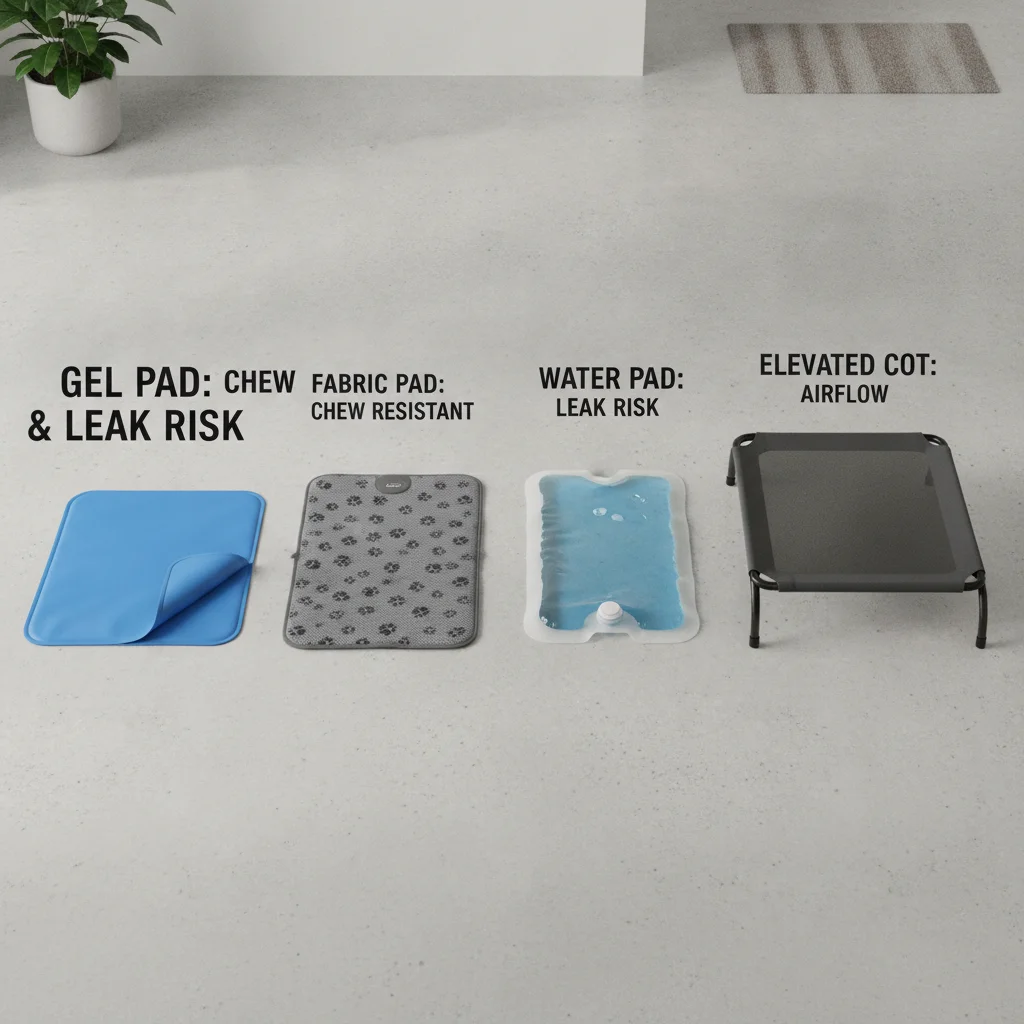
A pressure-activated gel pad is a sealed bladder. Body weight stirs the gel, the gel takes heat, and the surface feels cold for a short session until the packet needs time off the dog. Brands such as The Green Pet Shop quote a few hours of use and a brief rest to “recharge.” Treat those times as maker claims, not lab certificates.
A cool-touch fabric sheet has no payload. Mineral-treated weaves and “ice silk” knits feel cool on first contact because they dump heat into air and into whatever hard floor sits under them. They warm toward skin temperature if the dog lies still. Bedsure-style makers have said the quiet part: these are not refrigerators.
Pressure-activated gel feels colder in the first ten minutes than cool-touch fabric, then needs a rest while fabric keeps a milder surface with nothing inside to leak.
A water pad is a tap-filled mattress. Heat moves into a large mass of water, then into the slab beneath. CNN Underscored’s outdoor bake test found thin gel pads heating fast in sun while water-filled pads stayed cooler longer—useful as a physics hint, not as a reason to park a pad on a west-facing balcony all afternoon.
An elevated cot is a taut sling on a frame. Air moves under the dog. There is no gel, no valve, and no “recharge.” Cooling is less contact with a heat-soaked floor plus more surface dumping heat. That is why a cot belongs in this comparison even though the listing title rarely says “mat.”
| Build | How it cools | First hour | If claws win | Apartment cleanup |
|---|---|---|---|---|
| Gel bladder | Heat sink in a sealed packet | Coldest first contact; then a rest | Smear plus possible toxin exposure | Wipe only; puncture ends it |
| Cool-touch fabric | Treated textile plus airflow | Mild cool, no cycle | Frayed hem; nothing inside | Often machine-washable |
| Water mattress | Thermal mass of tap water | Stays cool longer on hard floor | Flood, not hydrogel | Empty, rinse, refill |
| Elevated mesh cot | Air under the sling | Steady, no packet | Chewed corner or sling | Hose or wipe; some slings swap |
Read the table as a failure catalog. If last summer’s object died at the binding, buying the same bladder in a new color is not a comparison—it is a repeat.
- Hard floor under anything with liquid. Carpet stores heat and hides leaks. Vinyl, tile, and wood are the intended heat dump.
- Sun at the window. Gel that sat in a sun patch is a warm plastic envelope until it sheds heat again.
- First-week watch. Most welds and hems fail the evening a new object appears, not in month four.
What DTC “gel versus fabric” posts leave out
Brand blogs often pick one gel SKU and one fabric SKU, then declare a winner by outdoor UV or indoor crate. That is a product page with a table. It does not ask whether either object survives a terrier who starts at piping.
US listicles still sort by “best cooling mat” stars. Chew, gel on rental floors, and cots as the safer alternative show up in FAQs if they show up at all. If your dog already unzipped a crate pad, you need the missing columns: water you can empty, a frame that hides corners, and tile you already pay for.
Gel versus fabric on feel, wash, and the chewed edge
Gel wins the first-touch contest. The surface feels colder than a textile, which is why photos look like a medical pack. The cost of that burst is a sealed packet sitting between the dog and your floor.
Fabric wins the all-day contest for a gentle dog. There is no rest cycle, no fridge step, and nothing to recharge. After an hour the sheet is just a cooler-feeling textile. That is enough for many apartment naps if the room itself is not a heat box.
A machine-washable fabric cooling sheet survives apartment accidents; a punctured gel pad is trash the moment a dewclaw opens the weld.
Wash is the apartment axis Amazon specs bury. Urine, drool, and hallway grit belong in a machine, not on a wipe-only vinyl skin. If the dog has accidents on the cooler, fabric (or a separate washable layer) is the only honest match. A gel pad that “cleans with a cloth” still holds odor in the cover’s seams.
Chew is the other axis. Gel fails as a bladder: one nail hole ends the product and starts a cleanup. Fabric fails as a hem: binding tape, piping, and stuffed borders become toys. A stuffing-free sheet with hidden stitching lasts longer than a quilted “cooling blanket” with a zipper the dog already knows how to open.
Gel: supervised burst, not a chew toy
Keep gel for a dog that never mouths objects, that uses the pad in sight, and that has short nails. The Green Pet Shop’s own copy tells you not to leave a chewer or scratcher unattended with the Cool Pet Pad and to call a veterinarian if anything is ingested—even while the gel is still labeled non-toxic.
That label is not an assay. ASPCA Poison Control has warned owners about hydrogel in cooling pet pads and similar packs. Some polyacrylamide gels have carried high residual acrylamide. Reported signs after ingestion have included vomiting, tremors, unsteadiness, and worse. Keep the carton if you still own a gel pad.
If gel is already on the floor, get the dog out, glove up, contain the smear with paper towels, and bag the pad. Do not chase hydrogel into vinyl seams with a kitchen sponge. Call your veterinarian or ASPCA Poison Control at 888-426-4435 if the dog licked the puddle. A $22 pad that punctures is not cheap once you add a Saturday of cleanup and a possible clinic bill.
Fabric: washable, portable, and still chewable at the hem
Fabric is the crate, couch, and travel layer. It folds into a tote. It does not slosh in an elevator. It can sit on a crate tray without stealing height the way a thick water mattress does.
It is not a chew-proof object. Dogs who peel orthopedic piping will peel this piping. Trim loose threads the first night. If the sheet has a decorative border, assume the border is the snack. Buy the plain rectangle, not the one with appliqué bones.
Outdoor marketing is mixed. Some mineral fabrics advertise UV resistance for a terrace. A west-facing fire escape in July is still a heat load. Fabric that sat in sun is warm fabric. Bring it inside, or you bought a picnic blanket with better copy.
- Machine-wash cold, air-dry if the maker forbids the dryer. Heat can kill the “cool touch” finish.
- Do not stack fabric over a gel bladder “for protection.” You hid the puncture under a washable cover.
- Pair fabric with a fan or a window unit. The textile cannot beat a closed, un-air-conditioned studio.
Water pads and elevated cots when neither sheet wins
If gel is too risky and fabric is too mild, the remaining cooling objects are a water mattress and a cot. They look like different categories on Amazon. For a chewed summer they are the actual choice set.
K&H’s Coolin’ Pet Pad is the named water SKU for indoor hard floors. The company stresses no electricity and no toxic gels, and it wants the pad on wood, tile, or similar—not carpet. Street prices often sit in the $40–70 range by size. The related Cool Bed III is a larger water mattress; filled large sizes have been described in the 33–50 lb band. That is furniture. Fill it where it will live.
A pinhole dumps water, not a neurotoxic smear. That is still a downstairs-neighbor problem if the pad sits on a soaked rug. Inspect the valve and corners weekly. Empty, rinse, and refill on a schedule you would believe for a water bowl, or algae will make its own biofilm in a warm studio.
- Fill the large size on the final parking spot. A 40 lb mattress does not belong in a stairwell.
- Overfill drums and stresses welds. Underfill wrinkles and invites chewing at slack corners.
- Cover or retire a mouthed fill port. A chewed valve is how a “no gel” product still floods laminate.
Cots: airflow instead of a packet
A cot with covered corners is the default for a dog who starts at bindings. Coolaroo’s Original is the common HDPE mesh on a raised frame; hose it on a balcony or wipe it in a tub. Extra degree claims on Pro or HeatShield versions are maker language unless you log temperatures yourself.
Chew-oriented frames from brands such as K9 Ballistics bury corners in aluminum and sell ripstop slings. That is still a brand promise, not a crash test. It is a more honest category than a gel rectangle using the same “chew proof” words. Budget steel cots that leave a hem at molar height are chew toys with legs.
Height and feet matter in a one-bedroom. A 7–8 inch platform can dominate a studio. Rubber caps save vinyl and the neighbor’s ceiling. Bare metal feet telegraph every shift. If the maker sells a spare sling, buy it with the frame.
Some dogs refuse a hammock and sprawl on a slab instead. Offer tile first. Add the cot in the airflow from a window unit. Forcing a frame the dog will not use is clutter, not cooling.
Apartment path after a chewed summer
Start with behavior, not brand. A dog who destroys edges should not “try gel one more time.” An armored cot or a committed tile station is the path. A gentle senior who wants a flat cool slab can use a water pad on hard flooring and a fabric sheet for the crate.
After a chewed summer, most apartment dogs last on an armored elevated cot or a water pad on hard floor—not on a replacement gel rectangle.
Dewclaws puncture even when the dog is not “a chewer.” If nails click on vinyl, grind or clip on a schedule before you blame the weld. Our dog nail grinder vs clipper comparison is the adjacent habit: short nails are cheaper than another pad.
Boredom is the other puncture engine. A cooling object that appears only at 2 p.m. in an empty studio is a toy. Give the dog a job that is not the hem: a quiet puzzle on a mat you do not care about, in a pen the dog cannot drag the cooler out of. The apartment puzzle-feeder noise and mess guide and the indoor apartment playpen picks are the containment layer. The cooler only lasts if it cannot be privatized in a hallway shredding session.
Tile remains free. Kitchen and bathroom slabs in a US rental are often the coldest legal surface you already have. If the dog already sprawls there, a $50 sheet they ignore is clutter. Make the station usable: a washable runner that does not skate into the tub, a gate so mop water and the dog are not a combination, airflow so the room is not a steam box after showers.
Heatwave protocol is still water, shade, AC, and a plan. AVMA hot-weather guidance is the medical line: heavy panting, drooling, unsteadiness, or collapse is a veterinary emergency. Buying a fourth pad does not treat that. A cooler surface is for the dog who can still choose where to lie down.
Re-check weekly the way you check a leash stitch. Cloudy water, a tacky gel spot, a loose corner cap, or a hem the dog has started are the end of that object’s useful life. Tape is not a repair on a third-floor walk-up. Retire it, then buy the next type up the table—not the same type in a new print.
Budget in 2026 terms: $25 gel is the expensive experiment after one puncture. $40–80 covers a water pad that you can empty. A decent elevated cot costs more and should include a spare sling if the dog is an edge specialist. Keep leftover money for a fan. Air moving through the room beats another bladder in a closet.
Travel splits the set. Fabric folds. An empty water pad rolls and refills at the destination. A cot is a weekend car object, not a subway object. Gel that goes in a hot parked car is a warm packet with a chew risk at the picnic. Match the build to the trip, not to the listing that ranked first last June.
If you already own a punctured gel pad, do not keep it “for guests.” Throw it out. If you already own fabric the dog ignores, park it in the crate as a wipeable liner and spend the next dollars on airflow or a cot. Ownership after a chewed summer is subtraction plus one honest object, not a stack of near-misses on the same rug.
Frequently Asked Questions
Is gel or fabric better for a dog who chews bedding?
Neither bladder nor hem is chew-proof. Fabric at least has nothing toxic to leak and often washes. Gel adds a puncture-and-cleanup failure. For a known edge-chewer, skip both as the main station and use an armored elevated cot or tile, with fabric only as a supervised crate layer.
Do gel cooling mats feel colder than fabric sheets?
Yes on first contact. Gel is a heat sink that then needs a rest. Fabric stays milder with no cycle. If you want a short icy nap and you will watch the dog, gel can feel more dramatic. If you want all-afternoon use and a washing machine, fabric is the better match.
Can you put a dog cooling mat in the washing machine?
Many cool-touch fabric sheets say machine-wash, cold, then air-dry. Gel pads are wipe-only; water pads empty and wipe, and some covers wash separately. Read the construction, not the word “mat.” A bladder in a machine is how you flood the drum.
Is an elevated dog cot cooler than a cooling mat?
It is cooler in a different way. Air under the sling beats a heat-soaked floor. It will not feel as icy as a fresh gel pack. For a chewer in a one-bedroom, that trade is usually worth it because there is nothing to puncture and a spare sling is a real repair path.
What should I do if a gel cooling mat leaks on vinyl?
Remove the dog, wear gloves, contain the smear, bag the pad, and wash the floor with a cleaner the flooring maker allows. Call a veterinarian or ASPCA Poison Control at 888-426-4435 if the dog licked gel. Do not replace the pad with another gel bladder if claws or teeth caused the hole.