People asking how to fly with a cat in cabin already own a tote. They need the reservation to list the animal, a TSA lane that does not dump a panicked cat onto the belt, and a seat well that still exists after boarding—not another “airline approved” shopping grid.
This is an operations walkthrough from booking through touchdown. It covers cats and small dogs that legally share the cabin. It is not a veterinary flight-fitness exam, not a cargo shipping manual, and not a reprint of any one airline PDF.
Policies move. Re-open the live pet page for the ticketed carrier and aircraft the week you fly. If the bag itself is the failure, use our cabin soft-sided carrier buying guide or the three-way Sleepypod Air vs SturdiBag vs Mr. Peanut's comparison; this page assumes you already have a squashable bag.
Reserve the pet as a passenger, not as a tote
Cabin pets are inventory, not a carry-on add-on you mention at the jet bridge. Most U.S. majors cap cats and small dogs per aircraft, sometimes per cabin. If the quota is full, the website will still sell you a human seat and leave you arguing with a gate agent who cannot invent a well.
Call or use the airline’s pet desk and get the animal on the passenger name record before you pack. Ask for the confirmation in writing: pet type, count, cabin (not cargo), and the fee collected. Screenshots of a chat bot are weaker than a record locator note you can read at check-in.
Pay the cabin pet fee when they ask, usually at booking or at airport special services—not “we’ll see at the gate.” United, Delta, and American have sat near $150 each way on many U.S. and Canada tickets issued after spring 2025. JetBlue, Alaska, and Southwest print their own numbers. Fees change; the live pet page wins.
United, Delta, and American cabin pet fees sit near $150 each way on many U.S. tickets issued in 2025–2026; the fee is not a size waiver.
What to put on the reservation
Name the species, not “emotional support.” U.S. airlines treat dogs and cats in carriers as pets. Service dogs have a separate DOT process. A cat in a tote is a pet even if it calms you.
One paying human typically escorts one carrier. Some airlines let two same-species animals share if they fit without stacking. Do not assume a puppy and a cat can share because a Facebook post said so.
- SSR / pet notation on the PNR, visible to the agent, not only in your email.
- Operating carrier on every segment, especially codeshares and regional jets.
- Return and connections as separate pet bookings if the airline treats them that way.
Cabin versus cargo on this itinerary
Cabin is the default for a cat or a small dog that fits the under-seat box. Cargo or “in hold as baggage” is a different product: temperature, pressure, and summer embargoes that have nothing to do with your tote’s Amazon title.
Brachycephalic dogs and some flat-faced cats get cargo embargoes even when the human ticket is cheap. If the only legal path is cabin, do not “just check them.” If they cannot stand, turn, and lie down in a bag that still fits the well, they are not a cabin pet on that aircraft—change the bag or the flight, not the physics.
International segments add health certificates, rabies timing, and destination rules that the U.S. airline desk will not invent for you. Start at USDA APHIS pet travel for the destination country, then ask the airline whether they even accept cabin pets on that metal.
Seat maps that kill the well
Buy a seat with a real under-seat cavity. Bulkheads have none. Exit-row stowage is an FAA block on those seats, so a legal tote still cannot live there. Premium cabins and some “extra legroom” rows hide IFE boxes or life-vest hardware that steal height.
Middle seats share a well with a stranger’s feet. Window seats on some 757s are the only legal pet row; aisle seats can be tighter because of the walkway. If the airline’s pet page names forbidden rows, pick around them before you pay extra for a seat that cannot hold a cat.
Do not count on a gate agent to reseat you into a well that still has inventory. If the map is ugly, pick another flight while the pet quota still exists.
TSA checkpoint: empty bag on the belt, pet in your hands
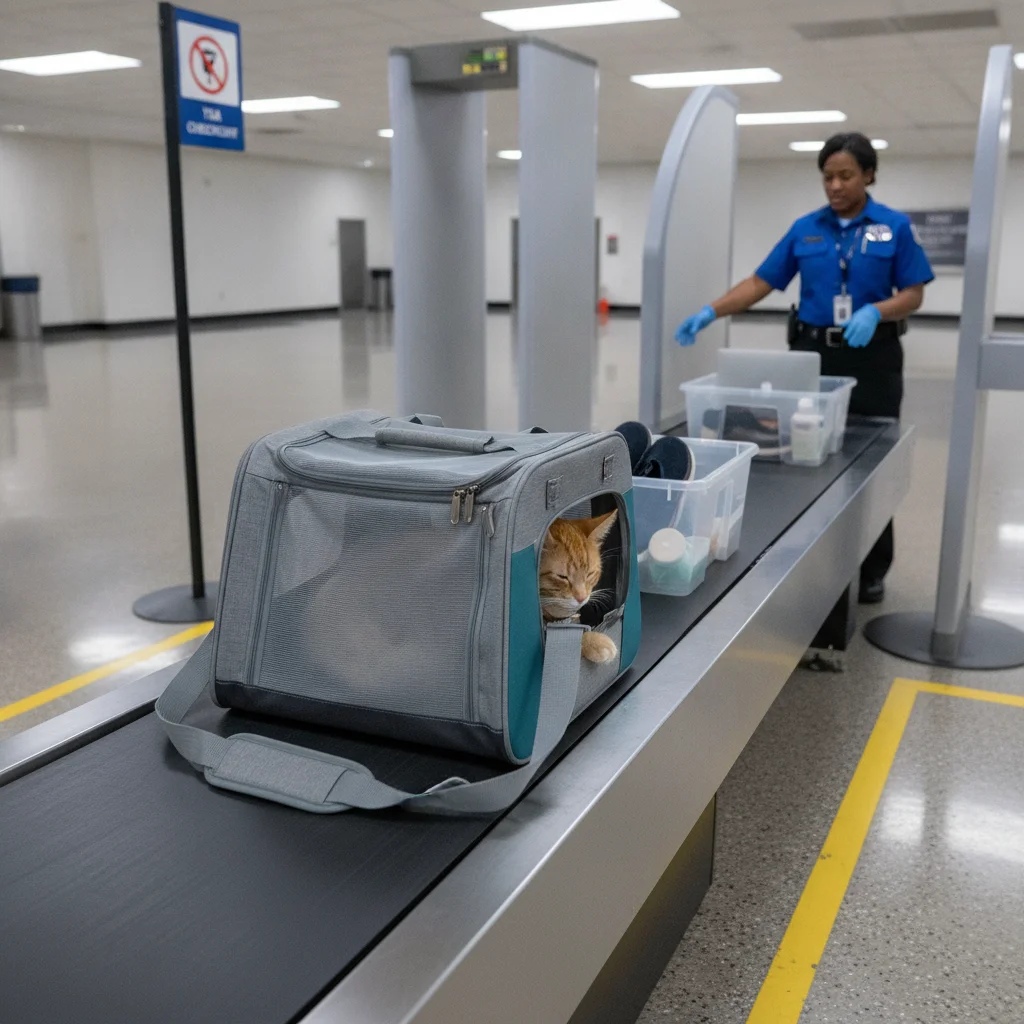
TSA’s small-pets page is short on purpose. Remove the animal from the carrying case. Send the empty case through the X-ray. Keep control of the pet on a leash or in your arms. Take the leash off if you are carrying the animal through the walk-through metal detector. Officers may swab your hands for explosives residue.
Never put a live animal through the X-ray tunnel. TSA has published incidents where pets went through anyway. The machine screens property. The pet is a passenger who happens to have fur.
TSA wants the pet out of the carrier and the empty bag on the X-ray belt; the animal never goes through the tunnel.
Harness on before the zipper opens
The dump happens in the three seconds after the zipper, not during the X-ray. Fit a harness (not a breakaway collar) at the house or in the car. Clip a leash. Then unzip at the bins. A cat in only a collar will reverse out of it when the belt starts moving.
Hold the cat against your chest facing inward, or keep four paws on the floor with the leash short. Dogs who will heel can walk the metal detector; cats almost never should. If you cannot control the animal at home in a hallway, you will not control it next to a bin of laptops.
Ask for a private screening room before you unzip if the cat is an escape artist or the dog startles. TSA’s own checkpoint tips tell skittish-pet owners to request that room and walk there with the animal still in the bag. That is not a special favor. It is how you avoid a cat in the sterile area.
A cat who bolts at the bin line is a private-screening request, not a tighter zipper after the fact.
What goes in which bin
The carrier is property. Shoes, liquids, and laptops still follow the lane’s usual rules. Do not nest a full water bottle inside the bag and hope the officer ignores it. Ice packs and wet food cans are liquids/gels in this context; freeze-dried food in a sealed pouch is easier.
Absorbent pads, a worn T-shirt, and a collapsible bowl can stay in the bag as it X-rays. Medications should be in their labeled bottles in your personal item, not loose in mesh the cat can shred.
- Phone and boarding pass in a pocket you can reach with one occupied arm.
- Leash in the hand that is not holding the cat.
- Zip the bag the moment it exits the tunnel, before you set the pet down “for a second.”
PreCheck, family lanes, and working dogs
PreCheck does not let the pet ride the belt. You still take the animal out. You may keep shoes on. The empty carrier still X-rays. Family or TSA Cares lanes are slower and often calmer; use them if the cat melts down at conveyor noise.
Government working dogs staff some checkpoints. If your pet will lock onto a K9, ask to move lanes. Do not “introduce” them. Recreate the pet in the composure area away from the rollers, not on the roller table.
There is no TSA hologram that makes a 22-inch bag legal on your airline. Officers screen you. The airline still owns the under-seat box.
Day-of packing that survives a four-hour hold
The bag you practiced with on the living-room rug is not the bag after a delay, a soiled pad, and a 14-pound cat who has decided the zipper is a threat. Pack for the hold, not for the Instagram boarding photo.
Line the floor with a trim-to-fit absorbent pad, then a familiar towel or shirt on top so claws have fabric, not slick plastic. Put a spare pad in your personal item, not only in the pet bag—once the carrier is under the seat you will not unpack it to reshuffle layers.
Food, water, and accidents
Skip a full meal in the three hours before security if the animal gets nauseous. A few familiar calories after you are through the checkpoint beats a vomit event in the first bin. Frozen water in a small bowl melts slowly; an open cup in mesh soaks the pad and then the human’s lap.
Airline rules usually forbid opening the carrier in the cabin. That means the animal cannot “just use a litter box” at 30,000 feet. For cats, an empty bladder before the airport and a pad they already accept is the plan. For dogs, a relief walk before security and again at the post-security pet area if the airport has one.
If you must offer water in the bag, use a no-spill bottle clipped so it cannot roll under the pet’s chest. Dump leftover water before the bag goes under the seat so the well does not become a puddle against someone else’s laptop backpack.
Scent, toys, and what not to sedate
One worn shirt beats five new toys that rattle. Cats hide; a drape that still leaves two mesh walls open is comfort, not a cave that blocks the airline’s ventilation rule. Dogs pant; do not bury the mesh because the terminal is bright.
Do not sedate a cabin pet because a blog said melatonin is harmless. Groggy animals cannot brace, cannot thermoregulate on a hot jet bridge, and may vomit with a suppressed gag. If a veterinarian who knows this animal writes a plan, that is a medical decision—not a packing hack. Many U.S. airlines discourage or refuse sedated pets in the cabin.
Pheromone sprays are optional. Test them at home. A first-time spritz in the TSA line is how you add a smell the cat does not have a file for.
Weight on the special-services scale
Some aircraft and cabins weigh pet plus carrier together. American’s three-cabin A321T is the famous 20-pound combined cap for the compartment up front. Most mainline Economy wells do not print a weight, but a 16-pound cat in a 6-pound bag is already a different object than the empty listing.
Weigh both the night before. If you are close to a published combined limit, lose the rigid insert, the extra blanket, and the metal bowls. The scale at check-in is not a negotiation.
Gate to takeoff: under-seat placement without a dump
Arrive early enough to check in the pet at the ticket counter or special services if the airline requires a sticker. The sticker is not decoration. It tells the gate you are a counted cabin animal, not a surprise.
Keep the carrier zipped in the boarding area. Jet-bridge gaps, service-dog teams, and rolling bags are all extractors. If the dog must toilet, use the designated relief area, then re-zip before you join the queue.
Boarding group versus the well filling up
If the airline boards cabin pets with an early group, take it. The well in front of you is also where the passenger in that seat wants their backpack. Once a 20-inch roller is jammed in, your legal bag has nowhere to live and you are in a gate-check argument you cannot win with a PDF.
Place the carrier under the seat in front of you, not in the overhead. Overhead is cargo with worse airflow and a slam risk. Unfold any expandable panels only if the airline’s live page still calls that size legal—which it almost never does. Collapsed is the cabin shape.
Windows often have a cleaner box than aisles. Confirm you are not in a row the pet page forbids. If the person in front reclines into your only cubic inches, you still cannot put the cat in the aisle.
Takeoff noise, pressure, and meowing
Takeoff is loud and the floor vibrates. Cats vocalize. That is not an emergency by itself. Opening the bag “to comfort them” is how you create an emergency. A finger through mesh, a voice they know, and a bag that does not slide are the tools you have.
Pressure changes bother some dogs more than cats. Swallowing and yawning are normal. Drooling plus panic plus vomiting is a vet conversation after you land, not a reason to unclip at 10,000 feet.
Keep your feet from crushing the mesh. Life-vest pouches and IFE boxes already stole depth; your heels should not steal the rest. If the bag will not go fully under, you picked the wrong seat or the wrong bag—say so to the crew before pushback, not after the safety demo.
Connections that are too tight for a mammal
A 40-minute connection can be legal for a human with a backpack and illegal for a cat who must toilet, a dog who must walk, and a second TSA if you exit sterile. Build 90 minutes or more when the pet has to re-clear security. International-to-domestic is the classic trap.
If the inbound is late, tell the gate you have a cabin pet before they rebook you onto a full aircraft. Pet quota is not the same as open coach seats. A rebooking that drops the animal into cargo is a refusal, not a convenience.
Connections, landing, and the first relief stop
Stay seated until the people in your row are actually moving. Unzipping in the aisle during deplaning is how a cat meets 150 rolling bags. Carry the closed bag off the aircraft, then use a quiet stretch of jet bridge or the first pet relief area.
Do not open the carrier in baggage claim “so they can see you.” Baggage claim is a stampede. A harnessed dog can walk there. A cat should stay zipped until you are in a room, a car, or a designated relief space with a door.
Post-flight litter and walks
Cats often refuse a novel box after adrenaline. Offer the pad they already used, in a bathroom stall if that is the only enclosed space. Dogs need a relief area map before you land; screenshot it, because you will be one-handed.
Offer water first, food later if they were fasted. A sudden full meal after a stressful landing is a vomit risk in the rental car. Watch gums and breathing on brachycephalic dogs; heat on the jet bridge is the dangerous part, not the cruise altitude.
International paperwork at the first desk
Destination agriculture, not TSA, decides whether the cat enters. Have originals (health certificate, rabies, titers if required) in your hands, not in checked luggage you do not have yet. USDA APHIS and the destination embassy pages beat a Facebook group’s 2019 PDF.
If a connector country requires a layover inspection, that is a planned stop, not a surprise at the gate. Cabin pets still need the same documents as hold animals on many routes. The soft bag does not waive rabies timing.
Coming home to the United States, cats and dogs still face CDC and USDA rules that have changed more than once since 2024. Recheck the live pages for your species and country of origin before you buy the return. Do not treat a U.S. passport as a veterinary document.
When to skip a connection entirely
Skip the tight connect if the animal is already soaked, overheated, or so panicked the bag is a weapon. A later nonstop costs money. A dumped cat in a foreign sterile area costs more. Crew can only work with an animal that is still in a closed, legal carrier.
If a gate-check is offered because the well vanished, treat that as a different product. Many “we’ll take it at the door” tags send the bag into the cargo hold. For a cat, that is often a hard no. Rebook or wait rather than pretending a cabin pet is now luggage.
If the bag fails the well, fix the bag not the itinerary
Ops cannot rescue a rigid 12-inch-tall tote on a JetBlue 8.5-inch page. Measure the loaded bag the way a gate agent will, then buy or swap using the cabin soft-sided carrier buying guide. If you are choosing among the three bags frequent flyers actually argue about, use Sleepypod Air vs SturdiBag vs Mr. Peanut's.
Practice the TSA unzip at home: harness on, timer for 20 seconds, pet out, bag “on the belt” (the table), pet back in. If you cannot do it in the kitchen, you will not do it at the checkpoint. That rehearsal is the whole article in one drill.
Fly the shortest nonstop you can buy the first time. Collect data: did the well accept the loaded height, did the zipper still close after security, did the animal eat the next day. Change one variable per trip. The reservation, the lane, and the bag are three different failure modes; do not “fix” all three with a new Amazon tote the night before departure.
Frequently Asked Questions
Can you fly with a cat in the cabin on U.S. airlines?
Yes, if the airline still has cabin-pet inventory on that aircraft, the cat fits in a soft-sided carrier under the seat, and you paid the pet fee on the reservation. TSA will screen the cat and the empty bag; the airline still owns the size and quota rules.
Do I have to take the cat out of the carrier at TSA?
Yes. TSA tells you to remove the pet, X-ray the empty carrier, and carry or leash-walk the animal through the metal detector. Never send a live animal through the X-ray. Request a private room before unzipping if the cat is likely to bolt.
How much does it cost to fly a cat in the cabin?
On many United, Delta, and American U.S. tickets in 2025–2026 the cabin pet fee has sat near $150 each way, collected in addition to the human fare. Other airlines print different fees. Confirm the live pet page; the fee does not make an oversized bag legal.
Can a small dog walk through the metal detector on a leash?
TSA allows walking a leashed pet through if carrying is not practical. Keep the leash short, watch for working K9s, and still X-ray the empty bag. Take the leash off if you pick the dog up to go through the detector so the metal hardware does not alarm by itself.
Which airline is easiest for cabin pets?
The easiest airline is the one whose live under-seat box matches the loaded bag you already own, with a nonstop and a seat that still has a well. Quota, regional jets, and codeshares break “best airline” lists. Measure first, then pick the metal.