People comparing under seat pet carrier dimensions already own a tote stamped “airline approved.” They need the published L×W×H for the ticketed airline, then the loaded height that actually slides into that aircraft’s footwell.
This is a measuring page, not a sixth roundup of cabin bags. Policies move. Confirm the live pet page for your itinerary and aircraft before you buy, and measure the bag you already own the same way a gate agent will: with the pet inside.
If you still need a bag, start with our cabin soft-sided carrier buying guide. If you are choosing among the three bags frequent flyers argue about, use Sleepypod Air vs SturdiBag vs Mr. Peanut's.
Why one “under 18 inches” rule fails every airline
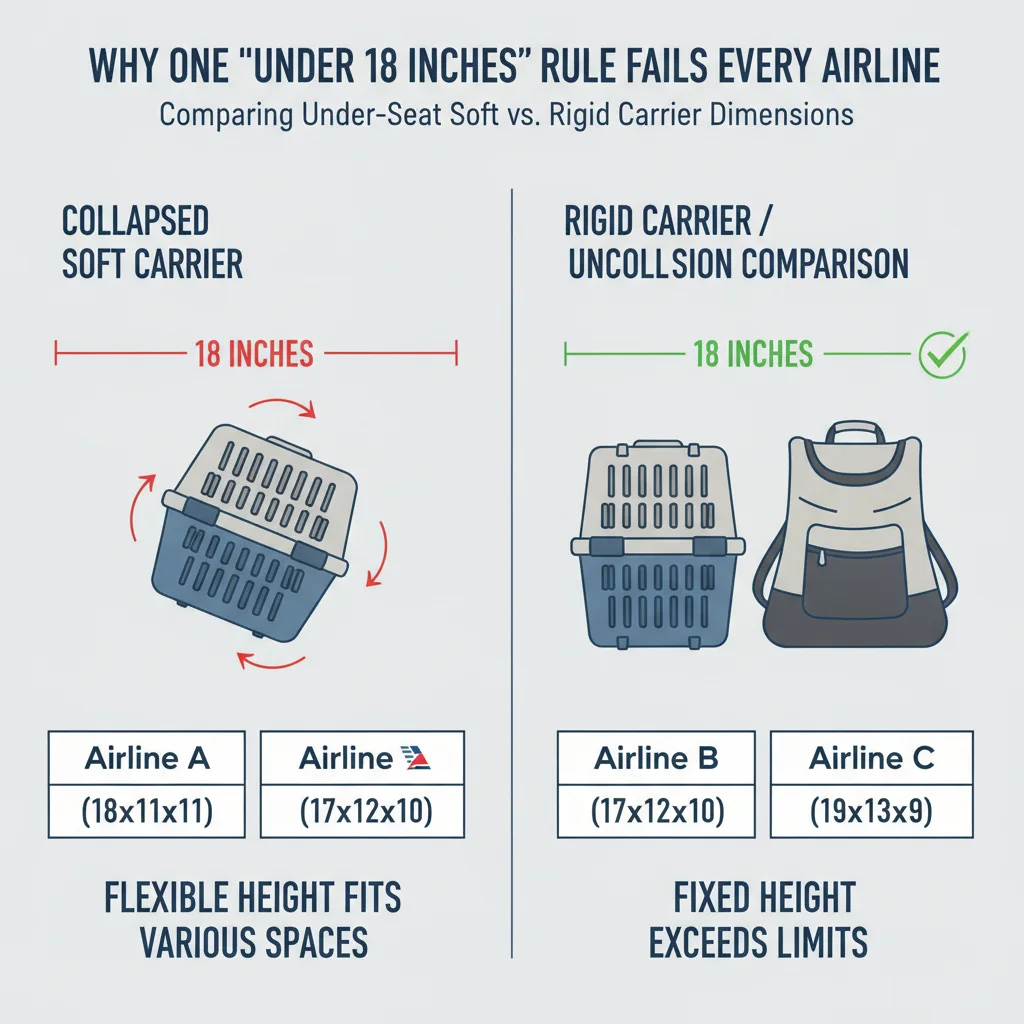
Amazon listings treat 18 inches as a passport. United, Delta, and American happen to print an 18-inch long side on their soft-sided boxes. JetBlue’s long side is 17 inches. Alaska’s published soft-sided box is 17 × 11 × 9.5 inches. Height, not length, is usually the gate failure.
Airlines also refuse to label the three numbers the same way. United prints 11 in × 18 in × 11 in and never writes “length,” “width,” or “height” on that line. American’s table header says length + width + height. JetBlue labels all three. If you map United’s unlabeled triplet as 11-inch length, you built a bag that will not exist under a 737 seat.
The second lie is that the PDF box equals the plastic well. Seat pitch, IFE boxes, life-vest pouches, and the metal bar under the seat all steal depth. A bag that “fits United” on paper can still fail a window seat on a 757-200, which United itself flags as window-only for pet carriers in Economy.
Seat pitch vs under-seat depth
Pitch is the distance between rows, not the cavity your bag lives in. A 31-inch pitch still hides a 9-inch-deep well once you subtract the seat structure and the passenger’s own feet. Soft-sided bags survive that gap because they squash; they still have a floor, zipper tape, and a pet who will not flatten.
Measure depth at home by sliding the loaded bag under a sofa or coffee table with the same clearance you expect at the gate. If the roof hits before the bag is fully under, that is your aircraft problem in miniature.
- Depth fails first on regional jets and on seats with IFE boxes bolted to the frame.
- Width fails on middle seats that share a well with the neighbor’s feet.
- Height fails whenever the published box is 11 inches and the bar is 9.
Bulkhead and exit rows
Bulkheads have no under-seat stowage. Exit rows are blocked by FAA rules, not by bag size. United also bans pets in Premium Plus and in the front row of each cabin. Delta blocks bulkheads, exit rows, “no stowage” seats, Delta One / flat-beds, specified A330 rear blocks, and center seats on the 757-200.
American’s three-cabin A321T is the extreme case: First has no under-seat stowage, so carriers go in a front compartment, and pet plus carrier together must not exceed 20 pounds. That 20-pound rule is an A321T check-in weigh, not a fleet-wide cabin limit.
United’s published soft-sided maximum is 11 in × 18 in × 11 in, and on a Boeing 737 MAX the carrier can be no more than 10 inches tall.
Regional jets vs mainline
American Eagle hard-sided limits drop to 16 × 12 × 8 inches. Soft-sided on American is still listed as 18 × 11 × 11 on all flights, with the extra sentence that the bag must fit without being “excessively” collapsed. On an ERJ-175 that sentence is the whole review.
United Express is not covered by the mainline table. United tells you to contact them for Express. Treat a CRJ or E175 connection as its own aircraft, not as “the United 18-inch bag.”
Published under-seat limits by US airline (November 2026)
Numbers below are the airline’s own published boxes as of November 2026, not Amazon “fits most airlines” copy. Where an airline does not label L×W×H, we keep their order and say so. Always re-open the live page the week you fly.
| Airline | Soft-sided published box | Hard-sided | What the page actually says |
|---|---|---|---|
| United | 11 × 18 × 11 in (unlabeled order; commonly mapped 18 L × 11 W × 11 H) | 9 × 17.5 × 12 in | Must fit under the seat. 737 MAX: no more than 10 in tall. No weight or breed cap. |
| Delta | Recommends 18 × 11 × 11 in | Not printed | Maximum is the aircraft well. Soft-sided, leak-proof, 3-side vents domestic / 4-side international. |
| American | 18 × 11 × 11 in on all flights | Mainline 19 × 13 × 9; Eagle 16 × 12 × 8 | Soft bags may be slightly larger if they still fit without excessive collapse. Mesh on 3+ sides. |
| JetBlue | 17 L × 12.5 W × 8.5 H in | Same numbers | Labeled L/W/H. One pet per carrier. Leak-proof bottom. |
| Alaska | 17 × 11 × 9.5 in | Not allowed in cabin | Soft-sided only. Two same-species pets of similar size may share. |
| Hawaiian (Alaska-operated policy) | Treat as Alaska’s 17 × 11 × 9.5 in unless your ticket still shows a Hawaiian-only page | Soft-sided cabin | Confirm the operating carrier after the merger, not the marketing name on the app icon. |
| Southwest | Not a stable number on the current help page | Soft-sided recommended | Must fit under the seat; aisle wells vary. Older charts listed 18.5 × 13.5 × 8.5 in; some 2026 roundups quote 18 × 10.5 × 10. Call before you trust either. |
Read United’s traveling with pets page for the unlabeled triplet, the 737 MAX 10-inch height, and the seat map footnotes. Read Delta’s pet travel overview for the “aircraft dimensions of your flight” sentence. Read American’s pets page for the soft vs hard table and the A321T 20-pound compartment.
Delta recommends a soft-sided kennel of 18 × 11 × 11 inches because that size fits most aircraft types, not because every seat well is that deep.
United, Delta, American
Those three share an 18 × 11 × 11-inch marketing silhouette and then diverge. United splits hard vs soft and adds aircraft footnotes. Delta refuses a hard maximum and asks you to bring kennel dimensions when you call Reservations. American prints two hard-sided boxes and a “slightly larger” soft-sided escape hatch that a gate agent can still refuse.
United’s 737 MAX 10-inch height is the one number Amazon never prints on a Sleepypod listing. If your itinerary includes a MAX segment, measure compressed height with the pet inside against a 10-inch stick, not against the 11-inch PDF.
Delta collects $150 each way for tickets issued on or after 8 April 2025 on U.S./Canada itineraries. United and American cabin pet fees sit in the same $150 band on domestic trips. Fees are not size. A legal bag still gets tagged at the special-services counter.
Southwest and JetBlue
JetBlue is the honest chart: 17 × 12.5 × 8.5 inches, labeled. An 11-inch-tall SturdiBag Large does not “almost” fit that height. It has to flex, and American-style “not excessively collapsed” is not JetBlue’s sentence.
Southwest’s current help copy leans on “fits under the seat” and tells you aisle seats can be tighter. That is operationally true and useless for shopping. If you fly Southwest often, size for 8.5–10 inches of height and 10.5 inches of width, then call with the bag on the scale. Do not buy a 11.5-inch-wide Large and hope the fabric folds in the jetway.
JetBlue labels length, width, and height: carriers cannot exceed 17 in L × 12.5 in W × 8.5 in H.
Alaska and Hawaiian
Alaska’s 17 × 11 × 9.5-inch soft-sided box is the multi-airline shopping target if you also fly JetBlue on other trips—except JetBlue is 8.5 inches tall, so Alaska’s 9.5 still overshoots JetBlue. The bag that truly threads both is closer to 17 × 11 × 8.5 with a pet who can still turn.
Hard-sided cabin kennels are a non-starter on Alaska. If your “airline approved” crate is a plastic Kennel Cab, Alaska is not the ticket. Hawaiian-branded flights now often inherit Alaska’s cabin rules; verify the operating carrier on the ticket, not the logo on the email header.
Soft-sided collapse: real inches when compressed
Published exterior size is the bag empty on a warehouse floor. Gate fit is the bag with a 9–16 pound animal, a pad, and whatever the brand calls “flex height.” Those are different objects.
Sleepypod’s Air page lists 16 to 22 inches long × 10.5 wide × 10.5 tall, with interior 15–21 × 9.5 × 9.5, for pets 18 pounds or less. Retailer spec sheets for Air 2.0 list compressed 16 × 10 × 8 inches. Length is what Sleepypod actually collapses; height stays near 10.5 unless you force the roof.
SturdiBag Pro 2.0 publishes rest dimensions by size. Large is 18 × 11.5 × 11.5 inches. Small is 18 × 10 × 9.25. Medium is 15 × 12 × 11.75. The brand’s own FAQ says listed height is at rest, and flex-height rods are the wiggle room. XL and XXL are not cabin tools.
Sleepypod Air and SturdiBag
Sleepypod Air at full 22-inch length is longer than every U.S. cabin box in the table. You are buying a bag that must be shortened under the seat. If the cat will not curl, the 22-inch lounge is a lie at takeoff.
SturdiBag Large is 0.5 inches wider and 0.5 taller than the United/Delta/American 11-inch box. On paper it fails. In practice the rods flex and frequent flyers shove it under 737 wells all year—until the pet braces and the roof will not go down. That is a behavior problem, not a listing problem.
Sturdi’s FAQ names Large Cube and Medium as the sizes that “meet all major airline specifications,” and Small/Large as “most.” Treat that as a brand claim. Medium at 15 × 12 × 11.75 trades length for width; JetBlue’s 12.5-inch width still has room, but 11.75-inch height does not.
Mr. Peanut’s and Amazon generics
Sherpa-class totes (Mr. Peanut’s Gold Series and unlabeled Amazon clones) print 17–18 × 10–11 × 8–10 inches depending on the SKU of the week. The listing is not a caliper. Measure the empty bag, then measure it loaded. Zipper tape and a stiff base add the quarter-inch a JetBlue template will catch.
Expandable side panels void the cabin box the moment they are unzipped. If a Petsfit-style bag is legal, it is legal collapsed. Photograph the bag zipped down before you leave home so a gate argument has a picture, not a memory.
- Empty measurement: longest exterior including mesh bulge, not the fabric label.
- Loaded measurement: pet, pad, and any rigid frame, roof pushed to the height you will actually use.
- Template check: a cardboard sleeve cut to the airline’s three numbers, not a tape draped over the handle.
Measuring at home before you book
Cut a cardboard sleeve to the published box of the most restrictive airline on the itinerary. United plus JetBlue means you size to JetBlue’s 8.5-inch height, not United’s 11. Put the pet in the bag, wait two minutes, and slide. If you need a knee on the roof, the gate agent will too—and they can refuse.
Weigh pet plus bag on a bathroom scale. United prints no cabin weight cap. American’s 20-pound rule is aircraft-specific. Other airlines still have agents with opinions and a hanging scale. A 17-pound cat in a 5-pound Sleepypod is 22 pounds of “please don’t make me gate-check this.”
Book the pet onto the reservation before you fall in love with a seat map. Delta is first-come for cabin pets and wants kennel dimensions on the phone. United wants “Travel with a pet” on united.com, not the app. A perfect bag on a flight with a full pet count is cargo or a rebook.
Pet plus carrier weight and gate-check risk
Size failures look like a template. Weight failures look like a hanging scale and a polite suggestion that the bag go below. Below is not a cabin. On U.S. majors, cargo pet programs for ordinary travelers are mostly gone; United’s PetSafe passenger program is closed except for qualifying military and State Department moves.
If the agent will not let the bag under the seat, you are not choosing a different bin. You are choosing not to fly, buying a second ticket on a later aircraft with a deeper well, or—rarely—checking a hard crate on an exemption you probably do not have.
Combined weight limits
United: no published weight or breed limit; the pet must fit the carrier and the carrier must fit the well. Delta: no combined-weight number on the pet overview; the pet must be able to move without touching or sticking out. American: 20 pounds for pet plus carrier in the A321T premium compartments that lack under-seat stowage; the rest of the fleet is still “fits comfortably inside.”
Do not treat 20 pounds as a secret industry standard. Treat it as a specific American check on a specific Airbus. If a Facebook screenshot says “Delta is 20 pounds,” ask for the date and the aircraft. Delta’s current public page does not print that number.
Scale tactics at the gate
There is no clever tactic. Put the pad in the bag. Put the pet in the bag. Hold the hanging scale yourself if they offer it so the bag is not yanked by a zipper. If you are over a posted limit, removing a fleece pad is the only honest ounce you can dump.
Do not empty water bowls into the jet-bridge carpet and call it compliance. Do not switch to a smaller bag at the counter unless the pet can still stand and turn. A bag that “fits” with a flattened animal is a welfare failure and an easy deny.
- Arrive with a second, smaller soft bag only if the pet has practiced in it.
- Never count on a hard-sided crate as a backup cabin plan.
- If the flight is a MAX or an E175, assume the scale is optional and the template is not.
When hard-sided gets forced
Hard-sided cabin kennels are legal on United and American within their smaller boxes, and on JetBlue at the same 17 × 12.5 × 8.5 as soft bags. They are not a solution to a soft bag that is too tall. Plastic does not flex. Alaska will not take them in the cabin at all.
IATA cargo crate charts (100-series and up) are irrelevant to this page. Those numbers are for hold travel you mostly cannot buy. Quoting a 21 × 16 × 15 crate as “airline approved” is how Amazon generics get people to the wrong counter.
Aircraft families where soft carriers fail most
The bag did not shrink between booking and boarding. The well did. These are the airframes frequent flyers name, with the airline’s own footnotes where they exist—not a seat-map dump from a Facebook album.
Embraer 175 under-seat bins
United’s own cabin-pet table lists ERJ 175 separately: three pets in Economy, one in premium. That is a density note. The physical well is short and low. A SturdiBag Large at rest height will need the rods flexed before the bag is fully under, and a braced terrier can pop the roof back into the passenger’s shins.
American Eagle ERJ-175 / CRJ flying as American still uses the all-flights soft-sided 18 × 11 × 11 print, plus the “not excessively collapsed” test. If your connection is an Eagle E175, that test is the itinerary. Do not size the bag to the mainline 737 you boarded in Dallas.
United Express on the same airframe is outside the mainline table. Call. Screenshot the answer. Bring the screenshot.
Boeing 737 window seats
United’s 737 MAX footnote is height: 10 inches, not 11. The same page tells you some 737s limit pets to one per person because middle-seat wells are small. Window vs aisle vs middle is not a preference; it is a cavity.
On United’s 757-200 in Economy, the footnote is window seat only for the carrier to fit. If you auto-assigned 15B, you did not have a pet plan. Move before you leave for the airport.
Delta blocks center seats on the 757-200 for cabin pets. That is the same airframe family, different seat-map logic. Always open the operating carrier’s pet page, not a generic “737s are fine” thread.
Airbus A321 rear rows and odd cabins
American’s A321XLR notes row 11 as no under-seat storage. The three-cabin A321T puts First carriers in a front compartment and caps pet plus bag at 20 pounds. Seat 13D on the A321neo is called out as blocked for pets.
Delta’s A330 blocks are rows 46–51 on the -200 and 54–59 on the -300. Those are not “rear of the plane is roomy” rows. They are no-pet blocks. Widebody bulk is not extra footwell.
United Premium Plus and the front row of each cabin are out. If the only seat left at boarding is a bulkhead, the bag has nowhere legal to live.
What this page will not pretend
A single-dimension Amazon chart that says “under 18 inches” is a keyword, not a measurement. Hard-crate IATA series numbers belong to cargo, which most of these airlines no longer sell to civilians. Unverified Facebook templates with a Sharpie and a 737 seat are anecdotes; they are not a substitute for the airline’s current page plus a cardboard sleeve at home.
WestJet, Air Canada, and the 8-kilogram European cabins are different math. If your trip connects to those, size to the tightest international segment, not to United’s 11-inch height. This page stays on U.S. majors because that is the search people actually type after they already bought a Sleepypod.
Nothing here is a veterinary fitness exam, a crash-test certificate, or a promise a specific gate will accept a specific SKU. The winning move is: pick the most restrictive published box on the ticket, measure the loaded bag against that box, then pick a seat that still has a well.
Frequently Asked Questions
What size bag actually fits every U.S. major?
Nothing honest fits every published box without collapse. JetBlue’s 8.5-inch height and Alaska’s 9.5-inch height are tighter than United’s 11. If you fly more than one airline, shop toward 17 × 11 × 8.5 inches loaded, then confirm the pet can still turn. Southwest still needs a phone call because its help page will not hold still.
Does United’s 11 × 18 × 11 mean 11 inches tall?
United does not label the three sides. The 737 MAX sentence is the only line that says “tall,” and that cap is 10 inches. Map the unlabeled triplet as an 18-inch long side and 11-inch height the way most flyers do, then still treat 10 inches as the MAX rule. Measure loaded height; do not argue unlabeled order at the counter.
Can I use a hard-sided carrier under the seat?
United and American publish smaller hard-sided boxes than their soft-sided boxes. JetBlue uses the same 17 × 12.5 × 8.5 for both. Alaska does not allow hard-sided kennels in the cabin. A hard box that matches United’s 9 × 17.5 × 12 still has to physically enter the well; it will not flex when it does not.
Why did my “airline approved” Sleepypod fail a regional jet?
Sleepypod Air’s own exterior is 16–22 × 10.5 × 10.5 inches. The 22-inch lounge is longer than every U.S. cabin box until you compress length. An E175 well can still be shorter and lower than a mainline 737, and a pet who will not curl keeps the bag at its largest size. Approval stickers are marketing.
Do I need to worry about pet plus bag weight?
United prints no cabin weight cap. Delta’s public pet page does not print one either. American does print 20 pounds for pet plus carrier in A321T premium compartments with no under-seat stowage. Weigh anyway. Agents still have hanging scales, and a 22-pound load is a conversation you do not want during boarding.