This Sleepypod Clickit Sport review treats the vest as a car restraint with a published lab record, not as a sled you can recreate in a driveway. The current retail SKU is the Clickit Sport Plus bundle on Sleepypod’s product page, listed from $103.49 as of 8 November 2026. Independent five-star paperwork lives on the Center for Pet Safety Clickit Sport listing. Fit, belt routing, and weekly clinic on/off decide whether that paperwork ever meets the dog.
This write-up draws on that CPS record, Sleepypod’s sizing chart and crash-replacement terms, retailer notes on sighthound bodies, and the Dog Meets Baby Clickit Sport Plus review (updated 28 August 2026), which states it did not crash-test or personally wear the vest. No household here ran a year-long wear log. Where owners describe ride comfort, those notes are attributed and linked.
If you need a three-brand stay-on shootout, use the Clickit Sport vs Kurgo Impact vs Ruffwear Load Up comparison. This page stays on one SKU: how it buckles, who it fits, what it costs, and when nylon should leave the car.
What the Clickit Sport actually does in a car
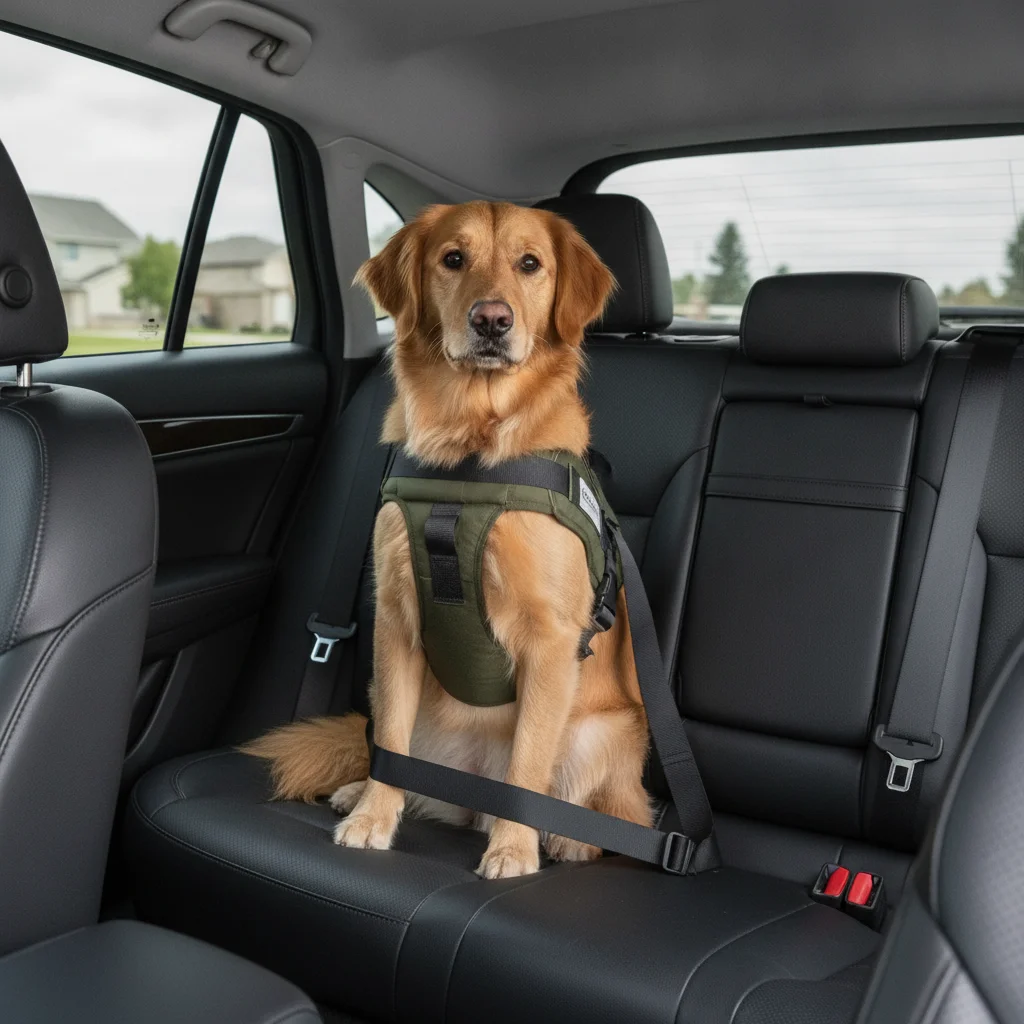
Sleepypod sells the vest as a three-point, energy-absorbing wrap. The company’s Infinity Loop webbing and padded chest panel are meant to spread collision force across the torso instead of concentrating it on a dorsal D-ring. The vehicle seatbelt threads a designed path on the vest, then latches in the car’s buckle. That is a different load path from a walking harness plus a grocery-aisle tether.
The brand also lists walking use and night-visible strips. Walking is a secondary job. The buying question for this niche is still the car: weekly clinic miles and highway stretches where a dog can become a projectile or a driver distraction.
- Seatbelt through the vest path, then the car latch—not a carabiner on a back ring.
- One seating position per dog. Do not share one belt across two animals.
- Use the current routing diagram, not a 2014 blog photo; hardware kits change.
Dog Meets Baby’s independent summary matches the catalog on that point: the Sport’s load path is the seatbelt-in-vest system. A short tether can still let a dog rotate into the seat ahead. If you want the taxonomy of CPS paper vs a manufacturer sled vs an untested clip, start with what “crash-tested” means for dog harnesses.
Sport vs Sport Plus
Search listings mix “Clickit Sport” and “Clickit Sport Plus.” Sleepypod’s live product is the Plus bundle: the padded Clickit Sport harness plus an S-Clip and a Buckle Shield. Those extras manage belt slack and keep a curious muzzle off the latch. They do not rewrite the CPS protocol. The certified vest is still the Clickit Sport construction CPS tested in 2014.
As of 8 November 2026, Sleepypod’s Sport Plus page showed $103.49 as the starting price. Dog Meets Baby recorded size steps on 28 August 2026: Small $103.49, Medium $109.24, Large $120.74, XL $126.49. Recheck the cart before you treat those as a quote; colorways move.
- Plus = harness + S-Clip + Buckle Shield on the current Sleepypod listing.
- Older “Sport” photos on marketplaces may omit those accessories.
- Price math below uses the $103.49 starting figure dated 8 November 2026.
What it is not
It is not a cabin-under-seat bag. Airline size limits and car collision loads are different jobs. For a flight leg, pick a carrier that actually fits the seat in front of you from the cabin-travel carrier shortlist.
It is not a crate. If the dog panic-peels every wrap, or the back seat is already full of a rear-facing child seat, a crash-tested crate class can be the calmer answer. Harness vs crate is a layout problem, not a loyalty test.
The CPS five-star record, in numbers
Center for Pet Safety’s public Clickit Sport page lists a five-star result under protocol CPS-001-014.01. Tests ran in July 2014. Report numbers are V14-698R for Small, V14-699R for Medium and Large, and V15-393F for XL. Passed testing: yes. That is independent of Sleepypod’s own FMVSS 213 / CMVSS 213 / ECE R44 marketing claims on the product page.
CPS also publishes rated dummy weights, which are easy to mix up with Sleepypod’s 18–90 lb sales band:
| Size on the CPS page | CPS rated test dog weight |
|---|---|
| Small | Rated to 25 lb |
| Medium | Rated 45–90 lb |
| Large | Rated 75–90 lb |
| X-Large | Rated to 90 lb |
CPS notes that it inspected Medium, Large, and XL Clickit Sport vests and found the same materials, stitching, and hardware. Dogs up to 90 lb who need Medium or Large, CPS says, get the same protection as the XL sample rated to 90 lb. That sentence is about construction sameness, not a promise that every 90 lb dog in a Medium will sit comfortably.
CPS certified Clickit Sport at five stars in 2014; certification describes a new sample on a published protocol, not a vest that has already been in a wreck.
Sleepypod separately says the Sport was validated at 30 mph in accredited labs against child-restraint standards. Those are manufacturer-directed tests. CPS is the third-party stamp this niche is paying for. Neither number is a home hard-brake. Vehicle direction, speed, neighboring seats, and a loose wrap still decide the outcome.
What the stars do not cover
The protocol does not grade parking-lot speed, salt-crusted webbing after a winter of Thursday dermatology visits, or a belt that only just reaches around a sideways sit. It also does not grade a walking harness you clip “for now” because the wrap felt slow.
For a ranked list of stay-on car harnesses in this same niche, see the hard-stop harness roundup. Clickit belongs in the CPS column there. This page asks the narrower buying question: will you actually thread this vest.
Rib-cage sizing, sighthounds, and the clinic lot sequence
Sleepypod sizes Clickit Sport Plus by rib cage, measured behind the front legs, not by “my last walking harness was a Medium.” The live Sleepypod sizing chart lists:
| Size | Rib cage (Clickit Sport Plus) | Weight band on the chart |
|---|---|---|
| Small | 16.5–22 in (41.9–55.9 cm) | 18–90 lb line (8.2–40.8 kg) |
| Medium | 22.5–28 in (57.1–71.1 cm) | 18–90 lb line (8.2–40.8 kg) |
| Large | 28.5–34 in (72.4–86.4 cm) | 18–90 lb line (8.2–40.8 kg) |
| X-Large | 34.5–40 in (87.6–101.6 cm) | 18–90 lb line (8.2–40.8 kg) |
Gaps between sizes are one inch. Measure standing, on a floor, with the tape snug but not cinched. Then sit the dog and look for the vest walking toward the ears. A wrap that looks tidy in the kitchen can climb once the dog tucks for a highway sit. Dog Meets Baby flags the same two owner patterns: the first adjustment is fiddly, and deep, narrow chests or long bodies land between sizes. Buy somewhere you can exchange inside the window.
DOG & CO.’s Sport Plus listing repeats Sleepypod’s sighthound caution: Greyhounds, Whippets, Salukis, Afghan Hounds, and Borzoi may not get a proper fit. Treat that as a stop, not a “size down and hope.”
- Measure rib cage, not coat fluff or a breed nickname.
- Confirm sit geometry before the return window closes.
- Sighthound and deep-narrow chests: verify the chart, then be ready to return.
Dogs under 18 lb
Sleepypod’s Sport Plus FAQ states that a dog under about 17–18 lb tends to have more fragile bone structure, and it points those pets toward crash-tested carriers rather than this vest. Do not put a 12 lb dog in an oversized Small “because CPS likes Clickit.” The Small CPS rating (25 lb dummy) is not a license to ignore the brand’s lower bound.
Belt reach and restricted sits
Owner threads describe a different failure than a popped clip: the seatbelt is too short once it threads both sides of a wide chest, so the vest wrenches the off-seat side. In a January 2025 r/dogs thread, a 55 lb lean shepherd mix sat at the top of Medium girth; the owner could not feed the belt without painfully cinching the far side unless the dog leaned into the seat. Replies there include a Large on a 60 lb dog that still trapped the animal when the belt locked, plus one report of a dog working free on the highway. Those are owner reports, not a lab retest. They are enough to make you mock-route the belt in your actual car before highway day.
If the dog only travels well lying down and the belt locks every time they shift, a crate with a published crash record may be kinder than forcing a vest sit. Comfort is not a safety add-on; a stressed dog that thrashes is a different load than a dummy.
Veterinary drop-off order
The Clickit wrap is slower than a dorsal clip. That matters when a dog already smells the clinic lawn. Stage the vest at home so the car step is belt-only. At the building, attach the leash while the vehicle belt is still latched, then release the car path, then open the door. Reverse that order and you are managing a dog in a driveway, not a restraint.
- Home: vest on, path hardware closed, leash in a pocket—not on the floor of the car.
- Arrival: engine still running or in park, leash on first, then belt off, then door.
- If that sequence feels like two extra minutes you will skip, this is the wrong vest.
A five-star wrap left on the floorboards is not safer than a manufacturer-tested car harness you will fasten. For storm-thrash on the same drive, the vest only holds the torso; pair it with a plan from how to calm a dog during a thunderstorm.
Cleaning, wear, and retiring after a wreck
Sleepypod’s current wash line is not a washing machine: wipe the vest front with a damp, soapy cloth and vacuum fur from the neoprene back. That matters for inspection. Wet, dirty nylon hides shine and grin at bartacks. Dry the vest, then look at the slot the seatbelt actually uses—that is the wear band—in daylight.
This page does not have a 12-month photo set from one household. What you can still do, because nylon and plastic age with use, is keep a dated photo of the belt path and latch on day one and recapture it each season of weekly clinic drives. Look for:
- Edge fuzz you can lift off the belt-path webbing.
- Bartacks that have opened or looked “grinned.”
- A latch that sits proud, takes three tries, or opens with a thumb and no remaining detent.
- Cracked housings, melted webbing, or a belt that walks out of the loop.
After any collision, stop using the vest even if the fabric still looks tidy. Sleepypod’s own Crash Replacement Program exists because a restraint’s integrity can be compromised in a wreck. Sleepypod customers may be eligible for a free replacement; other brands’ customers may get a 100% discount on a Sleepypod product. The program is listed as worldwide; shipping is not included. Claims ask for a police report and accident photos. Read the live form before you treat that as insurance. Terms change.
Do not rebuild a tired loop with a cheap buckle from a hardware aisle. Certification attached to a new sample. A patched vest is a different object.
Storage that ages a spare
Heat-soaked trunks and vests stuffed under crates cook plastic and crease load paths. Keep a spare—if you buy one—in a closet, not coiled under a crate all summer. Rain-soaked gear that lives on the floorboards should be dried and inspected, not replaced out of guilt because you did not want to look at it.
Cost if you actually buckle it
Take the 8 November 2026 starting price of $103.49. Fifty-two weekly clinic drives in year one is about $1.99 per fastened trip before tax and before any second vest. Twenty highway weekends on top of that drops the per-use figure further. Zero uses because the wrap felt slow makes the same $103.49 a coat hook. The expensive class only pencils if the belt goes through the path.
| Use pattern | About per fastened trip at $103.49 |
|---|---|
| 52 clinic Thursdays, year one | ~$1.99 |
| 52 clinic days + 20 highway days | ~$1.44 |
| Four interstate weekends, vest otherwise in the trunk | ~$25.87, and you still need a plan for Thursday |
Buy it, skip it, or move to a crate
Buy Clickit Sport (Plus bundle) when the dog’s rib cage hits the chart, weight sits in the 18–90 lb sales band, you have a full seating position, and you will thread the belt every time—including 12-minute clinic hops. Skip it when you already know you will grab a walking harness in the lot, when the dog is a sighthound shape the listing warns about, or when the belt in your car cannot complete the route without cinching.
| Situation | Clickit Sport? | Why |
|---|---|---|
| 18–90 lb, girth on the chart, will thread a belt weekly | Yes | CPS five-star vest plus a designed seatbelt path |
| Solo driver, spinning lot dog, hates two-hand gear | Unlikely | Unused CPS nylon does not restrain anyone |
| Under ~18 lb | No | Sleepypod points those dogs to crash-tested carriers |
| Greyhound-type chest or belt that will not reach | No until a mock fit in your car | Retailer and owner reports flag geometry, not star ratings |
| Needs an under-seat flight bag | No | Different product class |
If you want speed at the clinic door more than independent CPS paper, look at manufacturer-tested car harnesses you will actually latch, or a crate. Do not “upgrade” a walking vest with a $19 clip and call the words on the bag equivalent. Two load paths on one dog in one stop add swing; pick one path and inspect it.
Frequently Asked Questions
Is Clickit Sport the same product as Clickit Sport Plus?
The certified vest is Clickit Sport. Sport Plus, on Sleepypod’s current page, is that vest bundled with an S-Clip and Buckle Shield. CPS’s public listing still uses the Clickit Sport name and the 2014 protocol numbers. Buy the live bundle, then route the belt the way the current manual shows.
How should I size a Clickit Sport?
Use rib cage behind the front legs against Sleepypod’s chart (Small 16.5–22 in through XL 34.5–40 in), not a walking-harness size nickname. Sit the dog and watch for ride-up. Sighthound chests may never seat correctly; DOG & CO. reprints that brand caution. Measure before you open the package, and keep the return path open.
Can a dog under 18 lb wear Clickit Sport because CPS tested a Small?
Sleepypod says dogs under about 17–18 lb have more fragile bone structure and belong in crash-tested carriers. CPS’s Small rating to 25 lb describes its dummy, not a green light to ignore the brand’s lower bound. Put the small dog in the product class the maker specified.
When should I replace a Clickit Sport?
Replace after any collision, using Sleepypod’s crash-replacement form if you qualify. Replace sooner if belt-path webbing fuzzes, bartacks open, or the latch opens with no detent. Wipe-clean and dry the vest first so you can see the loop. Do not keep a wrecked sample because the hangtag still says five stars.
Does Clickit Sport stay on better than a walking harness with a carabiner?
On paper, yes: the seatbelt stays in a designed wrap instead of hanging from a leash ring. Stay-on still fails if you skip the wrap, size off coat fluff, or free the car path before the leash is on. Owner reports of highway peel-outs after a locked belt also show that a star rating does not fix a short belt or a wriggling sit.
Your next step
Measure rib cage on a hard floor. Open Sleepypod’s sizing chart and the CPS Clickit Sport page in two tabs. Mock-route your car’s actual seatbelt through the vest path before the first highway run. Photograph the loop and latch on day one so later shine has a baseline.
If you will not thread Clickit Sport on Thursday as well as on vacation Saturday, spend the money on the restraint you will fasten. Stars on a new sample only help when the belt is in the path.