People shopping for a chew proof dog cooling mat already watched a gel pad split at the binding. They need something that still cools a panting dog on third-floor vinyl, wipes after an accident, and does not turn a bored afternoon into a poison-control call.
This is a durability-and-cleanup ranking for apartment dogs who eat bedding. It is not a heatstroke protocol, not a “best cooling mat” Amazon clone, and not a promise that any pad is indestructible.
If the dog already treats fabric edges as a hobby, pair whatever you buy with a chew-hard enclosure. Our metal vs fabric playpen chew test is the adjacent problem: the mat only lasts if the dog cannot drag it into a private shredding session.
Rank cooling types by chewed-edge survival, not by Amazon stars
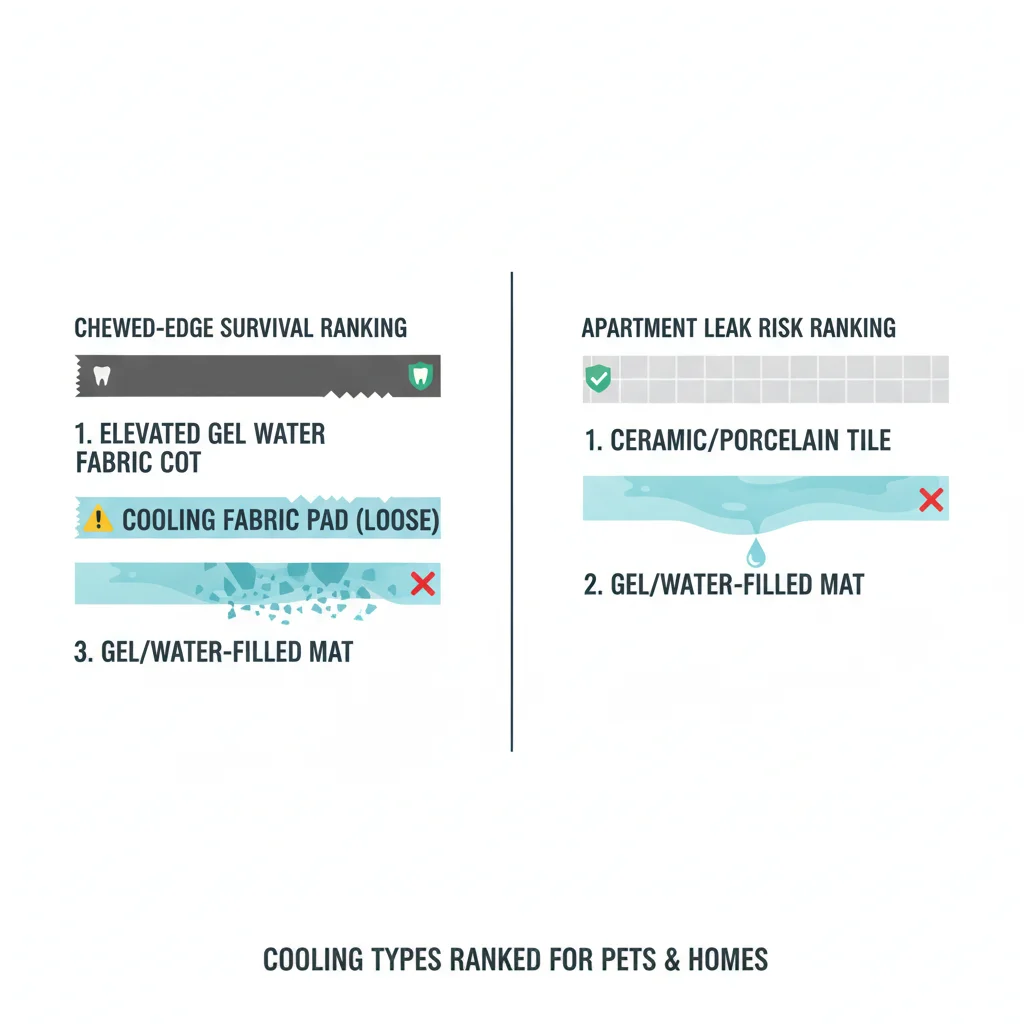
Star ratings collapse four different objects into one shopping carousel. A pressure-activated gel bladder, a water mattress, a cool-touch fabric sheet, and a mesh cot fail in different rooms of the apartment.
Score each type on four axes before you open a listing: what leaks, how the leak meets vinyl or laminate, whether a chewer can reach a seam, and whether the thing survives a machine or a hose. Comfort is fifth, not first, if last summer’s pad is already in the trash.
| Type | Chew / puncture | Leak on rental floors | Wash reality | Apartment fit |
|---|---|---|---|---|
| Gel / hydrogel pad | Fails at binding and nail holes | Sticky smear; possible toxin exposure | Wipe only; puncture ends the product | Cheap, then gone |
| Water-filled pad | Still puncturable; no gel | Water, not hydrogel; empty and inspect | Empty, wipe, air-dry; some covers wash | Heavy when filled; park it once |
| Cool-touch fabric mat | Edges fray; stuffing-free is better | None inside | Often machine-washable | Crate, couch, travel |
| Elevated mesh cot | Best if corners are armored | None | Hose or wipe; sling swaps on some models | Airflow; watch height in small rooms |
| Bathroom / kitchen tile | Nothing to chew | None | Mop | Free if the dog will lie there |
Use the table as a filter, not a scoreboard. A 40-pound chewer who starts at zippers should not “try one more gel pad.” A senior who never mouths objects and hates cots can still use a water pad on a hard floor.
- Hard floor under the cooler. Carpet stores heat and hides leaks. Vinyl, tile, and wood let a water pad dump heat the way the maker intends.
- Nails trimmed on a schedule. Dewclaws punch gel and water bladders even when the dog is not “a chewer.”
- Supervised first week. The first evening with a new object is when most bindings die.
An elevated mesh cot with covered corners outlasts most cooling Amazon pads for dogs who start at the binding.
What “chew proof” on a listing actually means
No cooling mat is chew-proof in the laboratory sense. Sellers use the phrase for ripstop slings, hidden seams, or aluminum frames that cover the chew start-points. They do not mean you can leave a bored terrier alone with a bladder of gel.
K9 Ballistics rates its own armored cots highly for chewing on its site. Treat that as a maker score, not a third-party crash test. Coolaroo and big-box cots often leave the fabric edge where a dog can get a molar on it.
If the dog has unzipped orthopedic beds, skip every hollow pad. Buy a cot whose frame buries the corners, or use tile and a fan. “Chew resistant” is a useful shopping filter. “Chew proof” on a $22 gel rectangle is marketing.
Gel pads: the leak, the vinyl, and the poison-control number
Gel mats are the default Amazon photo: a shiny rectangle that feels cool for a few hours, then “recharges.” They also concentrate the failure mode this niche cares about—punctures at the welded edge, then a smear that never quite leaves grout.
Makers still print “non-toxic gel.” That label is not a chemical assay. ASPCA Poison Control has warned pet owners about hydrogel in cooling pet pads, migraine wraps, and similar packs. Some polyacrylamide gels have carried high residual acrylamide, a neurotoxin.
Reported signs after ingestion have included vomiting, tremors, unsteadiness, sound or touch sensitivity, heart-rate changes, seizures, and death. ASPCA’s 2025–2026 research write-up describes analyzed gels far above expected residual acrylamide. Packaging that says “medical grade” does not settle the case.
ASPCA Poison Control has documented serious signs after dogs ingest hydrogel from cooling pads and similar packs; call 888-426-4435 and keep the packaging.
If the pad is already leaking on apartment flooring
Get the dog out of the room. Do not let them lick the puddle “to clean it.” Put on nitrile gloves. The ASPCA notes acrylamide can absorb through skin, so skip bare hands and skip a kitchen sponge you will use later.
Contain the smear with paper towels. Lift gel, do not smear it into the seams of vinyl plank. Bag the ruined pad, the gloves, and the towels. Keep the carton and any ingredient panel; a veterinarian will want the brand, not your memory of the Amazon title.
A gel smear on vinyl or laminate is a rental-deposit problem before it is a cooling problem: gloves, contain, then the product goes in the trash.
Wash the floor with the cleaner the flooring maker allows. Hydrogel can leave a tacky film that attracts grit. If the dog licked gel or chewed a corner, call your veterinarian or ASPCA Poison Control at 888-426-4435. Neurologic signs mean an emergency clinic, not a wait-and-see thread.
Apartment extras the product pages omit: gel in the expansion gap of laminate, gel in a rug pad, gel tracked onto a hallway runner you do not own. Photograph the floor before and after cleanup if you are in a deposit fight later.
Who can still own a gel mat
A dog that never mouths objects, that uses the pad in sight, and that has short nails can use a gel mat as a supervised nap tool. The Green Pet Shop Cool Pet Pad is unusually blunt: do not leave a chewer or scratcher unattended with it, and call a veterinarian if anything is ingested—even while they still call the gel non-toxic.
Arf Pets and similar solid-gel pads advertise a few hours of cooling and a short recharge. Believe the time window as a maker claim. Do not believe “non-toxic” as a chew license.
In a one-bedroom with a dog who already shredded a crate pad, gel is the wrong experiment. The replacement cost is not $25. It is a Saturday with gloves, a possible clinic invoice, and a landlord conversation.
Water-filled pads you can empty and inspect
A water pad is a bladder you fill from the tap. Heat moves into the water and then into the air or the hard floor. There is no hydrogel to ingest. There is still a puncture risk, and a filled large pad is heavy enough that you place it once.
K&H’s Coolin’ Pet Pad is the named apartment SKU for this job. The company stresses no electricity and no toxic gels, indoor or outdoor use, and placement on wood, tile, or other hard surfaces—not carpet, which holds heat. Street prices often sit in the $40–70 band depending on size and sales.
The related Cool Bed III is a bigger water mattress. K&H has described the large size as weighing on the order of 33–50 lb filled. That is a living-room object, not a tote you shuffle between rooms every evening.
- Fill on the final parking spot. Do not carry a full large pad down a hallway.
- Overfill makes a drum that sloshes and stresses welds. Underfill wrinkles and invites chewing at slack corners.
- Empty it into a tub or balcony drain if you need to move, wash, or store it. Never stab a suspected leak to “let it out.”
Leak behavior vs gel
A pinhole dumps water, not a neurotoxic smear. That is still a problem on laminate and on a downstairs neighbor’s ceiling if the pad sits on a soaked rug. It is a mop-and-fan problem, not an acrylamide problem.
Inspect weekly: corners, valve, and any cloudy film inside. Algae and biofilm grow if you leave the same water for a month in a warm apartment. Empty, rinse, and refill on a schedule you would believe for a water bowl.
If the dog mouths the valve, cover it or retire the pad. A chewed fill port is how a “no gel” product still becomes a flood. Dewclaws do the rest; keep them short the same way you would for a leather couch.
Wash, travel, and crate use
Most water pads are wipe-clean vinyl. They are not a substitute for a washable pee pad after an accident—urine sits on a slick surface and smells until you actually wipe it with an enzymatic cleaner.
Travel is the weak point. A filled pad is awkward in an elevator and illegal-feeling on a packed subway. Empty it, roll it, and refill at the destination, or use a fabric mat for trips and keep the water pad as the home station.
In a wire crate, a thick water mattress steals height and can fold against the bars where a chewer works the edge. If the crate is the only cool spot, a low fabric mat or a crate-sized armored cot is usually the cleaner fit.
Elevated cots: the apartment chewer’s default cooler
A cot is a taut sling a few inches off the floor. Air moves under the dog. There is nothing to puncture. The cooling is physics, not a phase-change packet: less contact with a heat-soaked floor, more surface area dumping heat.
That is why cots belong at the top of a chewed-edge ranking even though they look like “not a cooling mat.” For a dog who destroys bedding, the missing bladder is the feature.
Coolaroo’s Original is the common HDPE mesh on a raised frame. Hose it off on a balcony or wipe it in the tub. It promotes airflow; treat extra degree claims on Pro/HeatShield versions as maker language unless you have a thermometer log of your own.
Armored frames vs chewable edges
Chewers start at corners, then work the sling. An aluminum or covered-corner frame that the dog cannot peel is the difference between a cot that lasts a summer and a cot that lasts a weekend.
K9 Ballistics’ chew-oriented elevated beds use ripstop slings and armored frames aimed at dogs who have already shredded ordinary cots. They sell crate-fitting sizes and tell you to leave a sliver of clearance so the frame does not bind. Their “chew proof” language is still a brand promise; it is a more honest product category than a gel rectangle with the same words.
Budget steel cots from big-box brands often leave a hem. If your dog is an edge specialist, the $40 cot is a chew toy with legs. Spend on the frame, not on a second gel pad “for backup.”
- Height: a 7–8 inch cot can feel like a platform in a studio. Lower “pro” frames help seniors and short-legged dogs.
- Feet: rubber caps save vinyl. Bare metal feet telegraph every shift to the downstairs neighbor.
- Sling spare: if the maker sells a replacement deck, buy it when you buy the frame.
Where a cot fails in a one-bedroom
Some dogs refuse a hammock. They want to sprawl on a cool slab. Forcing a cot then becomes theater. Offer tile first; add the cot in the airflow from a window unit or a fan.
Cots also occupy floor plan. A large frame in a hallway is a shin-breaker. Measure the sleeping corner including the dog’s turn-around, not only the listing’s length.
Outdoors on a fire escape or a sun-baked balcony, mesh still helps, but metal feet can cook. Shade the cot. A cooling product does not replace water, shade, or a plan to get the dog inside when the apartment itself is a heat box. AVMA heat guidance is the medical line: heavy panting, drooling, unsteadiness, or collapse is a veterinary emergency, not a reason to buy another pad.
Fabric mats, tile, and when the SKU is wasted money
Gel-free fabric mats (cool-touch polyethylene weaves, “Arctic” style sheets) have no payload. They feel cool at first contact, then warm toward body temperature if the dog lies still. Bedsure and similar brands have said as much: these are not active refrigerators.
Their job in this ranking is washability. A machine-washable sheet on a crate tray or a couch beats a wipe-only bladder if the failure mode is drool, urine, and apartment dust. They lose if the dog peels binding tape for fun—trim loose threads, or the sheet becomes stuffing-adjacent trash even without stuffing.
Use fabric as the crate/travel layer and a cot or water pad as the station in the living room. Do not stack a gel pad on a memory-foam bed and call it dual cooling; you just hid the puncture under a washable cover.
Tile is free cooling if the dog will use it
Kitchen and bathroom tile in a U.S. apartment is often the coldest legal surface you already pay for. Many dogs self-select it during heat. If yours already sprawls on the bathroom floor, a $50 mat that they ignore is a clutter tax.
Make tile usable: a washable runner they can step onto without sliding into the tub, a baby gate so they are not trapped with cleaners, airflow so the room is not a steam box after showers. You are designing a station, not buying a gadget.
Tile fails for thin-coated seniors on winter laminate buildings that over-air-condition. Then a water pad or a cot with a light sheet is comfort, not heat-emergency gear. Match the object to the month.
A one-bedroom shopping path
Start with behavior, not brand. If the dog destroys edges, buy an armored cot or commit to tile plus supervision. If the dog is gentle and wants a flat cool slab, buy a water pad on hard flooring and inspect the valve monthly.
Keep gel out of the cart unless you will be in the room. The $22 pad is the expensive choice after one puncture. Budget $40–80 for a water pad, more for a decent elevated cot, and keep the leftover for a spare sling or a real fan.
Heatwave protocol is still water, shade, AC, and a vet plan. A cooling object is a comfort surface. It does not cancel a 90°F walk on asphalt or a closed car. If the dog will not lie on the thing you bought, stop buying variants and change the room: tile, airflow, a different height, a different texture.
Re-check the pad or sling every week of summer the way you check a leash stitch. Chewed piping, cloudy water, a loose corner cap, or a tacky gel spot is the end of that product’s useful life—not a “patch it with tape” project on a third-floor walk-up.
Frequently Asked Questions
Do cooling mats for dogs work in apartments?
They work as cooler surfaces, not as air conditioners. A water pad on tile or vinyl, a mesh cot with airflow, or the bathroom floor can drop the temperature the dog feels. A gel pad works for a short nap if it stays intact. None of them replace shade, water, or veterinary care for heatstroke.
What is a cooling mat for dogs made of?
Common builds are pressure-activated gel bladders, tap-water mattresses, cool-touch fabric sheets with no fill, and elevated mesh cots that are not mats at all. Read the construction before the star rating. Gel is the puncture-and-cleanup problem; water and fabric fail differently.
Do dogs need a cooling mat if the apartment has tile?
Not always. If the dog already sprawls on kitchen or bathroom tile and the room has airflow, a mat can be clutter. Buy a pad or cot when the dog refuses tile, when winter A/C makes the slab too cold, or when you need a washable station off the bathroom floor.
How do you use a cooling mat for dogs without a leak?
Place it on a hard floor, not deep carpet. Trim nails, hide fill valves, and watch the first sessions. Empty and inspect water pads. Retire anything with a hole. Never leave a known chewer unsupervised with a gel bladder.
Is a chew-proof cooling dog bed actually chew-proof?
No. Armored elevated cots hide corners and use ripstop slings, which is the honest version of the claim. Gel and water pads can still puncture. If the dog unzipped the last orthopedic bed, buy a covered-frame cot or use tile—do not keep testing hollow pads.