Quick verdict: who should choose layers vs trays
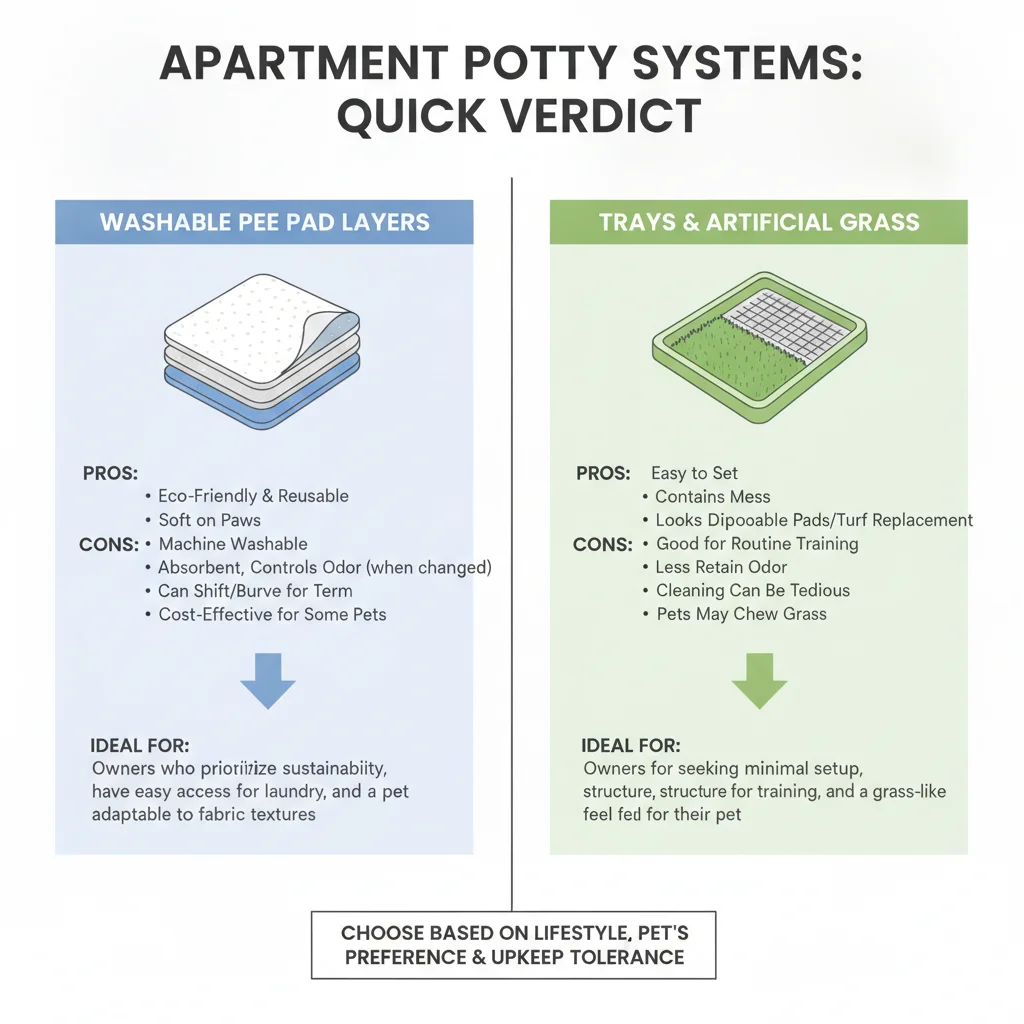
Shoppers searching dog potty tray vs pee pad are usually stuck between two washable architectures: a flat layered pad you rotate through the laundry, or a raised tray/holder that frames a pad or grass insert. The better pick depends on edge misses, laundry access, and how much visual bulk you can tolerate in a small room—not which Amazon photo looks cleaner.
This comparison is the system decision most listicles skip. We score layer pads against tray potty systems on leaks, odor after real wash cycles, weekly cleaning time, apartment footprint, and total cost. Product brand rankings live elsewhere; here the question is architecture.
Tray systems mainly win when dogs miss pad edges; flat layers win when you need fast laundry swaps and low visual bulk.
- Choose layered flat pads if your dog already hits the center, you can wash every 1–2 days, and you want a low-profile corner that guests barely notice.
- Choose a tray or holder if hard floors show edge rings after every visit, posture is wide (puppy circles or senior squats), or you need one fixed “this is the toilet” station.
- Hybrid wins often: a shallow holder with standard washable pads—tray walls for containment, laundry flexibility of multi-pack pads.
| Scenario | Better default | Why |
|---|---|---|
| Studio / no balcony, dog aims well | Layer pads (2–3 rotation) | Fast swaps, low bulk, cheap to trial |
| Hardwood with visible edge leaks | Tray / holder | Lip catches overspray listicles ignore |
| Puppy still circling the border | Tray first | Clear boundary beats thicker fabric alone |
| Senior overnight volume | Tray + high-capacity insert | Containment + fewer floor wipe-downs |
| Shared laundry delays | Layer multi-pack | Spare pads beat one damp tray insert |
| Roommates / landlord scrutiny | Depends | Flat looks subtler; tray looks intentional but bulkier |
If you still need pad brand picks after you choose architecture, start with our best puppy playpens for fenced potty corners. Apartment layouts and multi-pad rotations get a deeper treatment in the best puppy playpens for apartment layouts.
Leak and edge-mess reality on hard floors
Hard floors punish both systems, but they fail differently. Flat washable pads usually absorb fine in the center and lose at the quilted border: urine wicks sideways, the pad creeps a few inches, and you mop a ring nobody photographed in the listing. Trays fail when the wall is too low for the dog’s stream angle, when the insert warps and urine runs underneath, or when a grate sits in a puddle that never fully drains.
Apartment hard floors amplify edge leaks that listicles rarely measure.
Flat pad wicking at edges
Layer pads are rectangles of absorbent fabric with a waterproof back. They win when the dog lands mid-pad. They lose when the dog prefers the seam, when the pad bunches on tile, or when volume hits faster than the core can spread. “Extra thick” marketing rarely fixes aim; it mostly slows center soak while edges still dump.
- Stitched borders that stay flat after washing leak less than glued hems that curl
- Grip dots help on vinyl; slick backs turn every visit into a skating pad
- Overlapping two pads can catch wide stances better than one oversized sheet that folds
If you are mid-house-training and the dog still roams, containment tools matter as much as pad choice. Pair the potty corner with a defined zone—see our playpen vs crate house-training guide—so the dog practices on the pad instead of discovering the hallway rug.
Tray walls, grates, and insert fit
An indoor dog potty tray adds a raised lip and usually a removable insert: washable fabric, disposable pad, or artificial grass. The lip is the feature flat pads cannot fake. For puppies that circle and finish on the border, or seniors that dribble while standing, that wall turns “almost on the pad” into “still contained.”
Tradeoffs show up fast:
- Wall height vs ease of entry — taller walls contain better; short dogs and seniors may hesitate or step awkwardly.
- Grate designs — look cleaner but trap urine below if you skip scrubbing; smell follows the tray, not the grass.
- Proprietary inserts — excellent fit, higher replacement cost; open trays that accept standard washable pads keep laundry flexible.
Measure the dog, not the marketing photo. A tray sized for a toy breed will not catch a growing Labrador’s rear stance. Confirm whether the holder is a true pee pad holder vs flat pad upgrade or just a decorative frame with gaps at the corners.
Multi-dog and high-volume stress tests
Two dogs sharing one station stress both architectures. Flat layers need more pads in rotation and a larger surface so the second dog is not forced to the wet edge. Trays need either a larger footprint or a second station—stacking volume into one small tray creates overflow that looks like “the tray failed” when the real issue is capacity.
Run a one-week stress check before buying another thicker pad:
- Count visible floor rings after morning and evening peaks
- Note whether misses are edge, overshoot, or full misses beside the station
- Check under the pad/insert once daily—hidden puddles are odor factories
Edge rings → tray or better holder. Full misses beside the station → training/placement problem, not fabric thickness. Center soaking with no floor mess → stay on layers and fix laundry cadence.
Odor, wash cycles, and cleaning time
Absorbency claims sell pads; odor after week three keeps or kills the system. Flat layers put almost all smell control in the wash cycle. Trays split the job between fabric (or grass) and plastic: if you wash the insert but ignore the tray bed, ammonia returns within hours.
Total weekly cleaning time often decides the system more than absorbency marketing claims.
Pad-only laundry vs tray scrubbing
Layer systems are honest about time: rinse, wash warm with enzyme detergent, skip softener, dry fully, swap. A three-pad rotation absorbs shared-laundry delays. Failures look like “washable pads always smell”—usually a pad left wet overnight or softener coating the fibers.
Tray systems add a wipe-down every swap and a deeper scrub 1–2 times weekly. That extra step is why some owners abandon trays even when containment was better. Budget the minutes:
| Task | Layer pads (3-pack) | Tray + insert |
|---|---|---|
| Daily swap | 30–60 seconds | 1–3 minutes (insert + wipe) |
| Wash load | Pads with other pet laundry | Inserts + occasional tray scrub tools |
| Floor mop under station | Often weekly if edges leak | Less if walls work; more if urine under insert |
| Weekly deep clean | Optional floor wipe | Tray bed + grate soak |
If you hate scrubbing plastic, do not buy a grate tray to “solve” a flat-pad odor problem you actually caused with late laundry. Fix wash cadence first; then upgrade architecture only if leaks remain.
Artificial grass inserts vs fabric pads
Some indoor dog potty trays use synthetic grass. Grass can look more “outdoor” and help dogs who refuse fabric. It also holds moisture in the blade layer and needs thorough rinsing—owners who only hose the top still get a sour tray base. Fabric washable inserts behave like pee pads: machine washable, faster to fully dry if thin enough, less “yard theater.”
- Grass trays: better for dogs that need turf cues; higher rinse discipline
- Fabric inserts: better laundry workflow if your washer is reliable
- Disposable liners in trays: containment without laundry—higher monthly spend
Washable pee pads odor after washing is still the make-or-break metric either way. Retire inserts that smell after a correct enzyme wash; “more detergent” rarely fixes a failed waterproof laminate.
Weekly time cost that actually decides the purchase
Add up a realistic week: swaps, washer trips, tray wipes, and emergency mopping. The best indoor dog potty system 2026 for your home is the one you will maintain on a Tuesday night—not the one with the tallest wall in the photo.
- Layers win when laundry access is easy and aim is already decent
- Trays win when mopping edge rings costs more time than wiping plastic
- Hybrids win when you want tray walls with standard multi-pack pads
Cost-conscious owners should also read the ledger in our metal vs fabric playpen durability comparison—architecture choice changes break-even timing when trays add upfront kit cost.
Space, aesthetics, and roommate/landlord constraints
Apartment systems live in the visual field of roommates, partners, and sometimes landlords doing walk-throughs. A floppy pad in the hallway reads as temporary chaos. A large tray in the living room reads as permanent pet furniture. Neither is wrong; they fail different social constraints.
Footprint and trip hazards
Flat layers can tuck into a playpen corner or against a balcony door with minimal height. They become trip hazards when they creep onto walking paths or curl after shrinkage. Trays claim floor space with a hard edge—better visual boundary, worse in narrow galleries where every inch matters.
Measure the landing zone plus a small buffer. Then measure the path people walk at night. A “perfect” tray that blocks the bathroom door will get kicked, shifted, and blamed for leaks it did not cause.
- Doorways, radiators, and HVAC vents change drying and odor drift
- Balcony-adjacent spots help ventilation but need weatherproofing for splash
- Playpen-integrated potty corners reduce roaming accidents during training bursts—panel height and latch quality matter; see the puppy playpen buying guide if confinement is part of the plan
Visual bulk in small rooms
Low-profile washable pads win on stealth. Dark tops hide stains better in photos and in person. Trays look more intentional—useful when you want guests to understand the station—but they photograph as “dog toilet in the living room,” which some households reject on aesthetic grounds alone.
If aesthetics are the blocker, try a shallow pee pad holder vs flat pad first: enough lip to cut edge mess without a deep grass box. Many holders are sized for standard washable puppy pads, so you keep laundry simple.
Renter-friendly cleanup
Landlords care about floor finish and smell, not brand loyalty. Both systems can pass a move-out if you protect the floor under the station (wipeable mat), catch leaks early, and never let urine sit under furniture. Trays can leave plastic foot scratches; add grip pads. Flat pads can leave finish dulling if edge leaks go untreated for months.
Document your cleanup routine if you share space: who swaps, who washes, where the damp pad dries. Shared apartments fail potty systems when ownership is unclear—not when the quilt stitching is wrong.
Cost and final pick matrix
Price the full kit you will actually run for 90 days, not the cheapest single item in the cart.
| Cost piece | Layer pad system | Tray / holder system |
|---|---|---|
| Upfront | Multi-pack washable pads ($20–60 typical) | Tray/frame + 1–2 inserts ($40–120+) |
| Ongoing | Electricity/water for washes; rare pad replacements | Insert replacements + cleaner; optional disposables |
| Hidden | Floor cleaner, underlay, extra pads for laundry lag | Enzyme wipes, grate brushes, proprietary refill lock-in |
| Failure cost | Ruined rugs from edge wicking | Abandoned tray + still buying pads anyway |
Upfront kit vs monthly consumables
Layers are cheaper to trial. Buy a reputable multi-pack, run two weeks, and escalate to a tray only if edge misses persist. Trays cost more day one and pay off when they prevent floor damage and constant mopping. Proprietary grass systems can drift toward subscription-like insert spending; open holders that take washable pads keep monthly costs closer to a flat-pad rotation.
Keep a small disposable stash for travel and illness weeks either way. A washable-first home that panics into daily disposables during a stomach bug is normal—just return to washables when volume stabilizes.
Hybrid setups that work in 2026
- Shallow holder + standard washable pads: best default hybrid for apartments with mild edge issues.
- Flat pad rotation inside a playpen: best for early puppy aim with roaming control.
- Tray for night / flat pad for daytime balcony door: works when nighttime volume and daytime laundry differ.
- Grass tray for turf-preferring dogs + fabric travel pads: splits cues without forcing one product everywhere.
Avoid the expensive failure mode: buying an ever-thicker flat pad when the real problem is aim, or buying a complex tray when the real problem is that you will not wipe plastic twice a day.
Final pick matrix
| If this is true… | Pick |
|---|---|
| Dog hits center; laundry is easy; you want low bulk | Layer washable pads (2–3) |
| Hard-floor edge rings; need a fixed station | Tray or quality holder |
| Mild edge issues; want standard pad laundry | Hybrid holder + washable pads |
| Dog refuses fabric; needs turf cue | Grass-insert tray (rinse discipline required) |
| You will not scrub trays or wash pads on schedule | Disposables (honest choice) until habits change |
Architecture first, brand second. Once you know whether you need layers or a tray, shortlist pads and systems with leak and wash-cycle evidence—not fluff claims. Revisit the metal vs fabric playpen chew test for fabric picks, and keep apartment-specific sizing notes from the puppy playpen sizing for small apartments when the floor plan is the constraint.
The best washable pee pad system is the one that matches your dog’s aim and your real cleaning calendar. Choose containment when edges fail; choose layered speed when laundry is the bottleneck.
Frequently Asked Questions
Is a dog potty tray better than a washable pee pad?
Trays help contain misses and can look tidier, but they take more space and cleaning. Flat washable pads are faster to rotate through the washer if your dog aims well.
Can I use washable pads inside a tray or holder?
Often yes—many holders are sized for standard pads. Confirm dimensions and whether the tray wall actually stops sideways leaks for your dog’s size.
What’s best for apartments with no balcony?
A low-profile washable pad rotation plus strict wash cadence works for many. Choose a tray if your dog consistently pees off the pad edge or you need stronger containment.
Do tray systems smell less than flat pads?
Only if you wipe the tray when you swap inserts. Urine under a warped pad or grass insert creates odor people blame on the fabric. Flat pads smell less when you wash promptly and never leave them soaked overnight.
Should puppies start on a tray or a flat pad?
Start with whatever you will keep consistent. Many puppies learn faster on a tray’s clear boundary; others do fine on a flat pad inside a playpen. Switch architecture only if edge misses or laundry friction become chronic.
Related reading on our sister sites: Best Pet Camera for Multi-Dog