Why anxious dogs fail standard grinder tutorials
Most owners searching for the best dog nail grinder for anxious dogs already tried a viral “hold still and grind” clip—and watched their dog freeze, thrash, or shut down. Those tutorials assume a cooperative pet, a quiet bathroom, and a tool that starts soft. Anxious dogs get the opposite stack: sudden motor noise, firm restraint, and a session that only ends when every nail looks short.
Fear usually comes from three places stacked together. First, the sound and vibration of a spinning tip feel unpredictable—especially in echoey tile rooms. Second, past quick trauma teaches the dog that paws equal pain, so any tool near the nail triggers escape. Third, owners push for “one more nail” after stress signals appear, which turns a two-minute job into a lasting aversion.
- Noise + restraint stacking: pinning a dog while a motor surges is how panic consolidates. Soft body language and free choice to stay beat wrestling every time.
- Past quick trauma: a single bleed can make clippers and grinders look identical to the dog. Rebuild paw trust before you chase length again.
- Session length mistakes: finishing all four paws in fear teaches that struggle eventually works. Ending early on a win teaches the opposite.
The best dog nail grinder for anxious dogs is the quietest tool paired with a multi-day desensitization plan. Hardware alone does not erase fear; it only lowers the volume of the next practice rep. If you are still unsure whether a motor belongs in your kit at all, start with our dog nail grinder vs clipper decision guide—many noise-phobic homes keep guarded clippers for bulk length and add a grinder later for edges.
This guide is for home owners with dogs who bolt at motors, freeze under handling, or already hate nail day. It is not a substitute for a veterinary behavior consult when aggression or self-injury is in the mix. YMYL note: if nails are curling into pads, limping, or bleeding, get professional help before you run a two-week protocol at home.
One successful nail with heavy rewards beats finishing all four paws in a panic session.
2-week desensitization timeline
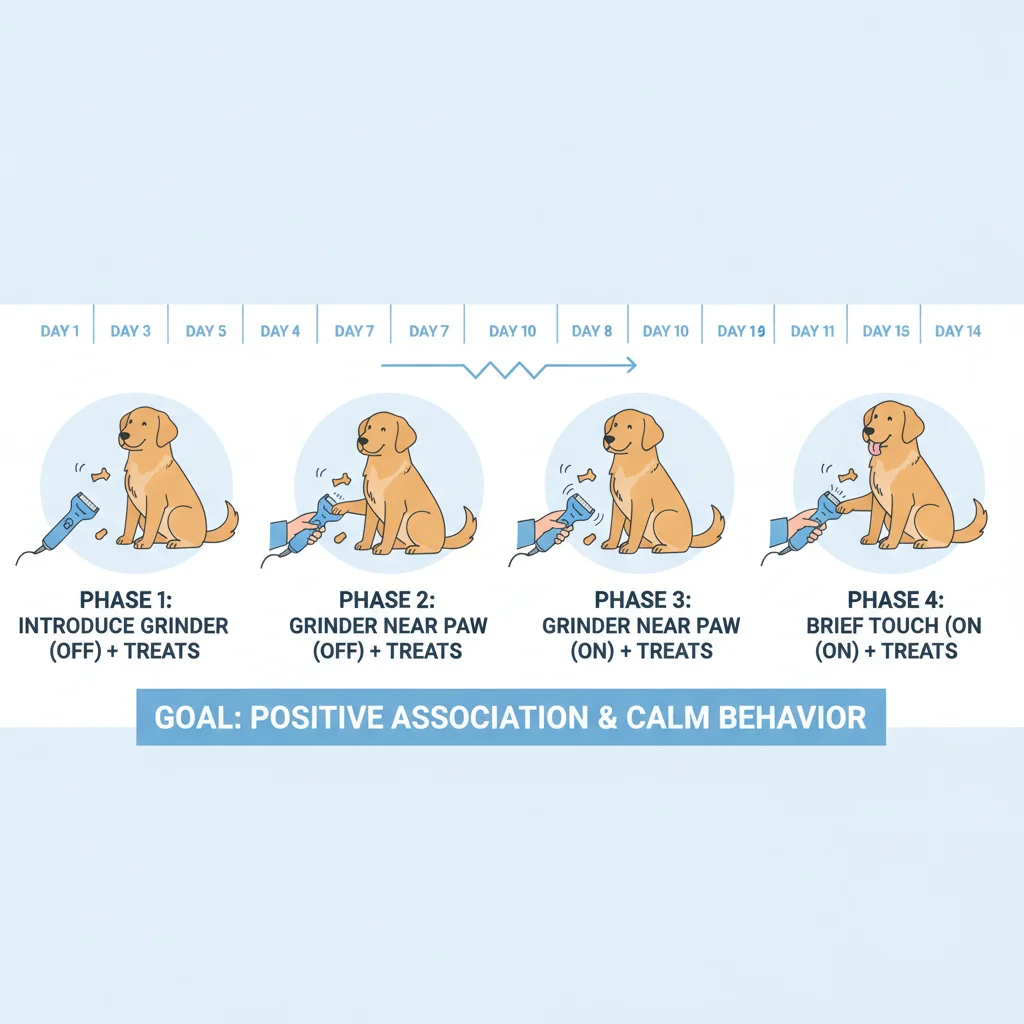
Treat the next fourteen days as training, not grooming. Your only job is to keep the dog’s body soft—loose mouth, soft eyes, voluntary paw contact—while the tool becomes boring. Skip calendar days when the dog is overstimulated from guests, thunderstorms, or daycare. Progress is measured in calm reps, not in nails finished.
Days 1–3: power off only
Leave the grinder powered off and visible in the room where you will eventually work. Pair every glance, sniff, and paw near the tool with high-value food. Touch the powered-off tip to your own hand first so the dog sees it is not a surprise weapon. Then lightly touch the guard to one nail for half a second, mark, and reward—then end.
- Session length: 30–90 seconds, two or three times a day.
- Success look: dog offers a paw or stays soft when the cold tool appears.
- Reset if: lip licking, whale eye, or pulling the paw becomes the default.
Do not spin the motor yet, even “just to show them.” Early noise before the powered-off association sticks is how dogs learn that the silent tool predicts a scary sound. Keep treats denser than the dog expects; anxious learners need a high pay rate to stay in the game.
Days 4–7: micro spins away from nails
Turn the tool on at the lowest speed across the room, then immediately feed. Gradually decrease distance over sessions while the dog remains soft. Next, run a one-second spin near—not on—the paw while you hold a treat at the dog’s nose. Stop the motor before you deliver the food so the quiet moment becomes the reward cue.
- Spin far away → treat → end.
- Spin closer → treat → end.
- Spin near the paw without contact → treat → end.
- Only then attempt a one-second tip touch on a single nail.
If fear spikes, drop back one step for two sessions. Do not “push through” a hard day because the calendar says Day 6. Micro spins teach that the sound starts and stops on your cue—and that stopping is reliable. That predictability matters more than shaving a few millimeters of nail this week.
Days 8–14: one-nail wins
Contact work begins only when the dog stays soft during near-paw spins. Grind one nail for one second on low RPM, mark, jackpot, and put the tool away. Next session, try a second brief pass on the same nail or a new nail—never a full paw set. One successful nail with heavy rewards beats finishing all four paws in a panic session.
Dark nails need even shorter passes: inspect the tip for a gray-to-pink shift, then stop. Heat builds fast on thick nails; pause every second or two and feel the nail with your fingertip. If the nail is warm, you are grinding too long. Anxious dogs often tolerate short cool passes better than one continuous rasp that smells and heats.
- Daily ceiling: two or three nails max until the dog volunteers paws again the next day.
- Location: carpeted room beats tile echo; soft lighting beats bright bathroom glare.
- Helper rule: a second person may gently stabilize—not wrestle—only if the dog already likes cooperative holding.
By Day 14 you want a pattern the dog understands: tool appears, short sound, tiny contact, big food, tool disappears. Full pedicures come later, after the pattern is boring. If you skip to “finish the dog” because guests are coming, you reset the clock.
Tool features that reduce panic
Buying for anxiety is different from buying for raw speed. You want a tool that starts gently, stays quiet under light load, and never feels like a vibrating toy in your hand. Marketing “whisper quiet” stickers measure idle spin; anxious dogs react to contact noise and start-up surge. For measured quiet rankings, see our companion piece on the quietest dog nail grinder picks we scored for noise and runtime.
Low RPM and soft start
Prefer a true low-speed setting under roughly 8,000 RPM for introduction work. Soft start matters: motors that jump from silent to full scream in a fraction of a second startle dogs even when peak dB looks acceptable. Two discrete speeds beat a vague turbo slider you will bump mid-session.
- Test the switch with the tool pointed away from the dog before every session.
- Reject units that rattle in the housing when they start—loose shells amplify fear.
- Keep high speed for later finishing on calm dogs; anxious intros stay on low.
Phone-meter readings at arm’s length help you compare tools in your own room, but treat them as a guide, not a clinic lab. Contact noise on a thick nail often sits 8–15 dB above idle. If two tools idle similarly, pick the one that stays smoother when you lightly load the tip on a scrap nail or emery board.
Light body and secure grip
A lightweight cordless body lets you move with the dog instead of bracing against them. Secure grip reduces accidental tip slips that scrape fur or skin—events that teach the dog the tool bites. USB-C charging is worth paying for so you are not mid-session on a dying proprietary dock.
Battery reality for anxious work is friendly: short bursts barely drain a healthy pack. What hurts anxious dogs is a tool that fades mid-nail and changes pitch. Charge overnight before multi-dog evenings. Store the grinder where the dog cannot find it between sessions so it stays a training cue, not a living-room toy.
Guards that hide the spinning tip
Tip guards that stay seated hide the spinning surface and limit how deep the bit can dig. Anxious dogs often accept a guarded tip better because less of the moving parts are visible. Confirm spare bands or diamond bits are sold as named accessories before you buy; a quiet grinder with a dead tip and no replacements becomes a paperweight.
| Feature | Why anxious dogs care | Skip if… |
|---|---|---|
| True low RPM | Softer sound and less vibration at first contact | Only one harsh “turbo” speed |
| Stable tip guard | Hides motion; limits over-grind depth | Guard pops off under light pressure |
| Solid housing | Less rattle than hollow toy shells | Body buzzes hard into your palm |
| USB-C pack | Reliable charge for short calm sessions | Pack dies mid-nail and pitch shifts |
Price band that usually works: roughly $35–$55 for calm-first cordless pet grinders. Cheaper units can succeed for tiny cooperative dogs, but rattly housings and weak guards are common failure modes when fear is already high. Spending twenty dollars more to avoid one panic session is usually the cheaper choice.
Recommended grinders for anxious dogs
These picks are use-case recommendations, not a ranked affiliate dump. Match the tool to your dog’s current tolerance, then run the timeline above. If the dog cannot accept powered-off touch after a week, pause grinding and rebuild paw handling with clippers or a vet tech before you buy another motor.
Best overall calm-first pick
Choose a mid-price cordless pet grinder with a discrete low speed, solid shell, seated guard, and USB-C charging. This is the default for single medium dogs in apartments and for owners who will grind weekly in tiny bursts. Expect quieter contact noise than toy-loud $15 sticks, plus enough torque for light weekly maintenance once desensitization sticks.
Who it fits: adults who startle at motors but can take food, small-to-medium breeds, and homes that can dedicate two weeks to training. Who should skip it: giant breeds with extremely thick black nails that need high sustained torque for rescue-length nails—those dogs may need a pro first, then a stronger tool later.
- Start every session on the lowest speed with the guard on.
- Keep sessions under a few minutes even when the dog looks “fine.”
- Replace tips when cutting slows; glazed grit raises heat and rasp.
Best if they tolerate short noise
Some dogs accept a brief motor sound but hate long rasp contact. For them, a slightly higher-torque quiet unit that finishes a nail in fewer seconds can reduce total exposure time. Use it only after Days 1–7 of the timeline are solid. Short, decisive passes beat lingering on one nail while the dog braces.
Tradeoff: a bit more contact noise for less time under the tool. If your dog’s fear is specifically the start-up surge, prioritize soft-start models even if peak load noise is similar. Always end on a win—stop while the dog is still taking food, not after the first hard pull-away.
Clipper fallback for non-responders
Not every anxious dog becomes a grinder dog. If three calm introduction cycles still produce freezing, snapping, or frantic escape, switch to quality scissor-style clippers with a safety guard for length, and leave grinding to a groomer—or skip motors entirely. Forcing a grinder because you already bought it is how aversion becomes permanent.
Clippers win on near-silent cuts and short sessions. Grinders win on dark thick nails once trust exists. Many households use both: clippers for bulk, quiet grinder for dull edges after the dog is emotionally ready. If your dog is terrified of all nail tools, book a cooperative-care groomer or vet tech and treat home tools as future maintenance, not this month’s emergency.
If fear escalates after three calm attempts, switch tools or hand off—forcing creates lasting aversion.
Failure modes and when to stop
Stop rules protect the relationship more than the nail. Anxious dogs show shut-down signals that look like “being good”: stillness, glazed eyes, holding breath, or a tucked tail without struggle. That is not consent. End the session, lower criteria, and come back later with easier reps.
Shut-down signals
- Hard freezing, whale eye, lip licking, yawning in context, or sudden sniffing to escape.
- Mouth closed tight, weight shifted back, or paw slammed down and locked.
- Growl, air snap, or skin twitch when the motor starts—even if no contact happened.
When you see these, power off immediately and jackpot for any softer behavior that follows. Do not finish “just one more nail.” The lesson you want is: stress signals make the scary thing stop. That lesson builds trust faster than a prettier paw this afternoon.
Handler frustration loop
Owner frustration is a failure mode too. Rushing because you are late, embarrassed, or angry leaks through leash pressure and voice tone. If you feel the loop starting, put the tool away and take a walk. Dogs read that urgency as danger. Schedule grinding when you have buffer time and good treats on hand—not after a hard workday when patience is gone.
Also watch for “success theater”: the dog endures a full set once, then refuses for weeks. That is not a training win; it is a single coerced session. Track whether the dog offers paws more readily the next day. If volunteering decreases, your criteria jumped too fast.
Vet or groomer handoff
Hand off when home practice risks injury—to the dog or to you. Red flags include attempts to bite, thrashing that could wrench a joint, nails grown into pads, or medical anxiety disorders already under treatment. A professional with cooperative care skills and proper restraint options is safer than a DIY marathon.
Ask the pro to keep sessions short and to share what worked so you can maintain at home later with the same tool type. Bring your quiet grinder only if the dog already accepts it in training; do not debut a new motor in a clinic hallway. After a pro reset, restart your timeline at Days 1–3 rather than jumping back to full nails.
Practical next step: pick one calm-first cordless grinder with a real low speed and guard, block fourteen short sessions on your calendar, and measure success by soft body language—not by how short the nails look on Day 3. If fear escalates after three calm attempts, switch tools or hand off—forcing creates lasting aversion.
Frequently Asked Questions
How do I desensitize a dog to a nail grinder?
Start with the powered-off tool near treats, then add brief spins away from nails, then one-second contact on a single nail. Progress only while body language stays soft.
What if my dog is terrified of nail trims already?
Reset expectations: no full trim for 1–2 weeks. Rebuild trust with paw handling and clipper or grinder exposure separately from cutting.
Should I muzzle an anxious dog for grinding?
Only with a trained basket muzzle and positive association. Muzzling without training can raise panic during noisy tools.
Is a quieter grinder enough for separation-anxious dogs?
It helps, but timing, location, and ending sessions early matter more than shaving a few decibels.
When should I hire a groomer instead?
If your dog freezes, snaps, or injures themselves despite slow desensitization, professional handling is safer than home forcing.
Your next step
Buy for calm first: low RPM, solid housing, stable guard. Run the two-week plan without chasing a full pedicure. Link quiet-tool shopping to our quiet-grinder rankings when you are ready to compare noise and battery, and keep the clipper-vs-grinder guide handy if motors still feel like the wrong tool for this dog.
Related reading on our sister sites: Best Pet Camera for Multi-Dog