How we ranked clippers in 2026
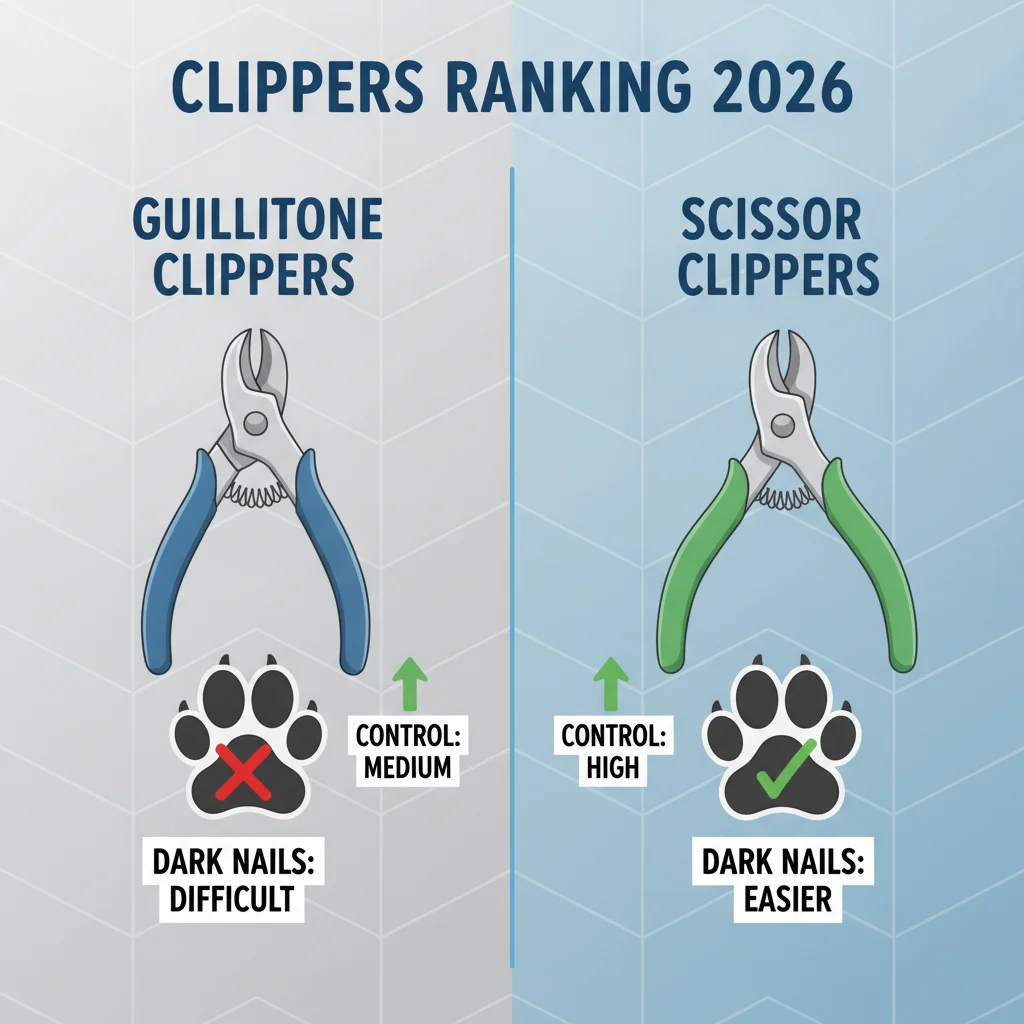
Owners hunting for the best dog nail clippers 2026 usually want the same outcome: a clean cut, less bleeding risk, and a tool that still feels sharp after a few months of home use. Blade type and safety design matter more than flashy handles or “vet grade” stickers.
We scored clippers on four practical criteria: how cleanly the blade slices thick keratin, whether a guard actually limits depth, how much hand strength the tool demands, and whether the jaw size matches small-breed nails or large-dog dewclaws. Marketing photos rarely show those failure modes, so we weighted real handling over packaging claims.
- Sharpness retention: Does the cut stay crisp after repeated sessions, or do nails start to crush and splinter?
- Guard usefulness: Can a beginner set a stop depth without blocking the view of the nail tip?
- Leverage and grip: Can average hands close the tool without twisting the dog’s toe?
- Fit by nail diameter: Undersized jaws slip; oversized jaws hide the quick on tiny nails.
If you are still deciding between tool categories, start with our dog nail grinder vs clipper noise and safety guide. Clippers remain the quieter first buy for many homes; grinders win when dark nails or smoothing matter more.
Safety-guard dog nail clippers reduce overcuts for beginners but still need correct nail angle. That sentence is the whole beginner promise in one line: guards help, technique decides.
1. Best overall: safety-guard scissor clippers
For most first-time home groomers, a mid-size scissor-style clipper with an adjustable safety guard is the safest default. You see more of the nail than with a guillotine hole, you can take smaller bites, and the guard gives a physical reminder not to chase length in one heroic squeeze.
Look for stainless blades that meet cleanly with almost no side play, a spring that returns smoothly, and a guard you can set and then ignore during the cut. Cheap plastic locks that drift mid-session defeat the point. Pair the tool with styptic powder or a styptic pencil before you start—not after the first nick.
Who this pick fits
- Small to medium dogs with light or medium nail thickness
- Owners who can hold a paw calmly for 30–60 seconds
- Homes that trim every 2–4 weeks and want a quiet tool
- People who prefer visual control over motor noise
Guard limitations you should expect
Guards do not magically map to the quick. Curved nails, thick black nails, and dewclaws sitting at odd angles can still bleed if you set the stop too deep or cut from a bad side angle. Use the guard as a ceiling, then still remove only 1–2 mm per pass.
On very small nails, a bulky guard can hide the tip. If you cannot see the cut line, remove or loosen the guard for that nail and switch to tiny bites. Visibility beats false confidence.
Maintenance that keeps the “best” label honest
Wipe blades after every session. A drop of clipper oil on the pivot weekly prevents sticky close and uneven pressure. If the cut starts to leave a crushed white edge instead of a smooth face, stop using the tool until you sharpen or replace it. Dull blades crush nails and cause the bleeding events that make owners quit home trims.
Budget for replacement every 12–24 months of regular use, sooner if you share one pair across multiple large dogs. A $15–$30 guarded scissor set that stays sharp beats a $40 set that was dull out of the box.
2. Best for thick nails: heavy-duty scissors
Large breeds, seniors with thick keratin, and dogs with outdoor lifestyles often overwhelm lightweight “universal” clippers. Heavy-duty scissor clippers with longer handles and a wider jaw give you leverage so the blade slices instead of pinches.
Scissor-style clippers usually beat guillotine tools on thick or dark nails when you can see a stop line. That is the practical rule we used when ranking thick-nail tools: if you cannot see where the nail turns softer pink or the denser gray core begins, take less and check more often.
Leverage advantage in real sessions
Longer handles reduce the force your fingers need. That matters when a dog squirms—high force plus a moving target is how blades glance and nick the quick. Choose a model you can close with a controlled squeeze from the base of your hand, not a fingertip pinch.
Test the jaw opening on the thickest nail you expect to cut. If the nail barely fits, size up. Undersized jaws ride up the nail and increase slip risk, especially on black nails where depth cues are already weak.
Angle technique that reduces bleeding
Hold the paw so the nail tip points slightly away from the toe pad. Cut perpendicular to the nail growth, not parallel to the floor if the nail hooks downward. Taking a diagonal “scoop” toward the quick is a common bleeding pattern on curved nails.
- Wipe the nail so chalk, mud, or polish does not hide color changes.
- Mark a conservative stop with a light scratch or chalk line if helpful.
- Remove a thin tip, then reassess before a second bite.
- File sharp corners with a hand file so fabric and skin do not catch.
For dark nails, shine a bright light from behind when possible and look for a denser circle in the cut face. Stop before that circle widens. If you cannot read the face at all, switch to a quiet grinder for finishing passes after a conservative clip—or book a groomer for a baseline length once, then maintain at home.
When a grinder still helps after clipping
Clippers excel at length removal. Grinders excel at smoothing and micro-adjusting when you are close to the quick. Noise-sensitive dogs may still prefer clippers alone; if motor sound is the blocker, see our picks for the quietest dog nail grinders we tested and only introduce power tools after short, rewarded practice.
3. Best guillotine pick (and who should avoid it)
Guillotine clippers thread the nail through a hole, then a blade slides across. On small, light-colored nails they can feel precise and compact. On thick or dark nails they are less forgiving because the hole can hide depth and the blade path is fixed.
Our best guillotine pick is a replaceable-blade model with a clear view of the hole edge and a spring that does not stick halfway. Fixed cheap blades that dull after a few weeks are why guillotine tools earn a bad reputation—they crush before they cut.
Where guillotine still makes sense
- Toy breeds and cats-sharing households with very small nail diameters
- Owners who already trim often and only remove tiny tips
- Travel kits where a compact tool matters more than multi-dog leverage
Who should skip guillotine designs
Avoid guillotine as your primary tool if your dog has thick black nails, strong dewclaws, or a history of quick hits. The hole alignment encourages one deeper cut, and dark nails give fewer visual warnings. Scissor styles let you nibble from the side and stop sooner.
Also skip guillotine if you have limited hand strength. A sticky blade mid-cut can leave the nail partly crushed inside the hole while the dog pulls away—exactly the panic loop that ends home grooming for months.
Jamming and blade alignment problems
Hair, dirt, and bent blade tracks cause incomplete cuts. Clean the hole after each dog. If the blade no longer meets flush across the opening, replace the blade or retire the tool. Do not “finish” a jammed cut by forcing the handles; back out, clean, and restart with a sharper edge.
Clipper care, size fit, and skip list
Buying the right blade type is half the job. Keeping it sharp and matching size to the dog is the other half. A premium scissor clipper used dull on a Great Dane is more dangerous than a mid-tier heavy-duty pair used correctly.
Size fit checklist
| Dog / nail profile | Preferred clipper style | Why |
|---|---|---|
| Toy / thin light nails | Small scissor or quality guillotine | Better tip visibility; less bulk |
| Medium mixed colors | Guarded scissor (best overall) | Depth stop + view of cut line |
| Large / thick outdoor nails | Heavy-duty scissors | Leverage prevents crushing |
| Dark nails, anxious dog | Guarded scissors; optional quiet grinder finish | Quiet first cut; micro-adjust later |
| Multi-dog household | Two sizes or heavy-duty + small | One size rarely fits all nail diameters |
If you share tools across dogs, sanitize blades between pets and check for hair wrap in the pivot. Cross-contamination is minor compared with a sticky blade that suddenly requires extra force.
Cleaning and oiling routine
- Brush keratin dust from the blade faces after each session.
- Wipe with isopropyl alcohol on a cloth; dry fully.
- Add one drop of clipper oil to the pivot; open and close ten times.
- Store closed in a dry drawer—not a steamy bathroom cup.
Replace the tool when you see mushroomed nail edges, white crushing lines, or when you need two squeezes to finish what used to take one. Those are dull-blade warnings, not a cue to squeeze harder.
Skip list: tools that look pro and fail at home
- No-name “vet kit” scissors with soft stainless that roll at the edge — pretty cases, poor metallurgy.
- Guillotine tools with non-replaceable blades sold as lifetime kits — lifetime of dull cuts.
- Combo kits that include a loud toy grinder as the hero product — if noise is already a problem, that bundle fights your dog.
- Human nail clippers for anything larger than a tiny puppy nail — wrong geometry, high slip risk.
- Deep fixed guards with no adjustment — one depth cannot serve dewclaws and main nails.
For anxious dogs that freeze at any tool near the paw, clippers are often the calmer starting point, but the training plan matters as much as the blade. Pair this listicle with a desensitization-first approach when fear—not steel—is the blocker.
Dark nails, bleeding control, and session length
Dark nails are the top reason people abandon clippers. You can still succeed without seeing a pink quick if you treat every cut as provisional. Cut less than you think you need, then walk the dog on pavement for a day and reassess length by click sound and posture—not by matching a groomer’s short salon finish on day one.
Keep styptic powder open and within reach before the first squeeze. If you nick the quick, apply pressure with powder for 30–60 seconds, stay calm, and end the session on a treat even if only one nail is done. Pushing through panic teaches the dog that nail time escalates.
Session length targets for home clips:
- Beginner dog: 1–3 nails, then stop while the dog is still cooperative
- Maintenance dog: full set in under 10 minutes if handling is solid
- Rescue with trauma history: weeks of touch-only practice before steel touches nail
Never restrain a struggling dog flat on its side for a “quick finish.” That is how bites and lifelong aversion happen. Reschedule, shorten the goal, or hand off to a professional for a reset trim.
Quick comparison: our 2026 shortlist logic
| Pick | Blade type | Best for | Watch-outs |
|---|---|---|---|
| Best overall | Scissor + safety guard | Most beginners, mixed nail colors | Guard can hide tiny tips |
| Best thick nails | Heavy-duty scissors | Large breeds, outdoor dogs | Overkill for toy nails |
| Best compact | Replaceable-blade guillotine | Small light nails, travel | Poor on thick/dark nails |
None of these replace judgment. The “best” clipper is the one whose blade stays sharp, whose size matches the nail, and whose noise profile—silence—matches a dog that already hates salon dryers and motors.
Frequently Asked Questions
Are guillotine or scissor dog nail clippers better?
Scissor-style usually offers better control on thick nails; guillotine can work for small, light nails if the blade stays sharp and aligned.
Do safety guards prevent cutting the quick?
They help limit depth but are not foolproof—especially on curved or dark nails. Still cut tiny amounts and keep styptic powder ready.
How often should I replace dog nail clippers?
Replace or professionally sharpen when cuts crush instead of slice cleanly—often every 12–24 months with regular home use.
What size clippers do large dogs need?
Choose heavy-duty scissor clippers with enough jaw opening for the nail diameter; undersized tools slip and increase injury risk.
Should beginners start with clippers or a grinder?
If your dog tolerates handling and you can see the quick, guarded clippers are quieter. Choose a quiet grinder when dark nails or smoothing matter more.
Your next step
Buy a sharp scissor-style clipper sized to your dog’s thickest nail, add a guard if you are new, and stock styptic powder before the first session. Practice paw handling for a few days with treats only, then remove tiny tips—not salon-short length—on the first real trim.
If motor tools enter the plan later, compare noise and runtime carefully rather than chasing the loudest “pro” grinder. Clippers remain the right first tool for many quiet homes in 2026; blade quality and conservative cuts are what separate a calm routine from a bleeding scare.
Related reading on our sister sites: Best Pet Camera for Multi-Dog