Buying a single “XL” fountain for two or three cats feels efficient. In practice, one bowl often becomes a choke point: the bold cat parks there, the shy cat drinks less, and the filter clogs twice as fast. Capacity awards ignore layout, conflict, and cleaning load.
This guide focuses on the best cat fountain for multiple cats as a household system—stations, access points, and maintenance—not one trophy product. Practical multi-cat layouts, not just capacity awards, decide whether every cat actually drinks. Cleaning and filter load scaled to household size matter as much as liters on the box.
For a model shortlist by noise, cleaning, and filter cost, start with our best cat water fountains 2026 roundup. For brand tradeoffs among popular stainless units, see Petlibro vs PetSafe vs Petcube.
Why multi-cat homes break single-fountain advice
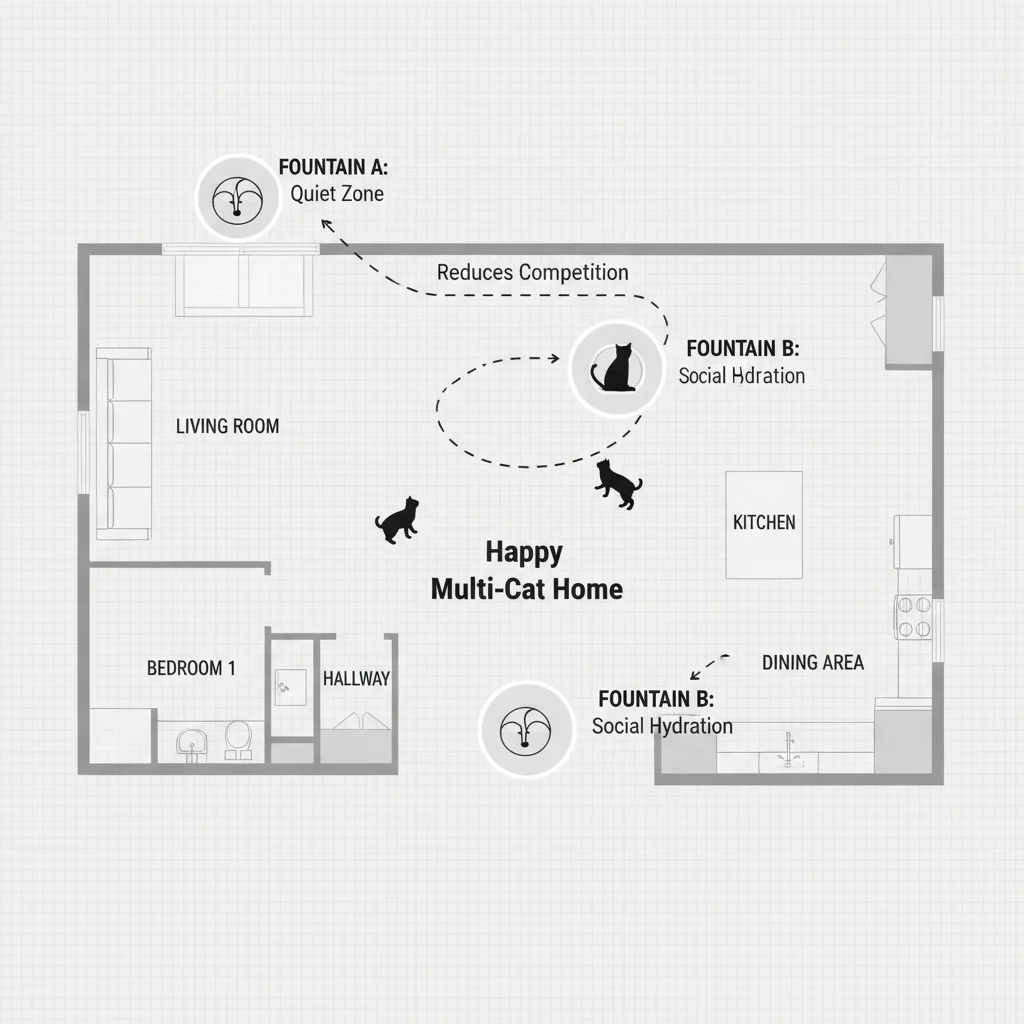
Single-fountain shopping guides assume one cooperative household. Multi-cat homes break that assumption in three predictable ways: resource guarding, faster dirt, and layout blindness.
Resource guarding at water looks quieter than food fights. One cat sits on the rim, stares, or drinks in long sessions that block the bowl. Others wait, then skip. You may never see a swipe—just a gradual drop in intake for the lower-ranking cat.
Dirt and filter load scale with paw traffic, not just liters drunk. Two cats mean more floating fur, more saliva film, and more “someone knocked kibble crumbs into the reservoir” events. A filter that lasts a month for one cat can smell and restrict flow in two weeks with three.
- Guarding is about access and sightlines, not bowl volume.
- Biofilm and hair arrive faster on high-traffic units—even stainless ones.
- “Best overall” badges rarely mention hallways, doors, or a second floor.
The best cat fountain for multiple cats is often two stations on separate paths, not one oversized bowl. A 3-liter unit in the kitchen still fails if both cats must cross the same doorway and the dominant cat owns that doorway at peak hours.
One-size awards also miss sleep zones. A chattery pump next to the sofa may be “fine” for a solo cat and unbearable when night drinkers take turns. Multi-cat homes need quiet enough hardware for shared rooms—and enough stations that nobody queues at midnight.
Capacity vs flow vs access points
Shoppers chase liters. Useful, but incomplete. Capacity reduces refill trips; it does not create extra mouths of access. Flow style (stream, waterfall, bubbling surface) changes what picky cats prefer, yet still serves one queue if cats must share a single spout.
Wide drinking surfaces help more than a thin jet when two cats approach together. Some large-capacity cat fountain designs offer a broad bowl rim where cats can drink side by side. That softens mild competition. It does not fix hard guarding across rooms.
Refill frequency math
Estimate daily intake roughly: many adult cats drink on the order of a few ounces each, more if they eat dry food or live in dry air. Two to four cats empty a 2-liter reservoir faster than the product page implies—especially if you discard water on cleaning days. High capacity buys convenience: fewer top-offs, less “empty bowl” panic. It does not buy peace.
- Buy capacity for your refill schedule and travel days.
- Buy wide surfaces if cats often arrive together.
- Buy a second station if you see waiting, blocking, or room-based territories.
When bigger still fails
A huge single fountain fails when:
- Cats claim separate floors or closed rooms for long stretches.
- One cat monopolizes the rim during stress (new pet, guests, litter changes).
- You clean so rarely that the “big” unit becomes a slime reservoir nobody trusts.
In those cases, a cat water fountain for multiple cats means plural hardware. Treat capacity as a convenience feature on each station, not a substitute for access points.
Best fountain picks for multi-cat use
Shortlist by durability under traffic, not by app features. Multi-cat homes punish weak pumps, fiddly lids, and plastic bowls that smell after weeks of fur and hard water.
High-capacity stainless options
Prioritize stainless drinking surfaces with reservoirs large enough that you are not refilling twice a day. Stainless resists odor better than scratched plastic when you actually scrub on schedule. For material tradeoffs beyond this use case, the stainless-first angle in our brand comparison still applies: hygiene beats gimmicks once two or three cats share the water path.
Look for:
- Dishwasher-safe bowl parts (never the pump motor).
- Filters you can buy in multi-packs without hunting obscure SKUs.
- Stable bases that do not tip when a second cat bumps the first.
Quiet enough for shared rooms
Night drinkers rotate. A buzzing impeller in the bedroom hallway wakes the whole house. Prefer models with quiet pumps and easy impeller cleaning—debris is the usual noise culprit. If you already own a loud unit, a second quieter station in a living area often cuts conflict more than swapping the first for a slightly quieter twin.
Parts that survive daily traffic
Multi-cat use means more lid removals, more accidental knocks, and more “someone batted the spout.” Prefer spare pumps and common filter sizes. Smart alerts are optional; a reliable float window or clear reservoir wall is enough. When comparing Petlibro-class stainless fountains to PetSafe or Petcube lines, weigh spare-parts availability and filter TCO alongside capacity claims.
Use this multi-cat fit matrix before you buy:
| Need | Prefer | Skip / deprioritize |
|---|---|---|
| 2–3 cats, mild conflict | Wide stainless bowl + optional second station | Tiny decorative fountains |
| Hard guarding / closed rooms | Two stations on separate paths | One mega bowl in the kitchen only |
| Shared bedroom / night drinkers | Quiet pump, easy impeller clean | Chattery or unserviced pumps |
| High fur / hard water | Easy teardown, common filters | Rare filters, sealed hard-to-scrub seams |
Two-fountain setups that work
A two cat water fountain setup is the most reliable upgrade for multi-cat households. You are buying parallel access and a cleaning backup, not just “more water.”
Separate rooms vs opposite corners
If cats already split territory—bedroom vs living room, upstairs vs downstairs—place one station in each zone on routes they already use. If they share one open floor plan, put fountains on opposite corners with a sightline break (furniture, half-wall) so a watcher cannot dominate both rims at once.
- Keep water away from litter boxes; most cats prefer distance.
- Leave a clear escape path from each station so a blocked cat can leave without passing the bully.
- Avoid placing both units beside the same food row unless cats already share meals calmly.
Backup during cleaning day
Dual stations shine on scrub day. You tear down fountain A while fountain B stays live. Multi-cat homes that rely on one unit often create a dry gap that drives cats back to sinks—or into conflict at the remaining bowl. Stagger deep cleans: full scrub one unit midweek, the other on the weekend.
Matching vs mixed brands
Matching brands simplify filters and spare pumps. Mixed brands work if each unit earns its place: for example, a high-capacity quiet stainless in the living room and a simpler backup in a bedroom. Do not mix just to chase features; mix to cover layout gaps. Whatever you choose, standardize a cleaning kit (brushes, vinegar or citric acid, spare filters) so maintenance does not depend on which logo is on the lid.
Layout rule of thumb: water stations on separate paths beat one shared queue—even when total liters look impressive on paper.
Cleaning cadence when usage is high
Multi-cat dirt is not a moral failing. It is math. More mouths mean more biofilm, more hair, and more mineral film if your tap is hard. Adjust cadence before you blame the brand.
Weekly vs twice-weekly scrub
Solo-cat advice often says “clean weekly.” With two to four cats, plan a light empty-and-scrub of wet surfaces every 2–3 days and a full teardown at least weekly. High-conflict or long-haired households may need twice-weekly full teardowns on the busiest station. Wipe spout lips daily; that is where saliva film starts.
- Daily: top off, wipe rim and spout, remove visible debris.
- Every 2–3 days: empty bowl, scrub wet surfaces, rinse.
- Weekly: pull pump, clean impeller, descale if needed, swap filters on schedule.
Filter spend at 2–4 cats
Filter cost is the hidden multi-cat tax. Expect shorter intervals than the box suggests. Buy multi-packs and track changes on a calendar. A clogged filter reduces flow, which can increase pump noise and reduce drinking—exactly when you hoped a big fountain would “set and forget.”
If annual filter spend hurts, prioritize models with common, affordable packs over proprietary smart cartridges. Capacity does not lower filter cost; usage and water quality do.
Pump failure warning signs
Listen for grinding, sputtering, or sudden silence after a dirty impeller. Multi-cat homes wear pumps faster because they run harder against hair and scale. Keep a spare pump for your primary model if you can. A dead pump with three thirsty cats is an emergency; a dual-fountain setup turns it into a temporary inconvenience.
Never soak the motor beyond manufacturer guidance. Clean the impeller blades gently; metal tools can scar plastic and worsen noise. If a unit smells after scrubbing, inspect silicone seals and lids—odor often hides there even when the stainless bowl looks clean.
Quick setup checklist
Use this before you order—or before you declare the current fountain “a failure.”
- Count cats and conflict level. Calm sharers may manage one wide station plus a backup bowl; conflict cats need two fountains on separate paths.
- Map rooms and doors. Place stations where cats already travel, not where the cord is convenient for you alone.
- Place away from litter and leave escape routes. Test food adjacency; some cats accept water near food, others do not.
- Choose stainless-first bowls for daily drivers when hygiene is the pain point; keep capacity high enough for your refill habits.
- Schedule clean + filter swaps for household size—not for the optimistic interval on the carton.
- Keep one station live whenever you deep-clean the other.
If you still need help picking among specific brands after the layout is set, return to the 2026 noise and cleaning shortlist or the Petlibro vs PetSafe vs Petcube head-to-head. Layout first, model second.
Frequently Asked Questions
Is one big fountain enough for three cats?
Often no. Capacity helps, but placement and a second station usually reduce guarding better than one huge bowl.
How many fountains do multi-cat homes need?
A common rule is water stations on separate paths—often 2 fountains for 2–3 cats, more if there is conflict.
Do multi-cat homes dirty fountains faster?
Yes. Expect shorter clean intervals, more filter swaps, and faster biofilm on high-traffic units.
Should fountains be near food?
Many cats prefer water away from litter and some away from food. Test both; conflict cats need separated stations.
What capacity should I buy?
Buy for refill convenience, not as a substitute for a second fountain when cats compete.
Your next step
Stop shopping for a single award badge. Sketch your floor plan, mark litter and food, and decide whether you need one wide station or a true dual setup. Then pick quiet, cleanable stainless hardware you can maintain on a multi-cat cadence. That is how multi-cat homes turn fountain shopping into actual drinking—not another ignored bowl in the corner.
Related reading on our sister sites: Best Dog Camera for Separation