Most “best of” cat fountain roundups still rank by capacity, LED lights, and app screenshots. Owners quit for quieter reasons: a pump that hums at 2 a.m., a filter bill that doubles the hardware price, and biofilm that returns three days after a scrub.
This best cat water fountain guide for 2026 ranks the shortlist the way you will live with it—nighttime noise, cleaning effort, material biofilm reality, and annual filter plus pump cost. Ranked by long-term hygiene and noise, not product dump lists.
If you already narrowed brands, jump to our Petlibro vs PetSafe vs Petcube head-to-head. Material tradeoffs live in the stainless vs ceramic vs plastic material guide. Multi-pet layouts belong in multi-cat fountain setups.
How we ranked cat water fountains in 2026
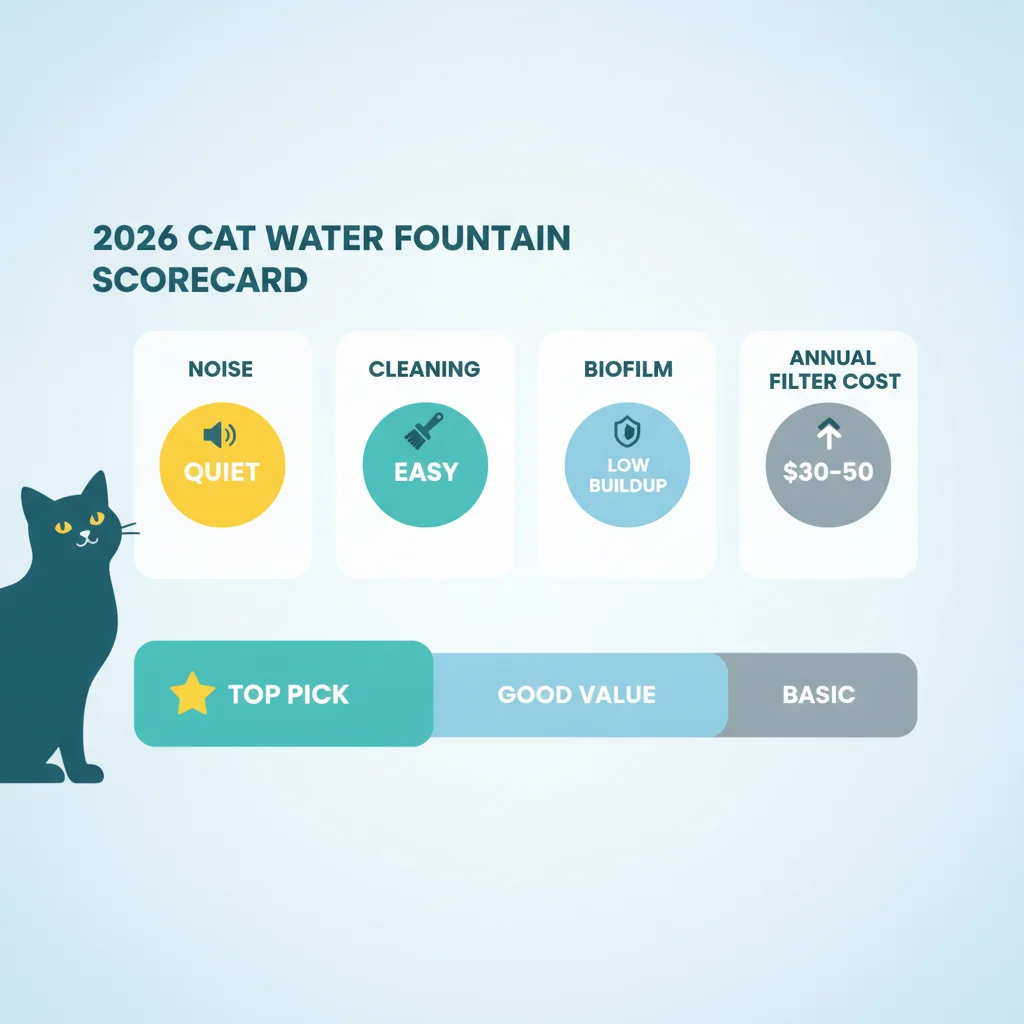
We treated “best cat water fountain 2026” as a maintenance problem first. Feature lists are easy to copy. Biofilm, scale, and sleep disruption are what make people shove a $90 unit into a closet.
| Score pillar | What we measured | Why it matters | Deal-breaker |
|---|---|---|---|
| Night noise | Pump hum, splash, vibration on hard floors | Bedroom and studio cats drink at 3 a.m. | Audible buzz across a quiet room |
| Cleaning effort | Disassembly time, pump access, dead zones | Skipped cleans = mold and dead pumps | Tools required for weekly rinse |
| Biofilm / smell | How fast film returns on wet surfaces | Cats reject stale plastic taste | Smell returns in under a week |
| Filter + pump TCO | 12-month parts cost at normal cadence | Filter and pump TCO included for every pick | Parts scarce or proprietary markup |
| Flow for households | Stable stream with 1–3 cats | Multi-cat homes compete for one spout | Starves when reservoir dips |
What we ignored on purpose
- RGB lights, “AI” drinking scores, and camera add-ons that do not raise intake
- Marketing dB claims without bedroom placement context
- Giant capacity alone—big tanks still go foul if you clean monthly
- Brand loyalty lists that bury stainless options under plastic bestsellers
The best cat water fountain is the one you will still clean weekly after month six. That line is the whole ranking philosophy. A quieter stainless bowl with boring filters beats a smart tower you dread opening.
Health language, kept honest
Running water can help some cats drink more, especially faucet chasers. It is not a treatment for kidney or urinary disease. If your cat has diagnosed urinary or kidney issues, follow your veterinarian’s plan; a fountain is hydration support, not a substitute for care.
Best overall: stainless workhorses
For most households, the best stainless steel cat water fountain class wins because wet metal resists odor better than scratched plastic and is easier to wipe free of film. Stainless is not magic—you still scrub the pump impeller—but the bowl itself stops smelling like warm dishwater after three days.
- Best default buy: a mid-size stainless fountain (~2–3 L) with a top-access pump and widely sold carbon/foam filters
- Best “set and forget” capacity: a larger stainless basin if you have two or more cats and refill discipline is weak
- Skip unless you love scrubbing: multi-piece plastic towers with hidden channels and glue seams
Why stainless wins for smell and scale
Plastic micro-scratches trap biofilm. Soft silicone gaskets still need attention, but a smooth stainless basin gives you a fighting chance between weekly deep cleans. Hard-water homes will still see white crust on the spout—expect vinegar soaks, not “self-cleaning” promises.
- Prefer brushed or food-grade stainless bowls over painted plastic shells with a thin metal insert
- Check whether the pump sits in a cup you can lift without dumping the whole tank
- Confirm replacement filters are sold in multipacks, not mystery SKUs
Pump access for weekly cleans
How to clean cat water fountain hardware without killing the motor is mostly about design. Look for:
- Impeller cover that pops off without prying
- No glued foam trapped behind a sealed housing
- A short tube path you can flush with a bottle brush
- Parts that survive dishwasher top racks if the brand says so—otherwise hand wash
Weekly rhythm that actually sticks: empty → rinse bowl → scrub pump cup → rinse filter housing → refill with fresh water → reseat the filter only when it is due. Midweek top-offs are fine; midweek “I’ll deep clean later” is how mold shows up.
Who should skip plastic-heavy designs
- Owners who already abandoned a plastic unit over smell
- Hard-water apartments where scale coats every groove
- Multi-cat homes that need a durable rim cats will not tip
Plastic can still be a cheap trial for a skeptical cat. Just treat it as a 30-day experiment with a short clean cadence, not a five-year investment.
What “best overall” means in practice
Overall winners in this niche are boring on purpose: a stable stream, a bowl your cat will touch on day three, and a pump you can service without a YouTube teardown. If a listing leans on RGB lighting or drinking “AI,” treat those as optional extras after the hygiene scorecard passes.
- Confirm the spout is removable—mineral crust concentrates there first
- Prefer wide basins cats can approach from more than one angle
- Avoid tall towers that tip when a large cat leans in
- Read recent filter reviews for “out of stock” complaints before you commit
Owners upgrading from a failed plastic fountain should transfer the water location gradually. Sudden moves can make even a better fountain look unused for a week. Keep the old bowl nearby for a few days, then retire it once the new stream is clearly preferred.
Best quiet picks for bedrooms
A quiet cat water fountain is less about a single magic pump and more about vibration path, splash height, and where you place the bowl. Bedroom drinkers need flow soft enough that you sleep; studio apartments need the same standard because the “living room” is six feet from the pillow.
| Noise source | What it sounds like | Fix that usually works | When to return the unit |
|---|---|---|---|
| Pump hum | Continuous electrical buzz | Foam pad under base; full water level | Still audible across a quiet room |
| Splash | Irregular drip onto dry plastic | Lower stream setting; keep basin filled | Stream only works on “waterfall loud” |
| Rattle | Parts vibrating on tile | Rubber feet; level surface | Housing buzzes even on carpet |
| Dry pump | Harsh grinding when low | Larger tank or smart low-water shutoff | No auto-shutoff and cats empty it overnight |
Nighttime placement that actually helps
- Keep the fountain off hollow furniture that amplifies vibration
- Use a small mat under the base on tile or laminate
- Aim the stream toward the bowl center, not the rim
- Refill before bed so the pump never runs near-empty
If your cat only drinks at night, test for one week with the door open and one week with the unit in a hallway. Sometimes “quiet” means relocating five meters, not buying a new motor.
When cordless units still buzz
Battery models advertise silence and travel freedom. Many still hum—the battery removes the wall wart, not the impeller. Treat cordless as a placement tool (no outlet by the litter-adjacent corner), not a guaranteed mute button. Runtime notes belong in the smart/cordless section below.
Best for hard water and low filter spend
Cat water fountain filter cost is where cheap hardware becomes expensive. A $35 fountain with $12 monthly filters can outspend a $90 stainless unit with $6 multipack media. Hard water accelerates that math because scale clogs pumps and owners replace “dead” units that only needed descaling.
| Setup | Hardware (approx.) | Filters / year | Pump risk | 12-month parts reality |
|---|---|---|---|---|
| Budget plastic + frequent filters | $25–$45 | $80–$140 | High if clean cadence slips | Often exceeds hardware price |
| Stainless + multipack filters | $60–$110 | $40–$80 | Medium with weekly cleans | Usually the better TCO |
| Ceramic basin + simple sponge | $50–$100 | $30–$70 | Medium; watch chip risk | Strong if you like heavy bowls |
| Smart fountain + proprietary pods | $90–$180 | $90–$180 | Varies | Pay for alerts, not hygiene |
Models and parts strategies that keep spend sane
- Buy filter multipacks the day you buy the fountain—confirm SKU match
- Prefer foam + carbon sandwiches you can rinse between replacements when the brand allows
- Keep a spare pump if your model uses a common, cheap motor
- Descale monthly in hard-water zip codes even if filters look clean
Cat fountain mold prevention is mostly cadence and drying time during cleans. Biofilm loves dark wet plastic tunnels. Designs with open basins and short water paths win. If you see black film in the tube, stop topping off and deep-clean the full path—filters alone will not erase an established colony.
When a rinse cadence beats premium filters
- Soft-water regions where mineral crust is mild
- Single-cat homes that empty and refill often
- Owners willing to scrub weekly and replace cheap foam on schedule
Do not “save money” by running a filthy filter for three months. That is how pumps burn out and cats walk away. Save money by choosing common parts and a bowl material that does not amplify smell between cleans.
For ceramic vs stainless cat fountain decisions in hard water: ceramic looks premium and resists odor well, but chips and weight matter if you scrub in a deep sink. Stainless usually survives clumsy weekly cleans better. Plastic remains the highest-maintenance bowl surface once scratched.
Best smart and cordless options (with caveats)
Smart fountains sell peace of mind: low-water alerts, app graphs, sometimes cameras. A cordless cat water fountain sells outlet freedom. Both can be useful. Neither replaces the hygiene pillars above.
App alerts that help vs gimmicks
- Helpful: empty-tank warning when you travel overnight; filter-change reminders you actually obey
- Mostly theater: drinking “scores,” social sharing, always-on video of a bowl
- Privacy tax: cloud accounts for a water dish—only worth it if the alert saves real hassle
If you live at home and already refill when the bowl looks low, a dumb stainless unit with a good pump is usually the better petlibro vs petsafe fountain-class purchase. Brand wars matter less than whether the pump is serviceable and filters are available next year.
Battery runtime under continuous pump use
Marketing often quotes standby or intermittent figures. Continuous pump draw is harsher. Before you rely on cordless for a weekend trip:
- Run a full charge at home and log hours until flow weakens
- Note whether the unit throttles or stops when voltage dips
- Confirm you can fall back to USB-C or a wall adapter without draining the battery cycle every day
Treat cordless as a placement and outage tool. For daily apartment use with an outlet nearby, plugged stainless usually wins on simplicity.
Always-on fountain tradeoffs
Some smart units want Wi-Fi forever. That is fine for travelers who need empty warnings. It is a poor default for owners who wanted “just water.” Prefer devices that still pump when the app is offline.
Also watch subscription creep. A fountain should not need a monthly plan to move water. If low-water alerts require a paid tier, walk away unless that alert is the only reason you bought the device. Offline-first pumps with optional Bluetooth reminders are a cleaner product category than cloud-locked bowls.
When smart features earn their keep
- You travel overnight and a sitter might forget the tank
- Your cat empties small bowls before morning and you have burned a pump before
- You genuinely use filter reminders—most people ignore them, so be honest
If none of those apply, spend the smart-tax money on a second stainless station or a year of filters instead.
Quick picks by household
Use this shortlist when you do not want to re-read the scorecard. Pair it with the material guide and multi-cat layouts when your household is messy.
| Household | Start here | Why | Watch-outs |
|---|---|---|---|
| Single picky / faucet cat | Quiet stainless with adjustable stream | Taste + soft sound beat gadgetry | Place away from litter dust |
| Multi-cat home | Larger stainless basin + second water station | Flow competition is real | One fountain is not a strategy for three cats |
| Apartment night drinkers | Quiet pick + mat + hallway option | Sleep is non-negotiable | Return units that buzz on carpet |
| Budget under $50 | Simple plastic trial, weekly clean cadence | Prove the cat will drink | Upgrade materials if smell returns fast |
| Hard water + TCO focus | Stainless + multipack filters | Parts cost stays predictable | Descale monthly |
| Frequent travelers | Smart low-water alert or trusted sitter checklist | Empty tanks kill pumps | Skip camera upsells you will not use |
Best cat fountain for multiple cats
Capacity helps, but placement helps more. Two medium stations in different rooms beat one giant tower that becomes a contested resource. If you see blocking, guarding, or one cat returning to the sink, add a second bowl immediately—fountain brand is secondary.
Setup checklist for week one
- Wash every part before first use—factory residue is real
- Place away from litter boxes and food if your cats prefer separation
- Run the fountain for an hour and listen from the bed or desk
- Log whether each cat investigates within 48 hours
- Schedule the first deep clean seven days out before you forget
If a cat ignores the fountain after a clean week, try a lower stream, a different room, or a stainless bowl with no plastic “flower” insert. Some cats dislike splash on whiskers more than they dislike still water. Matching preference beats forcing a viral product shape.
Buying verdict
Buy the quietest stainless (or ceramic) design you will actually disassemble every week, with filters you can reorder without hunting obscure SKUs. Add smart alerts only if empty tanks are a real failure mode in your life. Everything else is decoration.
Keep the geo truth in mind when you compare tabs: long-term hygiene and noise beat dump lists, TCO belongs on the same page as the price, and the winner is the fountain that is still cleanable after month six—not the one with the flashiest unboxing.
Frequently Asked Questions
Do cats really drink more from fountains?
Many do—especially faucet drinkers—but results vary. Prioritize quiet flow and clean taste over flashy apps. If intake stays low after two weeks of clean running water, talk with your veterinarian about underlying causes rather than buying another gadget.
Stainless, ceramic, or plastic?
Stainless and ceramic usually resist biofilm and odors better than plastic; plastic can work if you clean on a short cadence. Plastic is fine for budget trials; upgrade materials when smell or film returns within days of cleaning.
How often should I clean a cat fountain?
Plan weekly deep cleans in hard-water homes. Soft-water homes may stretch to 10–14 days, but skipping cleanings is the #1 reason pumps fail and mold shows up. Rinse the bowl midweek if the water looks cloudy.
Are smart fountains worth it?
Only if water-level alerts save you real hassle. App features rarely beat pump reliability and filter TCO. Skip always-on cameras and cloud accounts unless you travel often and need empty-tank warnings.
What matters more than capacity?
Noise at night, filter availability, and how fast biofilm builds on the parts your cat drinks from. A 2L stainless unit you clean weekly beats a 4L plastic tower you dread opening.
Your Next Step
Pick the household row that matches your home, order the fountain plus a multipack of filters the same day, and put a weekly clean on the calendar before the unit arrives. If brand shortlists still feel noisy, read the Petlibro vs PetSafe vs Petcube comparison next; if material doubt remains, settle stainless vs ceramic vs plastic before you chase another app feature.
Related reading on our sister sites: Litter-Robot Review After Months (2026)